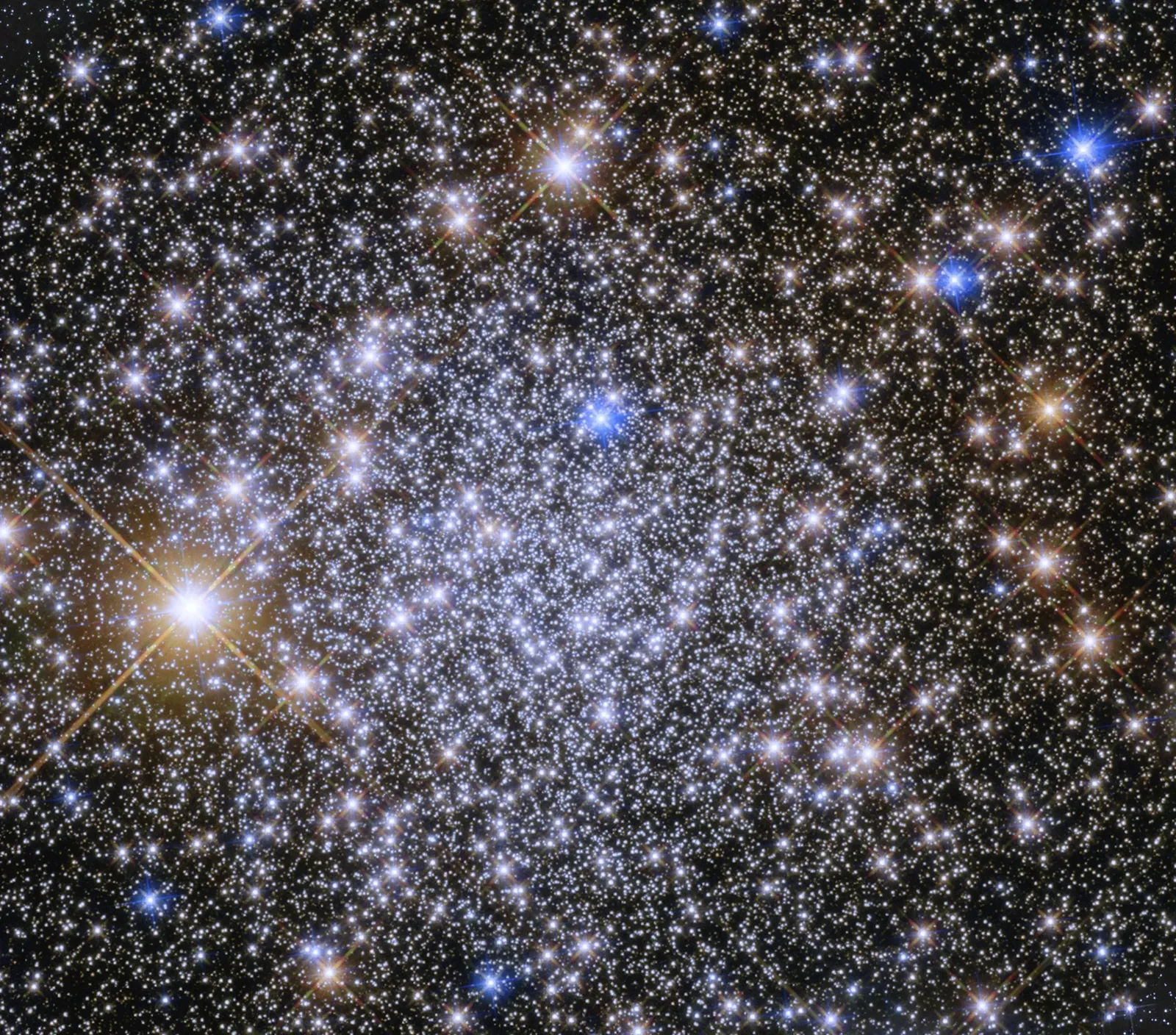
The bulge of the Milky Way is the dense central region of the Galaxy, formed during its earliest stages. The problem is that billions of years of mergers, tidal interactions, and internal evolution have nearly erased the original structure of this region. Direct traces of the bulge's formation era are scarce.
Globular clusters are the exception — dense groups of tens to hundreds of thousands of stars that formed at the same time and have existed as a single system ever since. If a cluster has survived for billions of years, it retains a chemical and age "fingerprint" of its birth epoch. This makes globular clusters toward the bulge one of the few tools available for probing the Galaxy's early history.
Hubble Photometry Through the Bulge's Crowded Field
Tonantzintla 2 sits directly along the line of sight to the bulge, which makes it difficult to observe: the cluster is projected onto a dense stellar field, and interstellar dust heavily dims and reddens its light. Researchers measured a reddening of E(B−V) = 1.44 — a very high value, indicating a thick layer of dust along the line of sight.
To obtain clean data, the team used photometry from the Hubble Space Telescope's WFC3 and Advanced Camera for Surveys (ACS), corrected for stellar proper motion. This allowed them to filter out field stars unrelated to the cluster and build a precise color-magnitude diagram — the primary tool for dating stellar populations.
By fitting isochrones (theoretical lines describing stars of the same age and composition) to this diagram, the team derived Tonantzintla 2's fundamental parameters: a metallicity of [M/H] = −0.68 (moderately metal-rich), and a heliocentric distance of d = 7.38 kpc — roughly 24,000 light-years from the Sun.
An Age of 13.6 Billion Years and a Limit on Star Formation
The key result of the isochrone analysis is the cluster's age: 13.58 billion years (with an uncertainty of roughly −1 to +0.72 billion years). This makes it one of the oldest globular clusters ever studied, and the oldest yet analyzed in the Galactic bulge.
The Universe itself is about 13.8 billion years old. Subtracting Tonantzintla 2's age suggests its stars ignited roughly 200 million years after the Big Bang.
This places a stringent constraint on the timeline of the inner Galaxy's formation: star formation in the future bulge began very early, essentially right after the Universe's reionization era. A cluster of this age is a rare benchmark for calibrating models of the Milky Way's formation.
Seven Stars' Chemistry Points to a Local Birth
Beyond photometry, researchers analyzed the chemical composition of seven member stars using high-resolution spectroscopy from APOGEE.
The distribution of elements in these stars matches an enrichment pattern characteristic of the inner Galaxy itself, rather than of systems captured from outside — such as remnants of dwarf galaxies that once merged with the Milky Way. This suggests Tonantzintla 2 most likely formed in situ, from the same material that built the bulge.
Combining two independent lines of evidence — photometric age and chemical composition — makes Tonantzintla 2 an exceptionally valuable object. It is not merely an old cluster, but a sample of material chemically enriched during the Galaxy's very earliest stages.
What This Changes
The researchers emphasize that Tonantzintla 2 is now one of the most precisely characterized globular clusters in the bulge. Its age sets a firm lower limit on when star formation began in the inner Galaxy.
Objects like this are rare precisely because of observational difficulty: the bulge's crowded stellar fields and dust obscure most potential relics. The successful analysis of Tonantzintla 2 shows that combining precise Hubble photometry with high-quality spectroscopy can extract reliable data even from the most challenging regions of the Galaxy to observe.