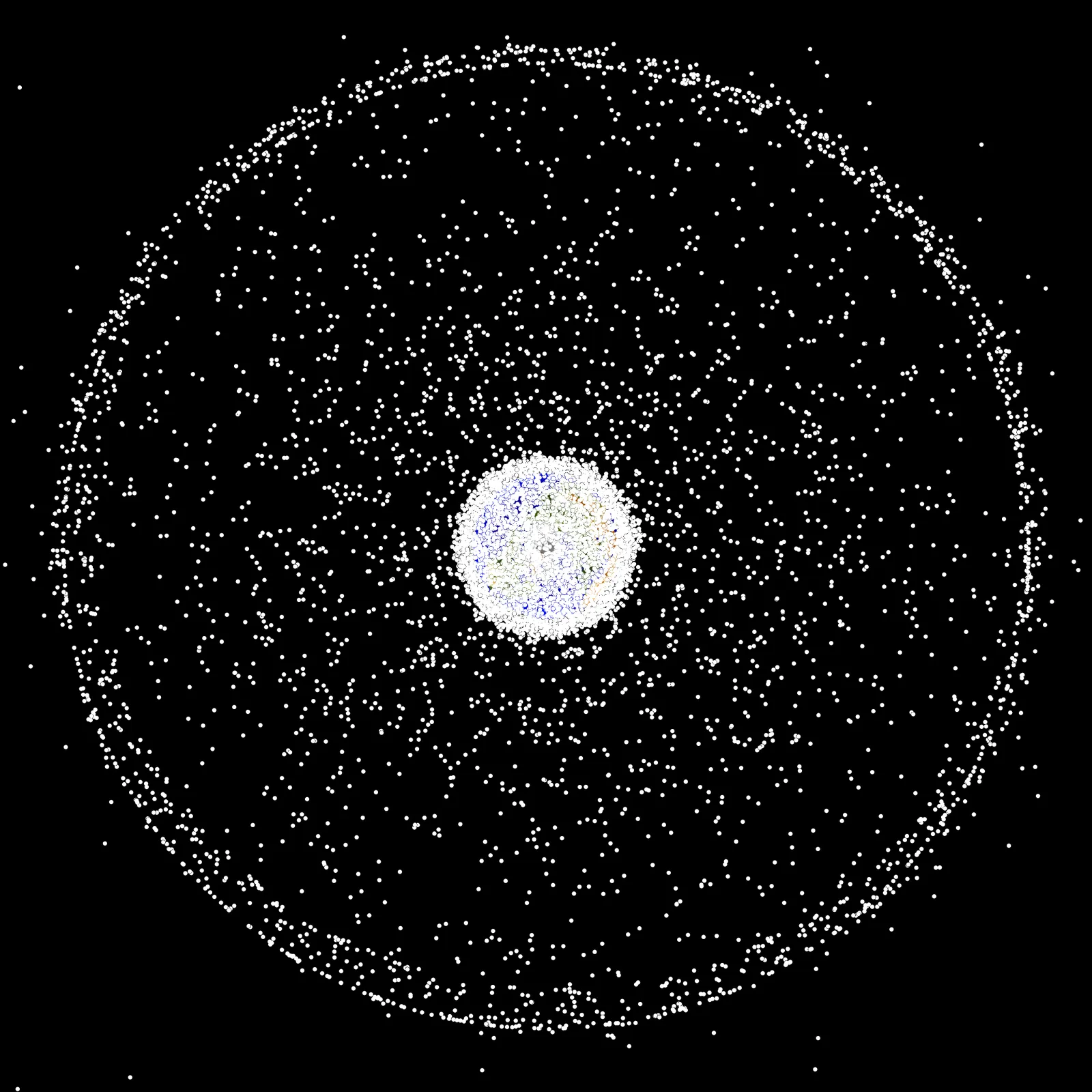
Near-Earth space stopped being an empty vacuum a long time ago. It is a stratified environment with tens of thousands of bodies moving at different altitudes, where each layer has its own rate of debris accumulation and its own rate of natural cleanup. A new paper by astrophysicist Slava Turyshev proposes treating this not as an inventory problem but as a nonlinear control problem: at every altitude, the balance between collision rate, fragment production, and natural or controlled removal determines whether a given shell becomes safer or more dangerous over time.
According to current public statistics, roughly 44,870 tracked objects with a combined mass exceeding 16,200 tonnes are currently in orbit. That is only the visible fraction — model estimates of populations below the radar detection threshold run orders of magnitude higher. The paper splits the problem into two zones of risk that are fundamentally different in character.
Two peaks of danger at different altitudes
The study identifies two peaks of concern that are frequently conflated. The first sits around 500-600 km, where the bulk of active satellites — and thus most of the orbital traffic — is concentrated. Collision risk here rises simply because of crowding, but this is an operationally busy zone, not necessarily a destabilizing one: the atmosphere at these altitudes is still dense enough to pull debris down within years rather than decades.
The second peak, near 850 km, has a fundamentally different nature. Atmospheric drag is weak there, so debris persists for decades. According to the paper, 96% of objects in this zone are inactive — largely dead mass incapable of any maneuver. This is where the deepest long-term risk is concentrated, not because of current traffic intensity, but because accumulated mass stays in orbit far longer than it takes to decay or burn up.
The paper introduces a stability margin: the ratio of new fragment production from collisions to the rate of natural and controlled removal from orbit. Shells where this ratio approaches or exceeds one are candidates for Kessler syndrome — a self-sustaining chain of collisions that can render an orbital band effectively unusable for years or decades.
Three control levers instead of one fix
The paper's central conclusion is that no single tool can solve the debris problem. Instead, it identifies three separate levers, each addressing a different part of it.
The first is a requirement for high-confidence disposal of new spacecraft immediately after mission end, with a short post-failure residence time. This is the cheapest lever, since it applies to spacecraft not yet launched: building deorbit protocols into a design costs far less than cleaning up debris already in orbit.
The second lever is reducing encounter-plane covariance — the statistical uncertainty in predicted close approaches. Tighter tracking accuracy means fewer false alarms and fewer unnecessary avoidance maneuvers, which drain a satellite's fuel reserves.
The third lever is targeted retirement or deflection of the residual stock of hazardous inactive bodies accumulated over decades of largely unregulated launches. This is the most expensive and technically demanding of the three, since it deals with debris that already exists rather than debris yet to be created.
What actually counts as success
Perhaps the paper's most practically important conclusion concerns how debris-removal programs should be evaluated. The author argues that the success metric cannot simply be the number of objects removed.
Debris removal is measured by verified reduction in time-integrated environmental hazard: verified disposal, verified reduction in ambiguous high-risk conjunctions, verified reduction in residual hazard stock.Slava G. Turyshev, author of the study
This is a fundamental shift in procurement logic: instead of paying for the removal of any object, agencies would pay for a demonstrated reduction in total risk over time. One large derelict at 850 km, threatening dozens of potential collisions over coming decades, matters more for removal than ten small fragments in low orbit that will burn up on their own within a few years anyway.
This is precisely the logic behind the paper's benefit-cost ratios of tens to hundreds when shortening the deorbit standard from 25 to 15 years. The question is no longer whether cleaning up orbit is worthwhile — the economics already answer that. The question is who agrees to pay first, when the benefit accrues to the entire industry while the cost falls on a single actor.