Oldest Compact Quasar Pair Ever Found
An international team led by Silvia Onorato of NSF NOIRLab has discovered J1602+4228AB, nicknamed Nāpōwawāʻenakaulua, the most distant and therefore oldest compact pair of quasars known. It was identified with the Gemini North telescope on Maunakea and the James Webb Space Telescope, and the results appear in The Astrophysical Journal Letters.
The two actively feeding supermassive black holes are separated by about 18,100 light-years, roughly one-fifth the diameter of the Milky Way, and have masses of 1.5 billion and 400 million Suns. We see them just 900 million years after the Big Bang. It is only the third quasar pair known from cosmic dawn, and it appears so early that astronomers cannot explain how such massive black holes came to exist.
JWST Finds Deuterium Excess on ε Ind Ab
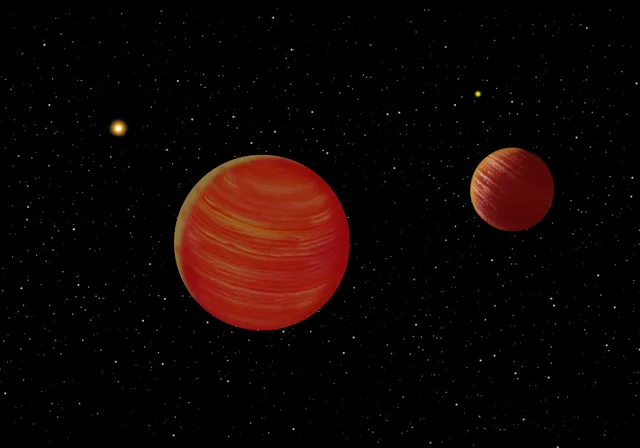
Using JWST, astronomers detected deuterated methane at 48σ in the mature giant exoplanet ε Ind Ab. The measured deuterium-to-hydrogen ratio is (4.4 ± 0.7) × 10⁻⁵. That is similar to Uranus and Neptune and about twice the value for Jupiter, Saturn and the protosolar nebula. The planet's heavy elements (carbon, oxygen, nitrogen and sulfur) are uniformly enriched, at a level similar to Jupiter's.
Explaining this requires the planet to have accreted solids with D/H of at least 1%, more than 30 times richer in deuterium than typical Solar System comets. Such values are seen in the interstellar comet 3I/ATLAS and in organic molecules in star-forming regions. This suggests ε Ind Ab built itself from pristine solids that formed in a very cold environment.
Webb Sees Forbidden H₃⁺ Rotational Spectrum
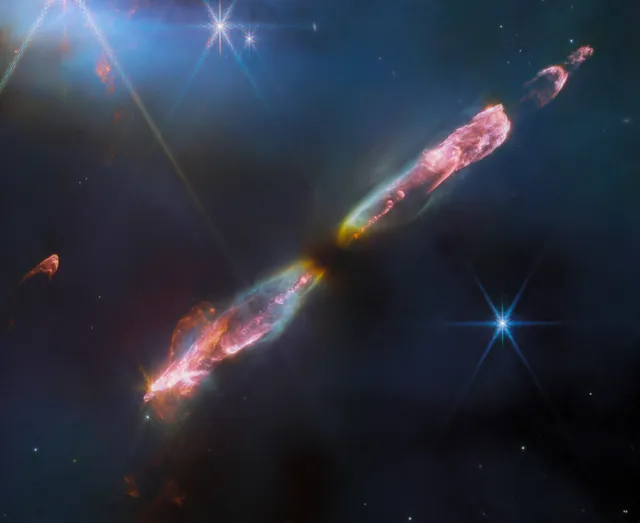
The H₃⁺ ion is the cornerstone of interstellar ion-molecule chemistry, yet its pure rotational spectrum, made up solely of “forbidden” transitions, had never been observed in a laboratory or in space. JWST's MIRI instrument has now detected it toward the Herbig-Haro object HH 168: 26 lines exceed 5σ, the strongest at 16.325 μm.
The lines share the velocity and spatial distribution of hot shocked H₂, not of ionized gas. The rotational temperature is about 730 K, but the level populations are non-thermal and point to gas hotter than 2000 K. A dissociative J-type shock model matches the emission within a factor of 1.5, while a C-type shock underpredicts it by a factor of 5–6. The spectrum also appears in archival HH 211 data, making H₃⁺ a new probe of ionization in shocked molecular gas.
ESCAPADE Probes Slingshot Around Earth to Mars
NASA's twin ESCAPADE spacecraft each completed a powered Earth flyby, combining the planet's gravity with an engine burn of about nine minutes. The first made its closest approach on Nov. 7 at an altitude of roughly 1,000 miles, the second on Nov. 9 at about 650 miles. It is the first time NASA has used a powered Earth flyby to send a spacecraft to Mars.
The probes launched on Nov. 13, 2025, when Earth and Mars were on opposite sides of the Sun, so they first looped around Lagrange point 2 in a “loiter” orbit. With the planets now favorably aligned, they are on a 10-month cruise and should reach Mars in September 2027. Lead mission designer Jeff Parker says the approach allows launching almost anytime, rather than waiting for a window every two years.
Voyager 1 Saves Power, Keeps Contact
In early September, NASA engineers turned off three devices on Voyager 1 and replaced them with lower-power alternatives. The effort, nicknamed the “Big Bang,” had to swap all three at once, since the devices help keep the spacecraft warm. The same swap was done on Voyager 2 about six weeks earlier. Each probe loses roughly 4 watts of power a year, and without the swap another science instrument would have had to be shut off as early as summer 2027.
On Oct. 18 and 19, the Deep Space Network could not detect a signal from the probe, which is 24 billion kilometers from Earth. Contact resumed on Oct. 20, before the team sent any troubleshooting commands. Engineers are still investigating: one group of thrusters went offline and its backups switched on automatically, as fault protection is designed to do.