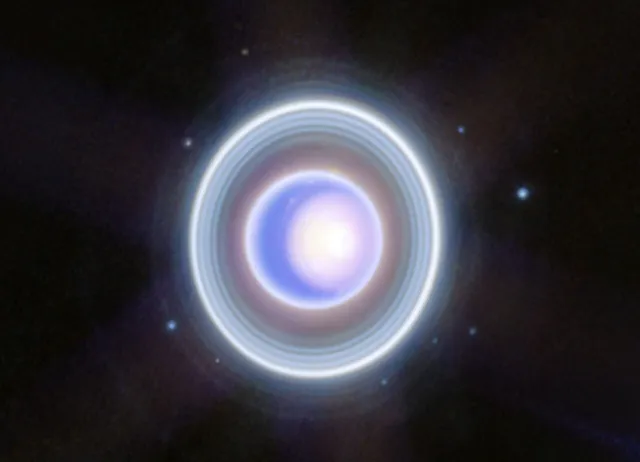
Uranus is famed for its lopsided rotation, but it also has a teeming system of rings and moons. Of its 29 recognized moons, half are much smaller than the main satellites. They are packed in close to the planet and dynamically linked to the rings. These are known as ring moons.
A new study presents the first JWST view of what these bodies and the rings are made of across 1–5 microns. It turns out that their composition closely resembles Kuiper Belt objects. That helps narrow down how the whole system could have formed.
Why ring moons are so hard to study
Ring moons are small and sit very close to Uranus. The planet's glare made them hard to observe, and before JWST their composition was largely out of reach. Yet that composition is a crucial step toward understanding how the Uranian satellites formed.
The team was led by Matthew Belyakov at the California Institute of Technology. They used JWST's Near-Infrared Spectrograph (NIRSpec) to obtain spectra of the Uranian rings and of the moons Puck, Perdita, Portia and Juliet. Before analysis, they subtracted the contribution from Uranus itself.
The results appear in a peer-reviewed paper in The Astrophysical Journal Letters (2026, volume 1010, L18).
What the spectra show
The rings and all four moons show signs of water ice, water-ice grains and carbon dioxide ice. But the rings differ from the moons. Their water-ice bands at 2.0 and 4.5 microns are much shallower. A band is a part of the spectrum where a material absorbs light. A shallow band can mean less ice or smaller grains.
There is also a pattern with distance. The water and carbon dioxide bands get shallower closer to Uranus. So the abundance of volatiles in the rings and moons increases with distance from the planet.
The authors see this as evidence of ring-moon cycling. Collisions between moons form rings, from which moons can later coalesce again, and so on. Over time, the system's dynamics sort material by density, and that leaves a mark on the composition.
A match with the Kuiper Belt
The spectra were compared with water-type Kuiper Belt objects (KBOs). These are thought to be old planetesimals, the building blocks of planets, that formed closer to the giant planets than other KBOs.
Overall, the ring-moon spectra are strikingly similar to those of such bodies. There are two differences: the moons have a deeper 3.0-micron feature and a shallower 2.0-micron feature than the average water-type KBO. This can be explained by grain size. The water ice on Uranus's moons and rings is finer-grained than on typical KBO surfaces.
What's new
These are the first JWST 1–5 micron spectra of the Uranian ring-moon system. Previously such objects were too faint and too close to the planet to study their composition in detail.
Now there is a direct comparison: the rings and small moons have a composition resembling icy Kuiper Belt bodies. On that basis, the authors outline two possible formation scenarios.
In the first, a water-type KBO caused the impact that tilted Uranus, and the rings and moons grew from the debris disk it left behind. The innermost moons would then have to form from undifferentiated material, meaning material that had not separated into layers. That would explain the lack of phyllosilicates, water-bearing silicate minerals, in their spectra. The scenario could also account for the properties of Miranda, one of the main satellites, which may have formed at the same time as the inner moons.
In the second, the inner moons formed after the main satellites. A KBO passed too close to Uranus, was torn apart by tidal forces and formed a ring of debris, from which the rings and ring moons accreted.
How solid is the result
The spectral similarity to KBOs is close, but it does not point to a single scenario. Both remain plausible.
The first scenario carries a caveat: the innermost moons must have been able to form from undifferentiated KBO material. The differences in band depth are attributed to grain size, and the link between volatile abundance and distance is read as a sign of ring-moon cycling.
To pin down the relationship between the inner moons and Miranda, additional measurements of the deuterium-to-hydrogen ratio in this system are needed. For now, one thing is clear: there is more to Uranus than its wonky rotation.