Where TDE Jets Get Their Magnetic Flux
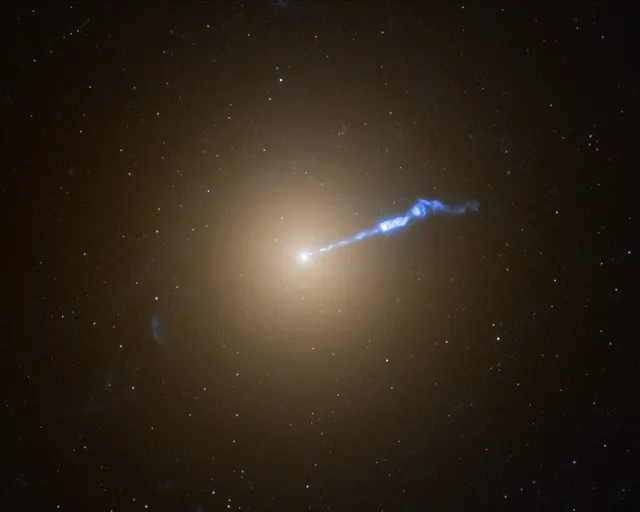
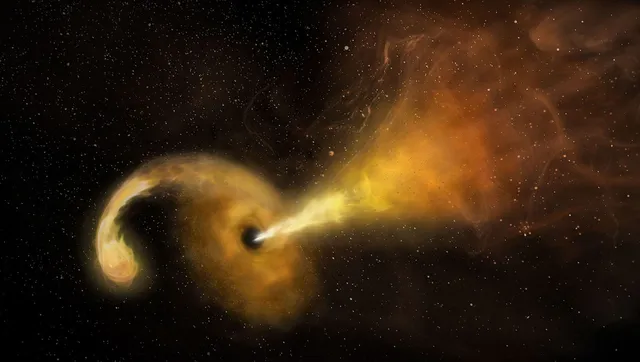
When a black hole tears apart a star through tidal forces, debris forms a disk, and in some cases a relativistic jet emerges with luminosities up to 10^48 erg/s. Such jets are powered by the Blandford-Znajek mechanism, which requires substantial magnetic flux near the event horizon. Researchers tested three possible sources of this flux: the star's own magnetic field, flux carried inward from large radii by debris (the Lasso mechanism), and flux already present in the inner accretion disk before disruption.
The study found stellar magnetic fields far too weak to power these jets, while the Lasso mechanism demands special conditions unlikely to occur in practice. The most plausible source turned out to be pre-existing magnetic flux already stored near the black hole in an accretion disk. This helps explain why relativistic jets appear only in a small subset of tidal disruption events.
Gas Outflows in the First Galaxies
Astronomers analyzed spectra of 811 galaxies at redshifts z=3-7 from JWST/NIRSpec data in the DAWN, Mirage and Miracle archives. In 20 galaxies, mostly massive systems above 10^10 solar masses at z<5, they found excess Na I D absorption, a signature of outflowing neutral gas. The overall detection rate was about 2.5%, rising to 43% among the most massive quenched galaxies.
The absorption features spanned 4 to 16 angstroms in width, consistent with outflowing rather than static gas. Estimated mass outflow rates ranged from 4 to 12 solar masses per year, exceeding the galaxies' own star formation rate in roughly a third of cases. This shows that powerful gas outflows, which regulate galaxy growth, were already active within the universe's first two billion years.
A Broad Debris Disk Around γ Ophiuchi
The star gamma Ophiuchi, located 29.7 parsecs away, has long been known to host an extended debris disk based on Spitzer imaging. New JWST mid-infrared observations at 15 and 25.5 microns revealed a smooth, ring-free structure extending to at least 250 astronomical units from the star, unlike the distinct ringed features JWST found around Fomalhaut and Vega.
The radial brightness profile, combined with earlier ALMA data, suggests the disk is populated by a broad planetesimal belt spanning from tens to over 200 astronomical units, rather than a narrow ring. The disk also shows a slight asymmetry, consistent with an orbital eccentricity of about 0.03, which could be caused by a hidden giant planet under 10 Jupiter masses, or a more massive companion orbiting closer to the star.
A Precessing AGN Jet Drives Gas Outflow
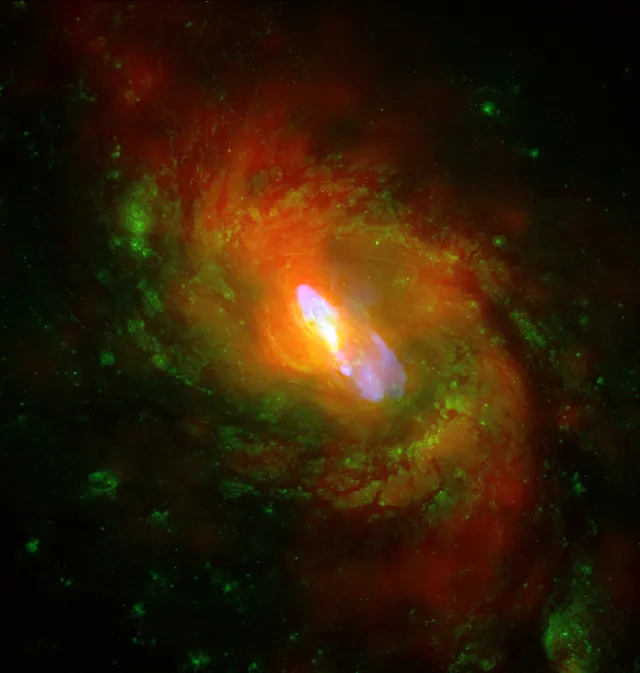
Researchers combined optical, infrared, submillimeter and radio observations of the active galaxy VV 340a, whose central supermassive black hole launches a low-power jet. They found that the jet precesses, with its direction slowly rotating over a period of (8.2 ± 5.5) × 10^5 years. This motion drives a gas outflow at a rate of 19.4 ± 7.9 solar masses per year out of the galaxy.
The jet shocks surrounding gas, creating highly ionized plasma extending several kiloparsecs from the nucleus. The ejected gas mass is enough to influence the galaxy's overall star formation rate. This provides a concrete example of how even weak jets can regulate galaxy growth, a feedback process long required by cosmological simulations but poorly constrained in terms of energy and timescale.
Why Early Galaxies Are Blue or Red
JWST observations at redshifts above z=10 revealed two extreme galaxy populations: extremely blue, nearly dust-free "blue monsters" with a UV spectral slope β_UV around -2.4 or lower, and massive dusty red systems with β_UV of -1 or higher, sometimes reaching -0.5. A new theoretical model explains both extremes through a single mechanism, the galaxy's ability to retain dust produced by supernovae.
The model describes two sequential barriers: supernova shocks must first break through the parent molecular cloud, then punch through the galaxy's gas disk. In compact, gas-rich systems both barriers are easily overcome, so dust escapes and the galaxy appears blue. In more massive galaxies, a thicker gas layer traps the dust, making the galaxy red. According to the authors, combining dust production, shock processing, radiative losses and mechanical ejection explains both galaxy types across the range z≈6-14.