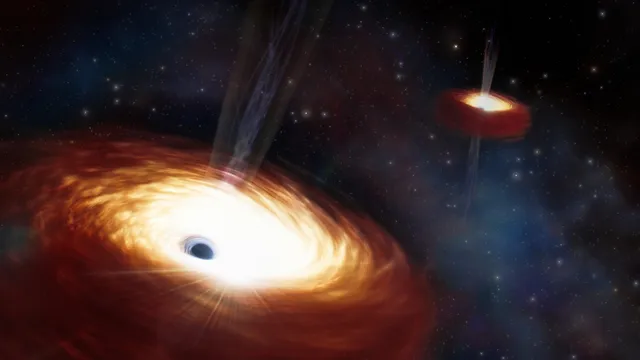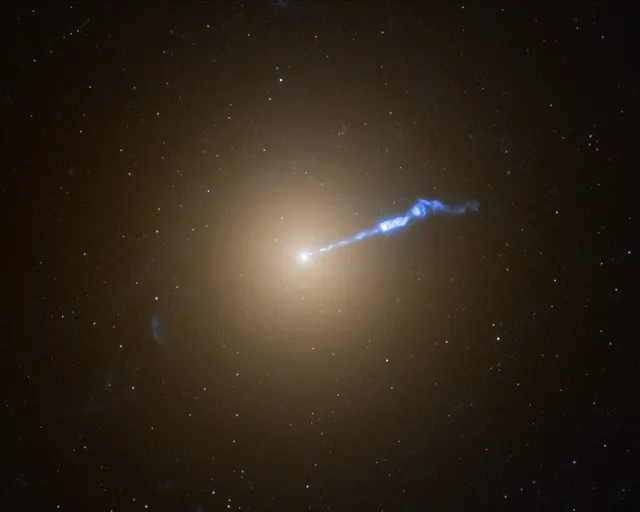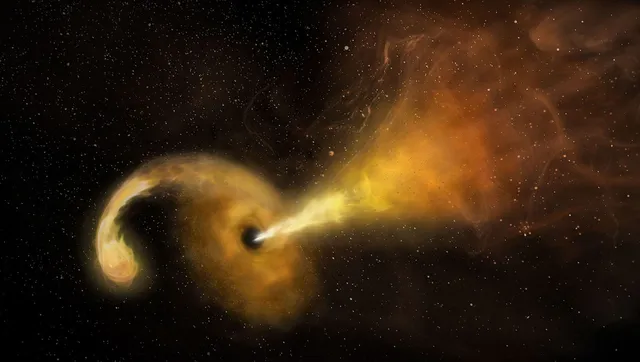
Neutrinos barely interact with matter, which lets them travel unimpeded from the densest, hottest regions of the universe straight to Earth. That property makes them a unique probe of places light cannot reach — the very centers of active galactic nuclei, where supermassive black holes devour surrounding gas.
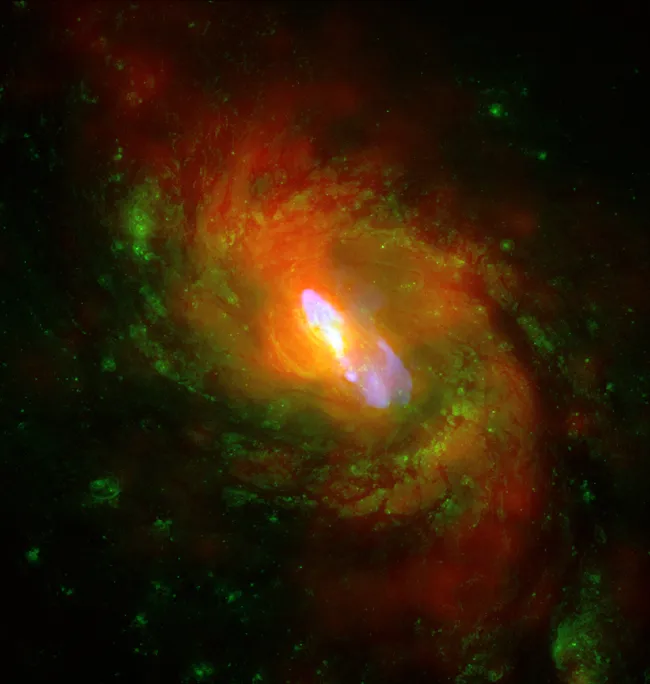
In 2022, the IceCube Neutrino Observatory at the South Pole reported the first statistically significant flux of high-energy neutrinos from a single source beyond our galaxy: NGC 1068, a Seyfert galaxy roughly 47 million light-years away. A new study from the collaboration now asks whether that detection was a one-off or a sign of a broader pattern across an entire class of objects.
Why the Southern sky stayed a blind spot
IceCube is a detector buried deep in Antarctic ice. It does not catch neutrinos directly but registers flashes of Cherenkov light produced when a neutrino occasionally collides with an ice atom.
The catch is that the detector is far more sensitive to sources in the Northern sky. Neutrinos arriving from that direction pass through the entire Earth first, which filters out nearly everything except neutrinos — leaving a clean signal by the time it reaches the ice.
No such natural filter exists for the Southern sky. There, the detector is swamped by atmospheric neutrinos and muons produced right above the ice, born from cosmic-ray collisions with the atmosphere. And according to the researchers, most of the brightest and closest Seyfert galaxies happen to sit in that very part of the sky.
ESTES cuts through the atmospheric noise
The breakthrough came from a new event-selection method called ESTES — enhanced starting track event selection.
The idea is to keep only those neutrino events that begin inside the detector's own ice volume, discarding much of the atmospheric background, which typically arrives from outside at characteristic angles.
Using ESTES, the team processed 10 years of accumulated IceCube data and selected 14 X-ray bright Seyfert galaxies from the Swift BAT AGN Spectroscopic Survey. They ran two complementary analyses: one searching for a signal from each candidate source individually, another looking for a combined signal from the whole sample stacked together.
13 galaxies and a 3.0σ signal
Both approaches turned up something. The collective neutrino signal from 13 of the 14 sources exceeded the expected background at 3.0σ significance — not a formal discovery, which requires 5σ, but strong enough to count as evidence.
As expected, NGC 1068 contributes the largest share of the combined signal. But other galaxies in the sample show measurable, if weaker, contributions too.
That pattern matches theoretical predictions: the brighter an AGN's core is in X-rays, the stronger its neutrino output should be. X-rays and neutrinos are produced in the same dense region around the black hole, one too opaque for visible light to escape — so their brightness should track each other.
We found evidence of a collective neutrino signal from the selected X-ray bright Seyfert galaxies in excess of the background with a 3.0σ significance. This finding benefits from the new event selection techniques, which improved the sensitivity towards the southern sky by effectively suppressing the large background.Qinrui Liu, former postdoctoral researcher, Queen's University
The team also highlights a methodological advance: a stacking analysis in which the weight of each source is derived directly from the theoretical model rather than assigned arbitrarily, making the whole approach more physically grounded.
From 3σ toward a confirmed discovery
The result complements earlier IceCube findings focused on the Northern sky and strengthens the broader case that X-ray bright active galactic nuclei are genuine neutrino emitters — not a fluke limited to NGC 1068.
Turning a 3.0σ signal into a solid discovery will require greater sensitivity. That is the goal of IceCube-Gen2, a proposed expansion of the observatory that would substantially increase the volume of ice monitored for neutrino flashes.
Another avenue for future work involves so-called cascade events, a different type of neutrino signal recorded by IceCube over more than a decade but not yet incorporated into the Southern-sky analysis. Researchers say examining them could reveal more about the physical conditions near supermassive black holes.