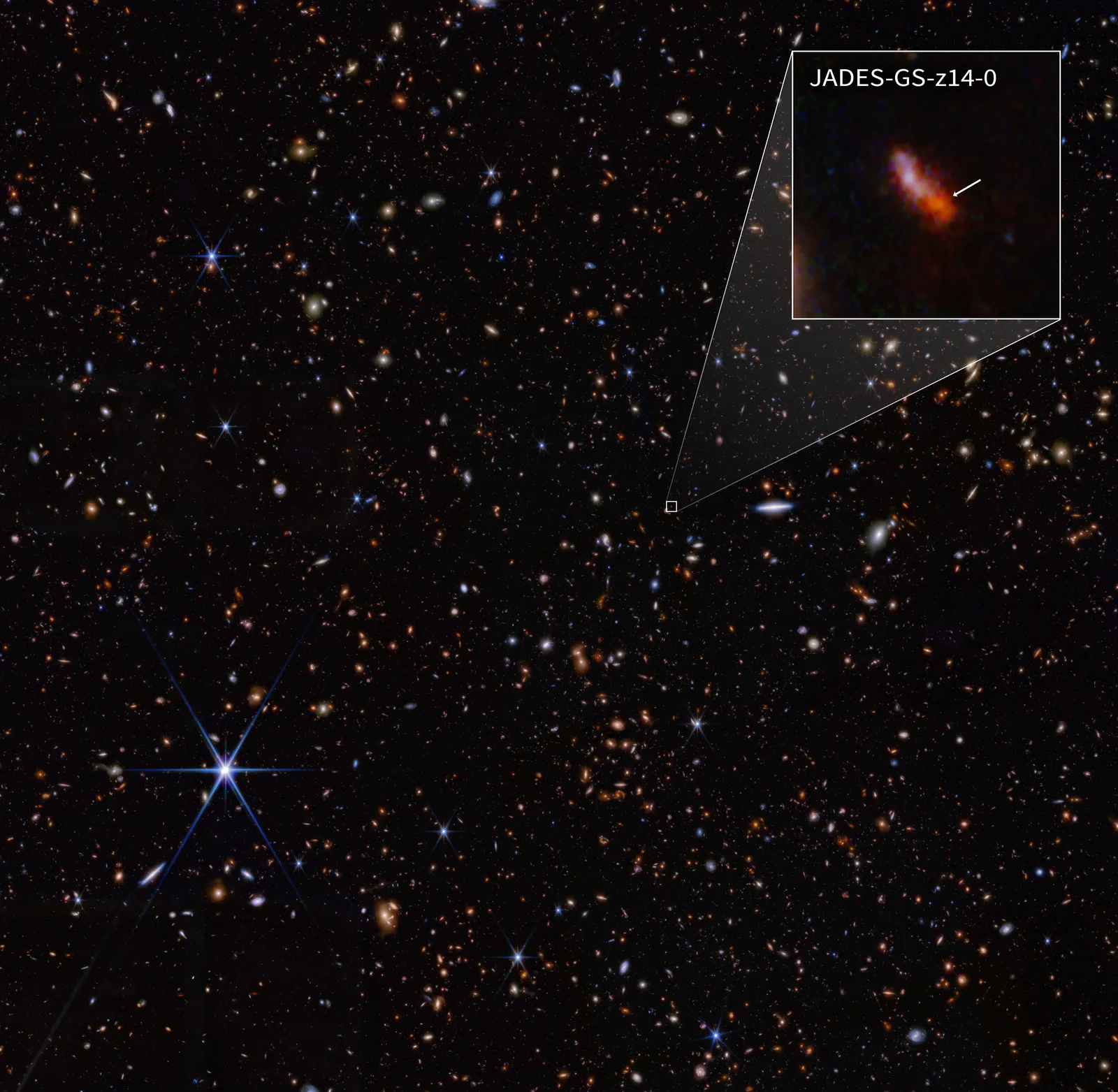
JWST has reshaped our picture of what galaxies looked like in the first few hundred million years after the Big Bang. Among them are two extremes. Some galaxies at redshifts above z=10 turned out to be extremely blue — with ultraviolet spectral slopes β_UV around -2.4 and below, pointing to almost no dust. Others, at the same distances, are the opposite: red, massive and dust-rich, with β_UV of -1 and higher.
A new theoretical study proposes to explain both types as different outcomes of a single process: how much supernova dust a galaxy can retain.
What "blue" and "red monsters" mean
A galaxy's ultraviolet color is described by β_UV — the slope of its spectral continuum. The more negative it is, the bluer the galaxy and the less dust it holds to absorb short-wavelength light.
"Blue monsters" are UV-bright but dust-poor galaxies with β_UV around -2.4 and lower. "Red monsters" are massive dusty systems where β_UV reaches -1 and higher, and in some cases climbs to -0.5.
Until now these two populations looked like separate puzzles: why the same era holds galaxies with almost no dust alongside very dusty ones.
How dust leaves a galaxy
The authors model the behavior of dust born in supernova explosions inside dense star-forming clusters. The key question is whether that dust stays in the galaxy or is expelled.
The mechanism works in two steps. First, shock waves from clustered supernovae break through the natal molecular cloud where the stars formed. Then, if there is enough energy, the outflow bursts through the galaxy's gas disk. The authors used dust opacities derived from three-dimensional hydrodynamical simulations of clustered supernovae in porous molecular clouds, and converted the retained dust mass into the spectral slope β_UV.
In compact, gas-rich galaxies both barriers are cleared efficiently. Little dust remains, so these systems look blue — at "blue monster" levels.
In more massive galaxies, greater stellar mass means a denser column of gas and dust. The supernova outflow does not always cross the gas layer, so dust stays behind and the galaxy reddens. When large-scale venting weakens due to radiative energy losses, β_UV can reach -0.5.
One process instead of two puzzles
The study's central idea is that the split into blue and red galaxies is set by a single condition: whether the clustered-supernova outflow can cross both barriers — the natal cloud and the galaxy's gas layer.
If it can, dust is vented and the galaxy is blue. If not, dust remains and the galaxy is red.
According to the authors, combining four processes — supernova dust production, shock processing, radiative energy losses and mechanical venting — can jointly explain both the UV-bright dust-poor galaxies and the red dusty massive systems across the whole range from z≈6 to z≈14.
The model also links early blue galaxies to dusty massive systems at later z≈6-7. If JWST and ALMA observations confirm these predictions, the two extreme populations of the early Universe would prove to be not separate phenomena but two sides of a single dust retention and expulsion mechanism.