The image of the supermassive black hole M87*'s shadow, released by the Event Horizon Telescope (EHT) in 2019, became one of the defining pictures of modern astrophysics. The bright, asymmetric ring surrounding the dark shadow is the glow of superheated plasma circling near the event horizon. But the brightness across that ring is not evenly distributed, and this unevenness turned out to carry information about how fast the black hole itself is spinning.
A new study published in The Astrophysical Journal, led by Vadim Bernshteyn and the EHT Collaboration, digs into exactly that. M87* is a black hole with a mass of 6.5 billion Suns, sitting at the center of the galaxy M87, some 55 million light-years from Earth. Its event horizon is so large it would comfortably enclose the orbit of Pluto in the Solar System.
Three epochs of data against a simulation library
The team compared EHT observations from 2017, 2018, and 2021 with an extensive library of simulations built using general relativistic magnetohydrodynamics (GRMHD). These models track how plasma orbiting a black hole behaves for different values of spin — a parameter denoted a*, where 0 means no rotation and 1 means maximal rotation.
Each spin value produces its own characteristic pattern of brightness asymmetry in the model. By matching real observations from three separate observing epochs against these predictions, the researchers were able to narrow down the plausible range of M87*'s spin.
Strongly magnetized disks give a clearer signal
The key finding concerns so-called MAD models — scenarios with a magnetically arrested disk, where the accretion flow is strongly magnetized. For this class of models, the three epochs of data disfavor very slow rotation: **|a*| ≲ 0.2**. In other words, the black hole is spinning, and noticeably so, at a level that shows up statistically across independent observations.
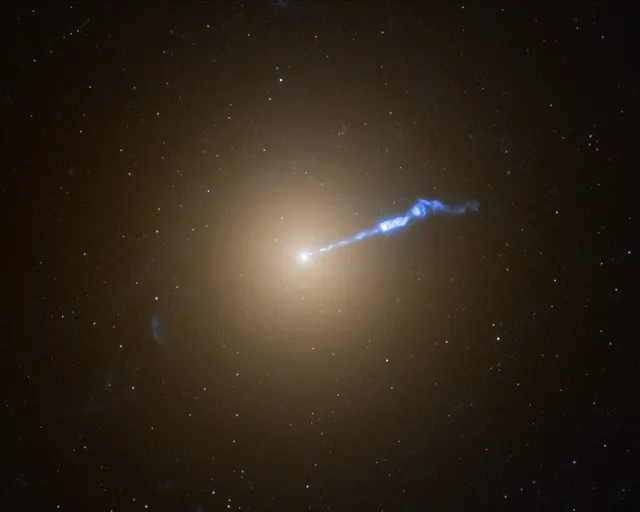
This is consistent with the Blandford–Znajek mechanism, a theoretical model explaining how a spinning black hole's rotational energy can be tapped to power a relativistic jet. M87's jet stretches thousands of light-years from its core. If the jet is indeed powered by rotation, the spin cannot be zero — and that is exactly what the data suggest.
A wandering bright spot as a fingerprint of rotation
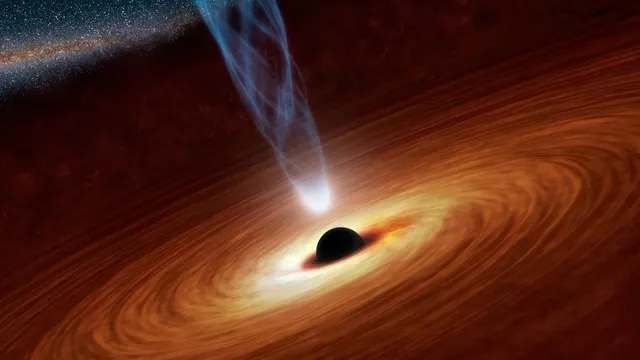
The ring's asymmetry doesn't come from a single effect but from an interplay of several relativistic phenomena: Doppler boosting, which brightens light from plasma moving toward the observer and dims light from plasma moving away; gravitational lensing, which bends photon paths near the horizon; and frame-dragging, the twisting of spacetime itself caused by a rotating black hole. All of these depend on the spin value.
The plasma in the accretion disk is turbulent, so the bright spot on the ring doesn't stay put — it constantly wanders around. That might seem like it would ruin any measurement. Instead, the researchers found that the statistical distribution of these fluctuations — how often and how strongly the spot's position and brightness change over time — acts as a fingerprint unique to each spin value. That statistical signature is what let them distinguish slow from fast rotation even amid the turbulence.
What future observations could reveal
The authors also estimated how much tighter spin constraints could become with future EHT observing campaigns. More epochs of data and higher sensitivity would not only narrow the allowed range of a* further, but could potentially help distinguish between different jet-launching mechanisms and different scenarios for how the black hole accumulated its mass over millions of years. M87*'s ring remains a working tool for testing general relativity in the most extreme environment we can currently observe.