70 Science Cases for HWO
NASA's Science, Technology, Architecture Review Team (START) has outlined 70 science cases for the Habitable Worlds Observatory (HWO), the flagship mission identified by the Astro2020 Decadal Survey as the top priority for large space telescopes. The cases span four themes — galaxy growth, chemical evolution, solar system studies, and the search for signs of life on roughly 25 Earth-like exoplanets.
Delivering on this science will require 140 separate observing programs spanning ultraviolet to near-infrared wavelengths. About 83% of the cases need data below 400 nm, while a third call for high-contrast or polarimetric capabilities. The observatory will also need rapid-response modes and precise astrometry to measure planet masses directly.
Protocluster "The Step" Near Quasar
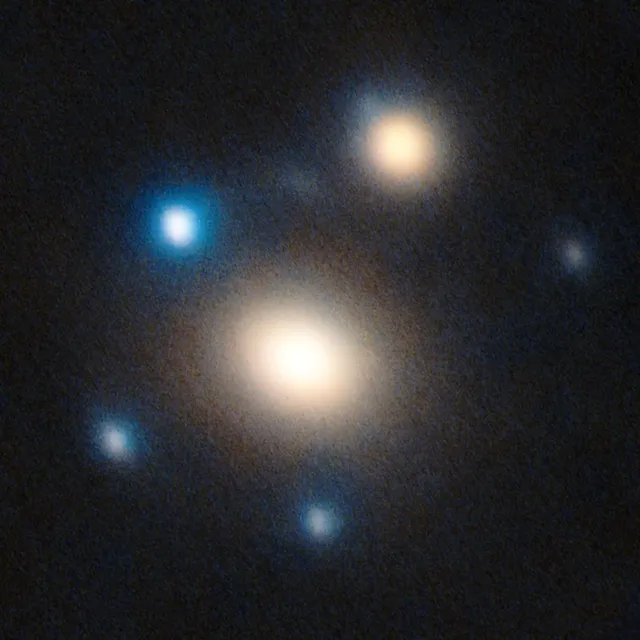
Using JWST/NIRISS slitless spectroscopy, astronomers discovered a dense protocluster dubbed "The Step" at redshift z=3, in the field of the luminous quasar SDSS J165202.64+172852.3. The structure contains at least 18 member galaxies and shows a distinctive step-like velocity distribution suggesting a merger of two dark matter haloes.
In the densest region, seven galaxies crowd within 70 kpc of the quasar, with an overdensity exceeding the average by more than a factor of 100. The halo mass is estimated at 10^13-10^13.8 solar masses, enough to eventually evolve into a massive, Coma-like cluster. The protocluster hosts both actively star-forming galaxies and two quiescent ones that have already shut down star formation, along with hints of an elevated active nuclei fraction.
Sulfur-Rich Atmosphere of AF Lep b
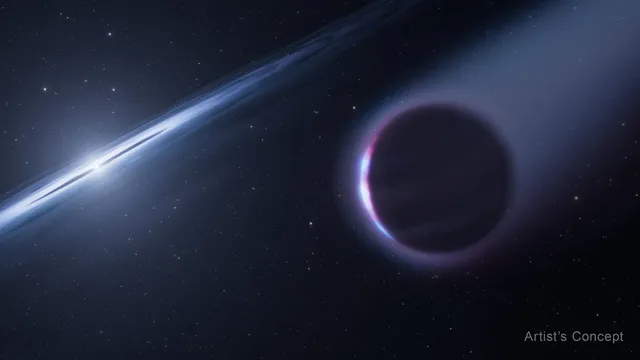
JWST/NIRSpec spectroscopy spanning 2.85-5.3 microns detected carbon dioxide, hydrogen sulfide, methane, carbon monoxide and water in the atmosphere of AF Lep b, a young gas giant with 3-4 Jupiter masses orbiting at 9 AU. Combined with VLTI/GRAVITY and VLT/SPHERE data, this allowed precise measurement of the planet's carbon, oxygen and sulfur abundances.
All three elements turned out to be enriched 3-5 times above stellar levels, with sulfur particularly pronounced — evidence of substantial solid accretion during formation, estimated at about 56 Earth masses of solids. The planet's C/O and C/S ratios suggest it formed near its current location rather than beyond the CO snowline, and its composition resembles Jupiter and other imaged giant exoplanets like the HR 8799 system.
Ultra-Long GRB from a Stellar Disruption
GRB250702B is the longest gamma-ray burst ever recorded, with its main emission phase lasting seven hours, preceded by a faint X-ray precursor about a day earlier and followed by a weeks-long fading X-ray tail. Researchers propose this unusual behavior stems from a micro tidal disruption event, in which a Sun-like star is torn apart by a roughly 10-solar-mass black hole.
3D hydrodynamic simulations show that within a day the stellar debris forms a disk with a low-density polar funnel, through which a relativistic jet propagates stably thanks to the black hole's rapid spin (around 0.9). The model consistently explains all three phases of the burst, from the X-ray precursor to its gradual decline, offering a new physical engine for ultra-long gamma-ray bursts.
Nitrogen Excess in Early Galaxies
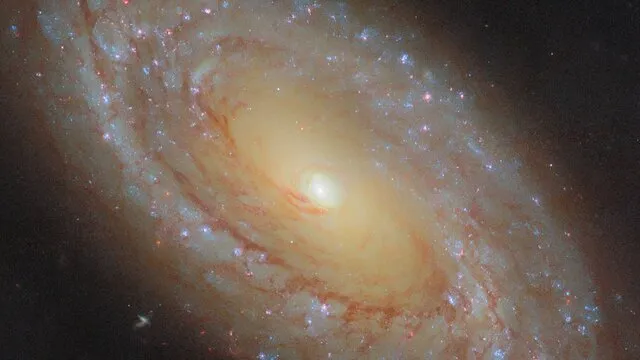
Stacked JWST/NIRSpec spectra of 135 galaxies at redshifts z=6-10 show that elevated nitrogen-to-oxygen ratios are not a rare quirk of individual objects but a widespread feature of galaxies from the universe's first billion years. The composite spectra reveal strong emission lines from highly ionized carbon, nitrogen and helium.
Electron-temperature measurements yield log(N/O) = -0.57, above solar values, while carbon remains deficient relative to oxygen. Notably, galaxies caught in a recent starburst are less nitrogen-enriched than those in a relative lull between bursts, consistent with delayed enrichment from AGB stars combined with dilution by inflowing pristine gas — no need to invoke exotic supermassive stars.