Roughly a few hundred million to a billion years after the Big Bang, the universe went through one of its most consequential transformations — the epoch of reionization. The first stars and galaxies began flooding the space between them with powerful ultraviolet radiation known as Lyman continuum (LyC), gradually converting the neutral hydrogen of the intergalactic medium into ionized gas. The trouble is that the exact mechanism allowing this radiation to escape galaxies in the first place remains poorly understood: ordinary gas and dust inside galaxies usually absorb such hard radiation before it can get out.
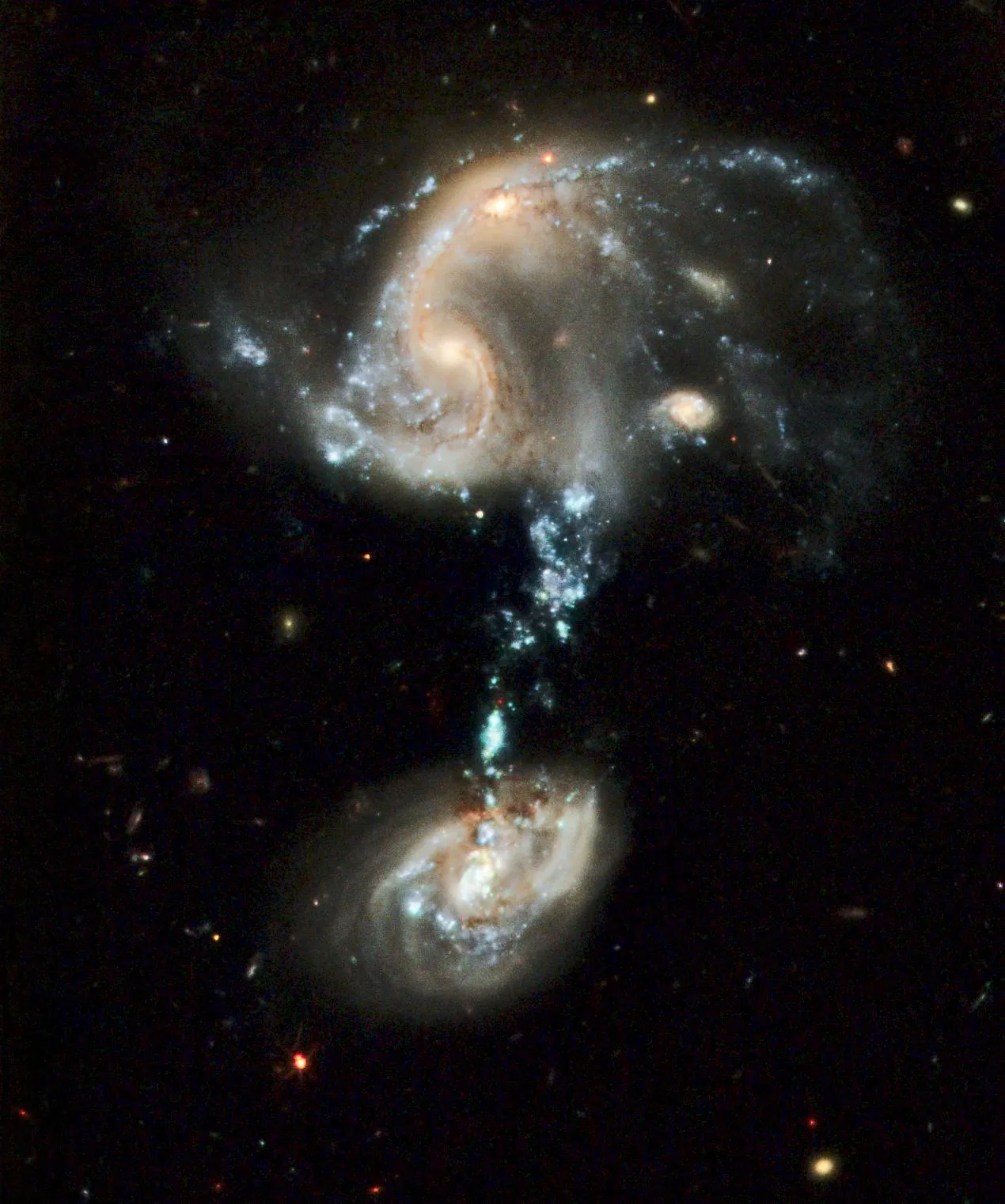
One of the leading hypotheses points to galaxy mergers. When two galaxies approach and interact gravitationally, they stir up each other's interstellar gas and trigger bursts of intense star formation. Young, hot stars form quickly and in large numbers, and the accompanying tidal tails — elongated streams of gas ripped from one disk by the other's gravity — can sustain brief but extremely intense bouts of star birth. There isn't much gas in these tails, so it burns through fast, leaving the newborn stars with nothing left to shield them: their ionizing radiation streams unimpeded into intergalactic space.
Two candidates, one test
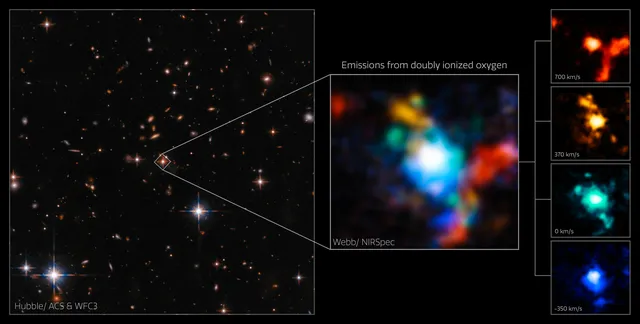
Before James Webb, testing this hypothesis observationally was difficult — spatial and spectral resolution simply weren't good enough to cleanly separate the contributions of different parts of a merging system. A team led by Shengzhe Wang (University of Chinese Academy of Sciences) used JWST's capabilities to closely study two candidate LyC leakers first identified in Hubble images from the LACES survey (LymAn Continuum Escape Survey). Both objects sit at redshift z≈3.1, corresponding to about 2 billion years after the Big Bang.
Using the NIRSpec instrument in its integral field unit (IFU) mode, which captures a spectrum for every point in an image simultaneously, the researchers carefully measured emission lines in both objects. The result went against one of the candidates: LACES94460 had to be dropped. What looked in Hubble images like an escape of ionizing radiation turned out to be contamination from an entirely different, lower-redshift object — one closer to us and unrelated to the galaxy under study.
A tail clump that lets almost all its light escape
The second candidate, LACES104037, held up completely. JWST spectroscopy showed it to be an early-stage merger system with two primary interacting galaxies — LACES104037-bulk and LACES104037s — connected by a tidal tail structure. It is precisely within this tail, in a region designated LACES104037-LyC, that the ionizing radiation escape was detected.
Combining the spectroscopy with photometry from earlier studies, the team modeled the physical properties of this clump. Its stars turned out to be only about 5 million years old — an extraordinarily young population by cosmic standards. And the fraction of ionizing photons that manage to escape this clump into the intergalactic medium comes out to roughly 0.99, meaning almost all of the radiation gets out. This suggests that merger-triggered star formation can be an extremely efficient way of pumping high-energy photons into the space between galaxies.
LACES104037-LyC represents the first confirmed example of its kind: a separate star-forming clump in a tidal tail, sitting outside the main galactic disks, responsible for nearly all of the system's ionizing escape. Previously, such sources either couldn't be spatially isolated or their contribution was lost against the overall signal from the host galaxy.
This discovery doesn't settle the question of exactly how the universe underwent reionization — the mechanism still needs confirmation across a larger sample of objects. But it does establish a concrete, observationally confirmed scenario: galaxy mergers can produce isolated stellar clumps that act as nearly perfect "spotlights" for ionizing radiation. The authors hope future high-resolution observations will reveal more such clumps within merging systems, deepening our understanding of this critical phase in the universe's evolution.