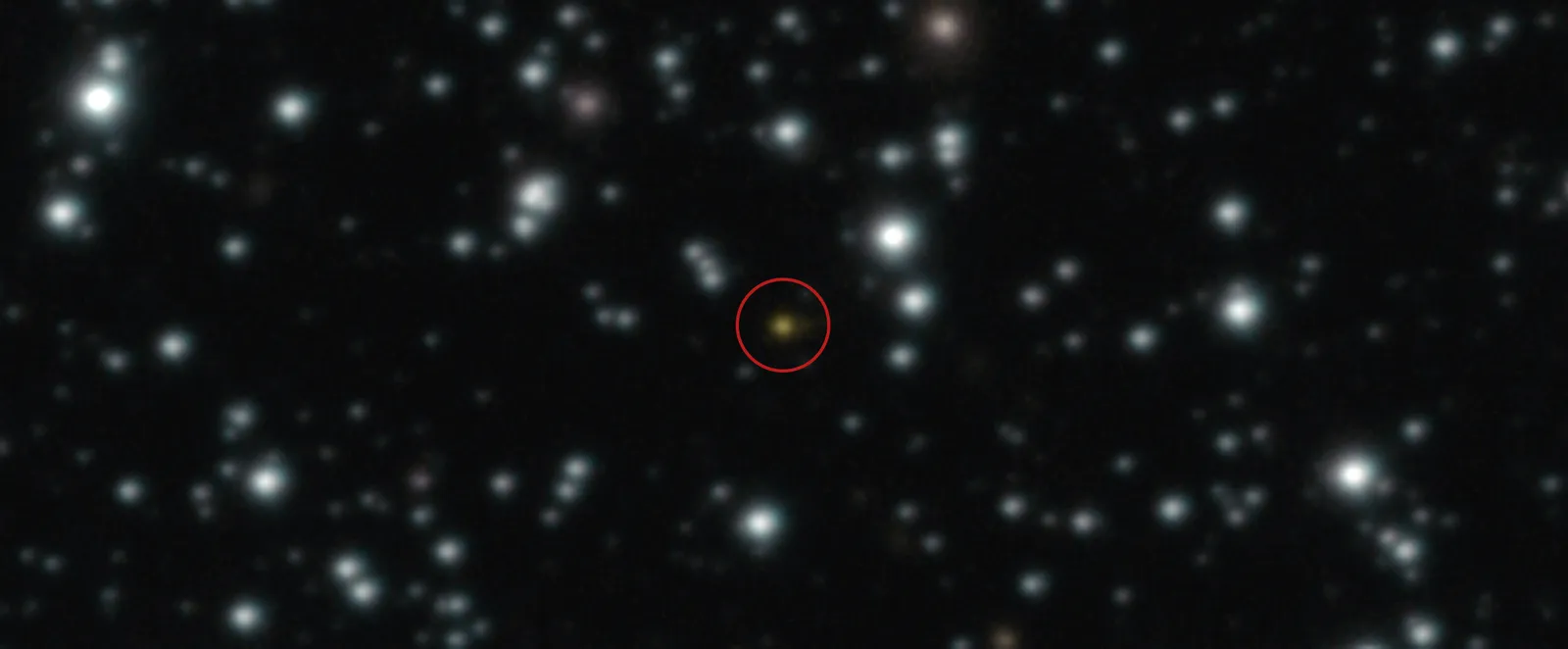
On July 25, astronomers recorded a gamma-ray burst unlike anything seen before: GRB250702B emitted gamma rays for seven hours. For comparison, typical gamma-ray bursts last from fractions of a second to tens of seconds, and even "long" bursts rarely exceed a few minutes. But the burst's duration wasn't the only puzzle.
A day before the main event, telescopes detected a faint X-ray precursor signal. And after the gamma-ray emission ended, the object's X-ray glow kept fading gradually for weeks. Three phases — precursor, burst, and long tail — don't fit any existing model of gamma-ray burst origins.
Why the standard models fell short
Long gamma-ray bursts are usually linked to the core collapse of a massive star into a black hole (a "collapsar"). Short bursts are tied to neutron star mergers. Both scenarios describe bursts lasting up to a few minutes reasonably well, but neither explains a seven-hour burst with a clear X-ray precursor a day earlier and a week-long fading tail afterward.
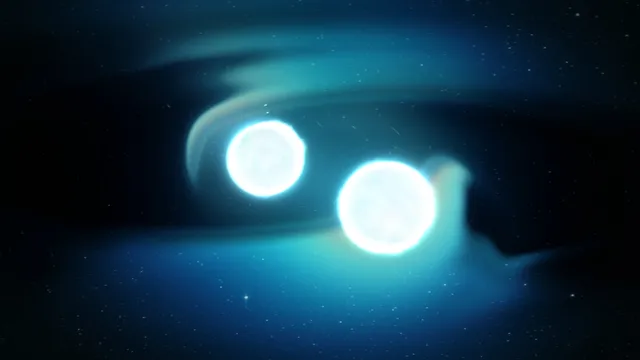
The authors of the new study proposed a different energy source — a micro tidal disruption event, or micro-TDE. This is analogous to classical tidal disruption events, where a black hole of millions of solar masses tears apart a star that wandered too close. The difference here is that the black hole involved has stellar mass — far smaller and more compact.
How disrupting a star launches a jet
In the model, a rapidly spinning black hole of about 10 solar masses (spin around 0.9) disrupts a Sun-like star with one solar mass. The stellar debris doesn't fall onto the black hole immediately — it first forms a disk, and the time it takes for matter from this disk to flow into the black hole (the viscous timescale) sets the burst's duration. For this type of event, that timescale naturally spans hours to days — matching the observed seven hours well.
To test whether this scenario is physically plausible, the researchers ran 3D hydrodynamic simulations using the AREPO code, modeling the disruption of a solar-mass star by a 10-solar-mass black hole. The result: within about one day after disruption, a quasi-steady envelope forms around the disk, featuring a low-density polar funnel. Density in this funnel falls off inversely with the square of distance, with a half-opening angle of about 15 degrees.
This funnel turned out to be a critical detail. Applying an analytic jet-stability framework to the resulting density profiles, the authors showed that this particular profile keeps the jet below the threshold for the so-called kink instability — a phenomenon that typically tears apart narrow relativistic jets before they can break free. This allows the jet to propagate stably and break out, provided its power exceeds roughly 10 to the 47th power erg per second.
Three phases of a single event
In the proposed picture, the entire observed signal is explained by a sequence of processes around the same black hole. The X-ray precursor a day before the burst comes from accretion of the stream of stellar debris before a full disk even forms. The seven-hour gamma-ray burst itself results from a tightly beamed jet with an opening angle under one degree and isotropic-equivalent luminosity around 10 to the 51st power erg per second, breaking through the polar funnel via the Blandford-Znajek mechanism — a process that extracts the black hole's spin energy to power the jet.
The week-long gradual fading of the X-ray emission is explained by a combination of two effects: mass loss from the disk through a disk wind, which causes the jet's power to decline inversely with the square of time, and gradual widening of the jet's opening angle over time. Initially these two effects combine to steepen the decay dramatically — luminosity drops inversely with the fourth power of time — before the curve flattens to match the slower decline of the jet power alone.
What this means for burst classification
The model reproduces all three observed phases of GRB250702B within a single physical scenario, without invoking separate mechanisms for each. If this approach holds up for other ultra-long gamma-ray bursts, it would add another class of objects to the list of known burst origins: not just collapsing massive stars and merging compact objects, but ordinary stars torn apart by stellar-mass black holes. For now, this is one proposed scenario, tested through simulations, for one specific event — confirming it will require analyzing other similar bursts.