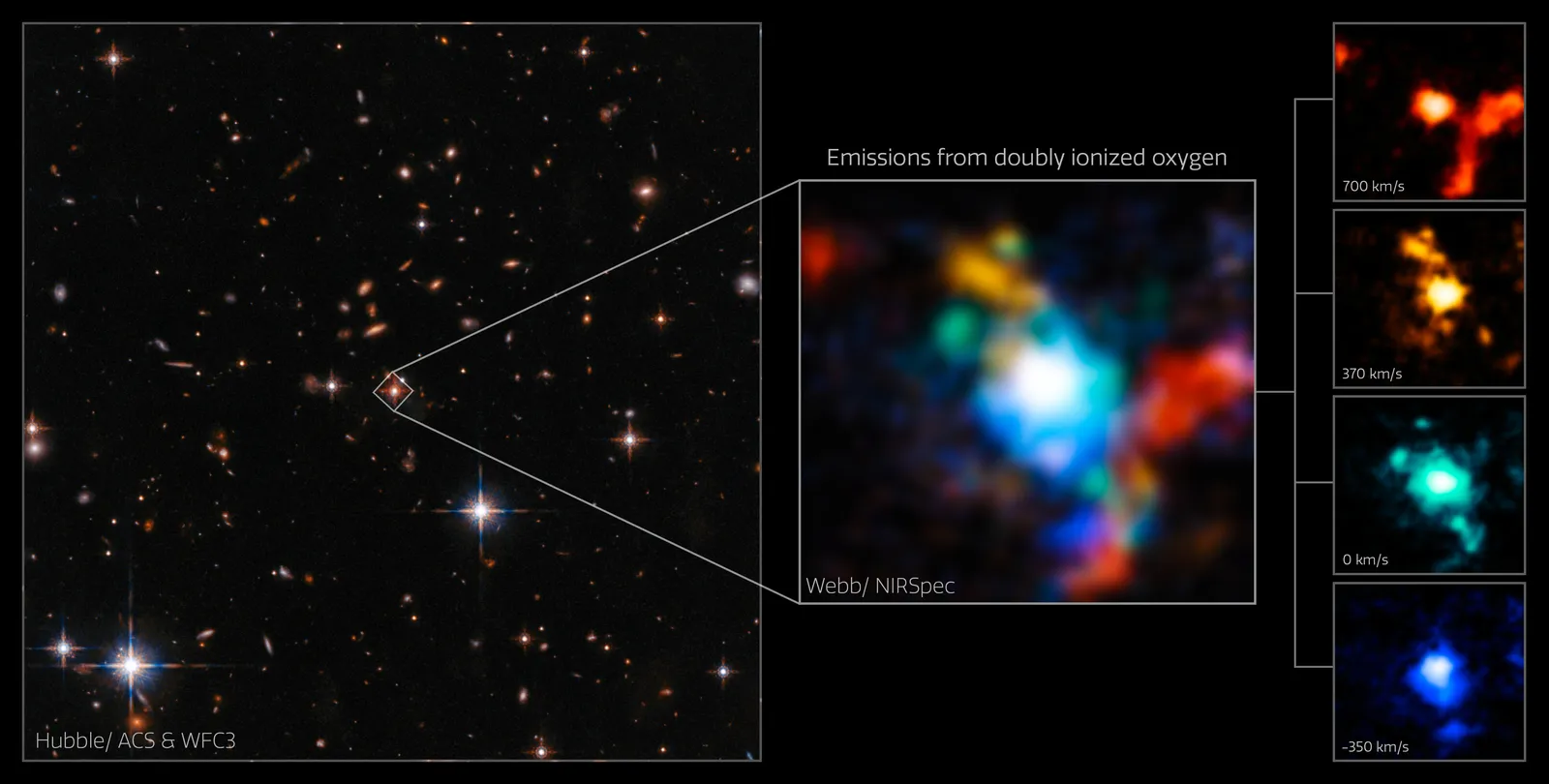
Astronomers have reported the discovery of an extraordinarily dense galaxy protocluster at redshift z=3 — an epoch when the universe was only about 2.2 billion years old. The structure, nicknamed "The Step," was found around the well-known object SDSS J165202.64+172852.3, a luminous red quasar that also shows vigorous star formation (a starburst). The study used the James Webb Space Telescope and its NIRISS instrument in Wide-Field Slitless Spectroscopy (WFSS) mode.
Slitless spectroscopy allows researchers to obtain spectra of many objects in a field simultaneously, without pointing a spectrograph slit at each galaxy individually. This made it possible to quickly measure precise redshifts for dozens of galaxies around the quasar and build a three-dimensional map of their positions and velocities.
Two subgroups and a possible halo merger
The analysis confirmed at least 18 member galaxies of the protocluster. Their distribution in position-velocity space turned out to be unusual: it clearly splits into two subgroups forming a distinctive step-like pattern — hence the structure's nickname. The authors suggest this could be a signature of a merger between two separate dark matter haloes that have not yet fully combined.
Supporting this idea is the large velocity spread among galaxies along the densest line of sight, ranging from 700 to 850 km/s. Such a broad velocity range is hard to explain if all the galaxies belong to a single, already dynamically settled system — but a merger of two haloes offers a natural explanation.
Record density in the core
The most striking result concerns the density of galaxies in the central part of the structure. Along the densest sightline, the researchers counted seven galaxies within just 70 kiloparsecs of projected distance from the quasar. This corresponds to a galaxy overdensity of more than 100 times the cosmic average for this epoch, while within a larger 1 square megaparsec area the overdensity still exceeds 15 times.
This is one of the densest known protoclusters at this redshift.
According to the authors' estimates, the total dark matter mass associated with the structure is between 10^13.1 and 10^13.8 solar masses — a mass already typical of mature galaxy clusters in today's universe. If the structure continues to grow at expected rates, by z=0 it could potentially evolve into a massive cluster resembling the well-known Coma Cluster, one of the largest clusters in the nearby universe.
Star formation, quenched galaxies, and active nuclei
Despite its density, the protocluster's galaxies do not show an extraordinary burst of star formation. Compared to field galaxies (typical galaxies of this epoch outside dense structures), star formation here is only slightly elevated. Compared to other known z=3 protoclusters, star formation rates in "The Step" turned out to be similar or even somewhat suppressed.
Interestingly, among the protocluster members the researchers found two galaxies with a strong "4000-angstrom break" (D4000 break) — a spectral feature indicating an old stellar population and the absence of ongoing star formation. These galaxies had effectively already "quenched," even though the universe was only about 2 billion years old at the time. In addition, two new active galactic nucleus (AGN) candidates were identified in the field, and the estimated overall AGN fraction among protocluster members is 10-20% — noticeably higher than the average among field galaxies.
Why it matters
The combination within a single structure of both star-forming and already quenched galaxies, along with an elevated AGN fraction, makes "The Step" a telling example of a protocluster caught in a transitional stage of development. The authors note that such structures at redshifts between 2 and 4 remain a small but growing list of discoveries that simultaneously host both star-forming and quenched galaxies.
This redshift range may represent a key epoch for understanding cluster evolution: it appears to be when dense overdensities shift from being the most active star-formation "factories" of the early universe toward shaping the massive quenched elliptical galaxies observed today in the cores of nearby massive clusters. "The Step" offers a rare opportunity to observe this transition directly, while it is still underway.