No planet, however large, keeps its atmosphere forever — solar wind and thermal escape eventually strip away light gases into space. But where exactly does the line fall, the point past which a planet turns into bare rock with no air left? A team led by Michelle Hill, together with Stephen Kane, Bradford Foley and Laura Schaefer, set out to answer this with a new model called STEHM — the Smaller Than Earth Habitability Model.
The question isn't academic. Next-generation telescopes are increasingly finding rocky exoplanets smaller than Earth. There won't be enough resources to study every one of them in detail, so astronomers need a way to figure out in advance which planets stand a real chance of holding onto an atmosphere.
The model tests planets from Earth-size down to half Earth's radius
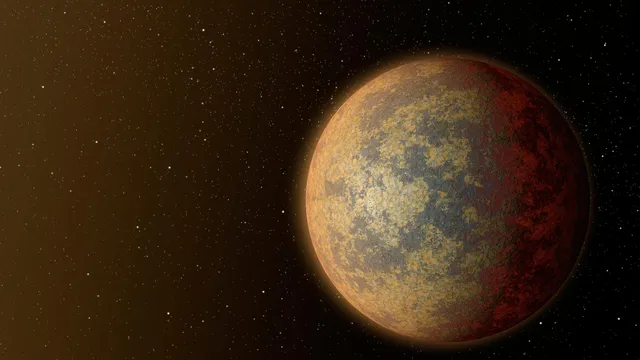
STEHM simulates rocky planets ranging from 1.0 down to 0.5 Earth radii (R⊕), placed in the habitable zone of a Sun-like star. The researchers track whether each planet can retain its atmosphere over billions of years — a timescale comparable to Earth's own age.
The result came out fairly sharp: planets ≥0.8 R⊕ hold onto their atmospheres under Earth-like default conditions. Anything smaller loses its atmosphere over time.
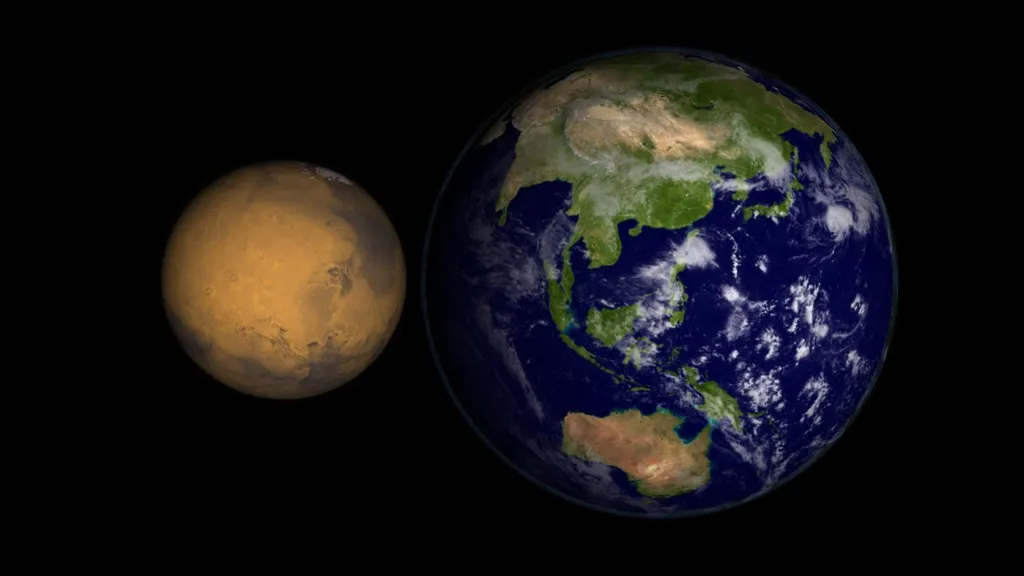
For scale, 0.8 R⊕ sits between Mars (~0.53 R⊕) and Venus (~0.95 R⊕). Mars falls well below this boundary, and the consequence is visible firsthand — its atmosphere is hundreds of times thinner than Earth's.
Carbon in the interior turns out to be the decisive factor
Under certain combinations of parameters, the boundary can shift down to 0.7 R⊕, but that requires unusual starting conditions. The single most influential factor is a planet's initial carbon inventory.
Carbon fuels volcanic degassing — the process by which gases trapped in the interior escape to the surface through eruptions, replenishing an atmosphere that's constantly leaking into space. But to meaningfully extend a planet's atmospheric lifetime, carbon reserves need to differ from Earth's by orders of magnitude, not by a modest margin.
The best odds of keeping an atmosphere belong to planets with large carbon reserves, abundant radioactive elements in the interior (which generate heat and sustain volcanic activity), cool mantle temperatures early in their history, and a relatively small core compared to the planet's overall size.
The model is deliberately conservative
STEHM is built around a stagnant lid planet — a type of geology where the crust doesn't move as separate plates but sits as a single, immobile shell. That's how Mars and Venus are structured, unlike Earth with its plate tectonics.
This is a conservative choice on purpose. Plate tectonics would likely improve a planet's ability to retain an atmosphere further, since moving plates tend to make interior degassing more efficient. That means the real lower size limit for planets with active plate tectonics could sit even below 0.7–0.8 R⊕.
The authors stress that atmospheric retention on small planets depends not just on size but on formation conditions and early evolution — the initial thermal state, the abundance of radioactive elements, and the carbon budget a planet starts with.
The practical value of the model lies in prioritizing observation targets. As future telescopes begin detecting ever smaller rocky exoplanets, STEHM will help identify which ones are worth checking first for an atmosphere and potential habitability, and which have most likely already lost their air, the way Mars did.