Sgr A Polarization During the 2018 EHT Campaign
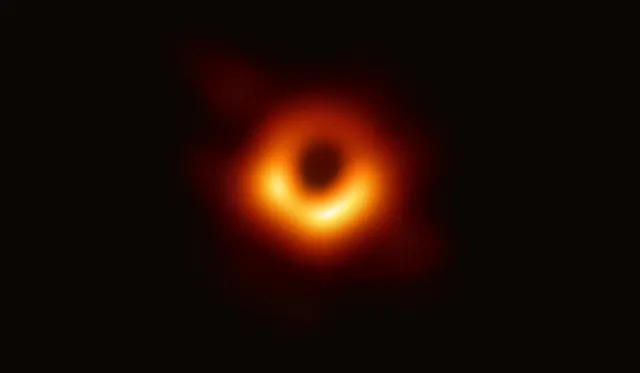
The Event Horizon Telescope collaboration released an analysis of ALMA data collected during the 2018 observing campaign of Sagittarius A*, the supermassive black hole at the Galactic center. The source's total millimeter brightness varies only weakly, under 10%, while its polarization fluctuates far more dramatically, by up to 50%.
A particularly striking episode showed a simultaneous X-ray flare and millimeter peak with none of the delay predicted by standard flare models. This suggests energy is fed into the plasma around the black hole continuously rather than in discrete injections, challenging current models of accretion flow dynamics near the event horizon.
Chaotic EMRI Migration in Turbulent Disks
A team led by Mudit Garg modeled how turbulence in accretion disks affects extreme mass ratio inspirals (EMRIs) — objects spiraling into supermassive black holes that are key targets for the future LISA gravitational wave detector. For a system with total mass 10^6 solar masses and mass ratio 5×10⁻⁵ at redshift z=0.276, the standard linear gas torque alone produces a waveform dephasing too small for LISA to detect.
Including chaotic turbulent torque changes this picture: the dephasing crosses the detection threshold at signal-to-noise ratio 50 once the Eddington ratio exceeds 0.3 and turbulence and viscosity parameters are sufficiently large. The result argues for long-duration MHD simulations of disks with embedded EMRIs to properly interpret future LISA signals.
Where Did the First Black Holes Come From?
Researcher Pratika Dayal compared three scenarios for the origin of the overly massive black holes JWST has found within the universe's first billion years: light seeds (~100 solar masses), heavy seeds (10³–10⁵ solar masses), and primordial black holes formed before the first stars. The models were tested against black hole mass, host stellar mass, and gas metallicity at z~5–10.
Only the scenario of light seeds growing through Eddington-limited accretion could be definitively ruled out. The observed black hole-to-stellar mass ratios together with extremely low metallicities (Z ≤ 0.01 Z☉) are reproduced simultaneously only by heavy-seed and primordial black hole models, making black holes with a declining mass ratio in 10⁹–10¹¹ solar mass halos a promising discriminating test.
Analytic Formulae for Binary Black Hole Populations
Astrophysicist Chayan Chatterjee applied symbolic regression to the statistical results of the GWTC-4 gravitational-wave catalog to derive compact analytic formulas in place of complex numerical population models for binary black holes. Four relationships emerged: the merger-rate evolution with redshift, the dependence of the effective-spin distribution on mass ratio and on redshift, and the conditional mass-ratio distributions for the 10 and 35 solar mass primary mass peaks.
Exact analytic derivatives revealed that correlations between spin and both mass ratio and redshift arise mainly from the broadening of posterior distributions rather than shifts in their means. Such formulas allow rapid comparison of formation channels and forecasting of merger rates without heavy numerical computation.
Planetary Exploration 3.0
Participants of a Keck Institute for Space Studies workshop presented Planetary Exploration 3.0, an alternative to NASA's approach that proved effective on Mars through 22 successive missions over decades but does not scale to distant worlds requiring decade-long cruises. PE 3.0 proposes software-defined space systems capable of reconfiguring hardware and functions through software updates during the mission itself.
Onboard artificial intelligence for autonomous science, navigation, and control plays a central role, letting a spacecraft move from exploratory observations to hypothesis-driven investigation based on data gathered in situ. Proposed mission concepts include a smart Neptune/Triton flyby, an ocean world explorer, and an Oort cloud reconnaissance mission.