Every crewed NASA mission carries pouches of intravenous saline. A simple mix of sodium chloride and purified water, it can treat close to a third of typical in-flight medical situations — dehydration, burns, and more. But deep in space, this routine medical supply turns into a logistics problem.
IV fluid shelf life is only 16 months. A mission to Mars could last up to three years. Carrying a supply that expires before the halfway point isn't an option. Engineers at NASA's Glenn Research Center in Cleveland found a different answer: produce saline on board, from drinking water, exactly when it's needed.
A filter and a bag of salt instead of a medicine cabinet
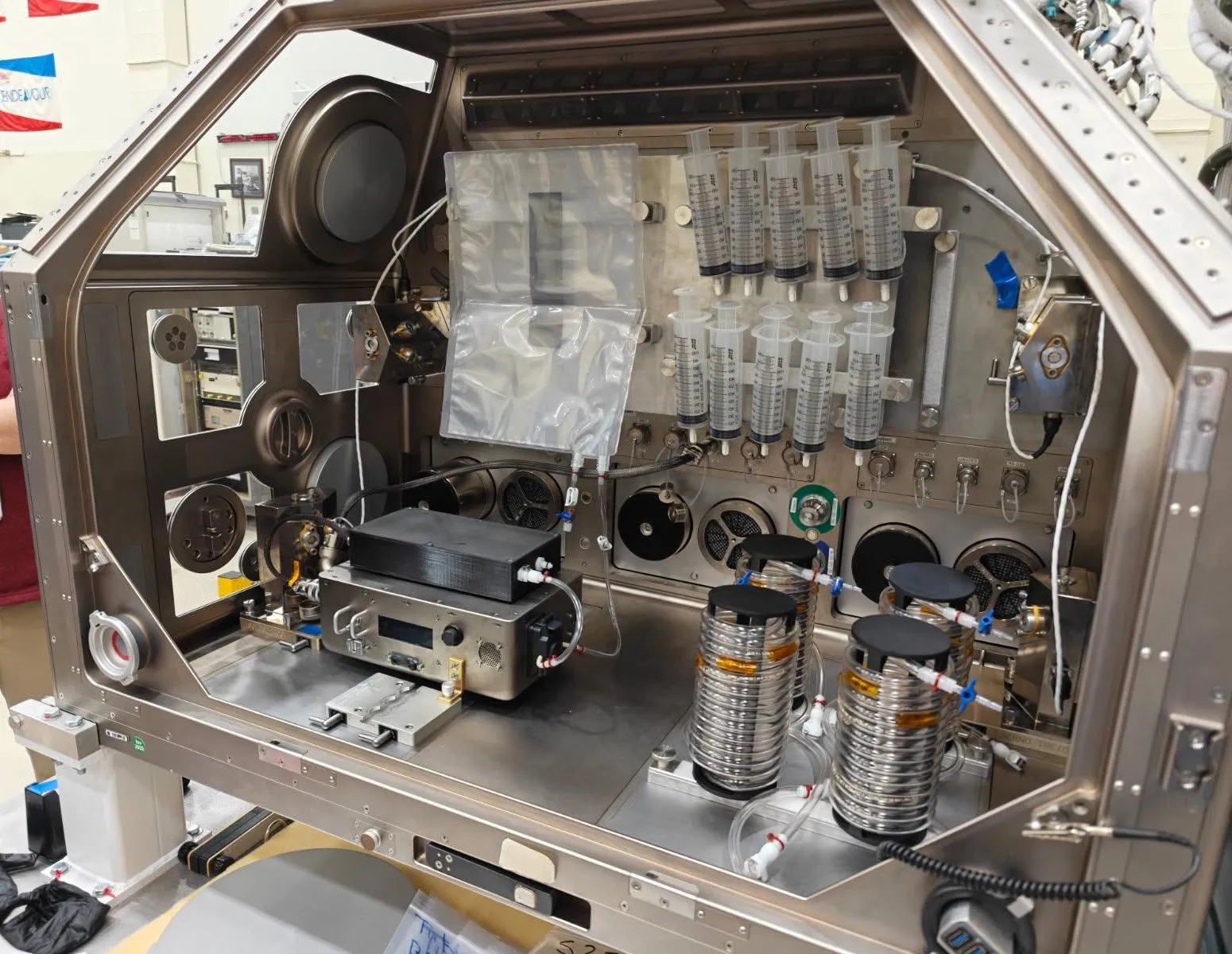
The system is called IVGEN Mini (IntraVenous Fluid GENeration Miniaturized), and it works on a simple principle. Station drinking water is poured into a large supply bag connected to the device.
IVGEN Mini filters the water, removing particulates and mineral ions. The processed water flows into an output bag containing a premeasured amount of sodium chloride. The result is sterile, medical-grade IV fluid.
The system can produce 1.2 liters of saline per hour — enough to cover crew needs in emergencies during a long-duration flight. The device meets United States Pharmacopeia (USP) standards, checking pH, salinity, and the absence of bacteria, organic carbon, and particulates.
On April 11, 2026, IVGEN Mini was delivered to the ISS aboard a Cygnus cargo spacecraft as part of Northrop Grumman's 24th resupply mission. Demonstrations are planned for both spring and fall this year.
In May, the crew will run a two-day demonstration, generating 10 liters of fluid. Those samples will be returned to Earth for quality analysis to confirm the fluid produced in flight is safe and meets requirements. None of the test fluid will be administered to the crew — this is purely a technology check.
A second attempt after the 2010 experiment
IVGEN Mini is the second iteration of the technology. The original system, IVGEN, was tested aboard the ISS back in 2010. It proved the concept worked, but the hardware itself was much larger — due to additional sensing equipment needed to verify the process was functioning correctly.
Following that successful demonstration, the team set out to miniaturize the design.
With IVGEN Mini, we've reduced the system's size and weight. The previous system used gaseous nitrogen to pump fluid through the system. Now, we have pumps that are miniaturized, which allow us to optimize our designs and refine the filtering process.Courtney Schkurko, engineering project manager, NASA Glenn
The development team included members from NASA's Glenn Research Center, Sierra Lobo, Inc., and NASA's Johnson Space Center.
Saving mass for deep space missions
Beyond the expiration issue, IVGEN Mini addresses cargo weight. On a long mission, every kilogram counts.
If a Mars flight required 100 liters of IV fluid, a hundred separate one-liter bags would take up significant volume and mass. A compact device producing fluid on demand takes up far less space.
As Schkurko put it, the choice is between packing a supply that risks expiring en route and carrying a small device that generates fluid incrementally. The latter means the fluid is always within its expiration window, always available to the crew, and one less risk to worry about.
Next, the team plans shelf-life testing of saline produced by the system in orbit. The project is managed by NASA's Mars Campaign Office, which oversees technologies for crewed missions to the Moon and Mars.