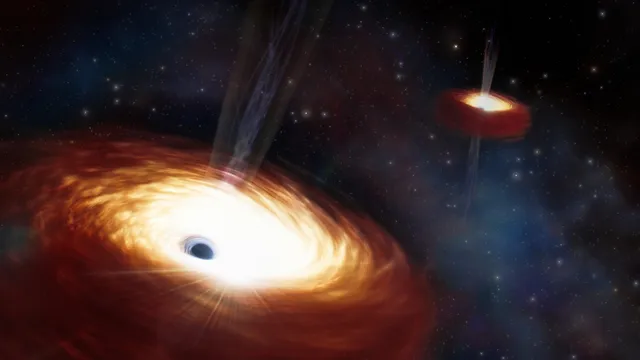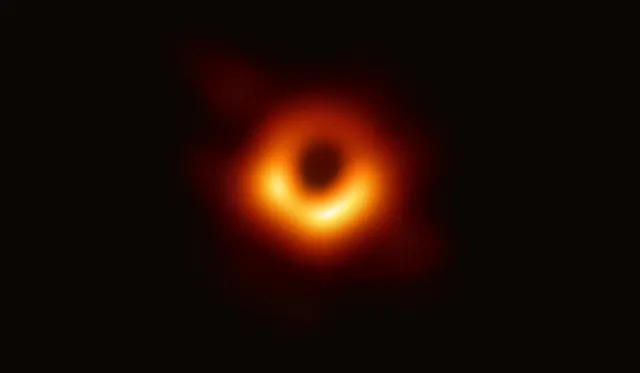
Since the first confirmed black-hole merger in 2015, the LIGO and Virgo gravitational-wave observatories have accumulated hundreds of such events. Each merger leaves a distinctive signature in spacetime — a signal from which scientists can reconstruct both black holes' masses and how their spin axes are oriented relative to the orbit. Once enough events piled up, a statistical picture emerged — and it turned out more complicated than models predicted.
What was known before
Two main hypotheses explained the origin of binary black holes. The first is isolated binary star evolution, where two massive stars pass through a common envelope phase and eventually collapse into black holes. The second is dynamical formation in dense stellar clusters, where black holes randomly encounter each other and pair up under the gravitational influence of neighbors. Each scenario predicts its own characteristic imprint on the mass and spin distribution. The trouble is that neither alone reproduces the full picture: observations show a sharp peak in primary black-hole mass near 10 solar masses, a substantial fraction of systems with markedly misaligned spins, and a preference for near-equal-mass pairs — all at once.
What the researchers did
The authors of the new study focused on a fact often overlooked: a large fraction of massive black-hole progenitor stars actually form not in isolation, but in hierarchical triples — tight binary star pairs accompanied by a more distant third companion. That third body's gravity can periodically perturb the inner pair's orbit through a mechanism known as Lidov-Kozai cycles: the orbit alternately stretches and tilts relative to its initial plane.
The researchers ran a series of simulations combining triple-system orbital dynamics with stellar evolution models — tracking stars from birth through collapse into black holes and eventual merger. They compared the results with the real catalog of gravitational-wave events.
The model reproduced several key features of the observed population simultaneously:
— a sharp, dominant peak in primary black-hole mass near 10 solar masses;
— a substantial fraction of systems with large spin-orbit misalignment both within and beyond this peak, matching the skewed distributions of χ_eff and χ_p, the parameters astronomers use to describe a pair's effective spin;
— a mass-ratio distribution favoring near-equal-mass pairs, with a slope matching observations.
Why it matters
The main value of the result isn't any single coincidence — it's that one model simultaneously explains three different population properties: mass, spin, and mass ratio. No previous formation scenario achieved all three at once. This suggests hierarchical triples could be a dominant channel for forming the low-mass, most numerous bulk of black-hole mergers, rather than a rare exception.
The authors also highlight a predicted sharp decline in mergers around 30 solar masses. This threshold coincides with a feature previously spotted in the observed mass distribution and linked to a possible transition to another formation mechanism — one dominating among heavier black holes. If confirmed, at least two distinct formation channels would coexist within the merger population, each with its own characteristic mass range.
How solid is the result
The work is currently posted as a preprint on arXiv and has not yet undergone peer review. The conclusions rely on simulations — model calculations of triple-system dynamics and evolution — rather than on direct observations of the progenitor triples themselves. The authors emphasize that their findings apply specifically to the low-mass, bulk part of the merger population; the heavier tail of the distribution likely involves a different, not yet fully identified mechanism. Further verification will require both larger statistics from LIGO, Virgo, and KAGRA detections and independent observations of massive triple star systems within our own Galaxy.