Calcium reveals supernova explosion mechanism
Using the MUSE instrument on ESO's VLT, astronomers examined the young supernova remnant SNR 0509-67.5 in the Large Magellanic Cloud and found a double shell of highly ionized calcium [Ca XV] alongside a single shell of sulfur [S XII] in the shocked ejecta. This layered structure matches predictions from hydrodynamical simulations of a sub-Chandrasekhar-mass white dwarf explosion.
The outer calcium shell traces an initial helium-shell detonation, while the inner one marks the subsequent explosion of the carbon-oxygen core — the hallmark of the double-detonation mechanism. Two spatially separated brightness peaks in [Ca XV] provide the first strong observational evidence that this scenario actually occurs in nature. The result matters because Type Ia supernovae underpin measurements of dark energy, so pinning down their explosion mechanism sharpens cosmological distance estimates.
XRISM captures black hole corona evolution in real time
During a coordinated campaign in February 2024, the XRISM X-ray observatory, together with NuSTAR and XMM-Newton, monitored the active galactic nucleus MCG-6-30-15. Spectral analysis reconstructed the reflection of coronal X-rays off the accretion disc around a rapidly spinning black hole (a > 0.93), yielding the most detailed picture yet of corona dynamics.
For most of the observation the corona stayed compact, within 10 gravitational radii, but during a flare it expanded to 15 rg and accelerated outward reaching 0.27c, then collapsed to just 2.5 rg during brief dips around the flare, boosting relativistic effects from the inner disc. Capturing these changes in size and velocity is essential for obtaining accurate black hole spin measurements through X-ray reflection spectroscopy.
Photonic lanterns for the HWO telescope
For the future Habitable Worlds Observatory, which aims to detect biosignatures on exoplanets at contrasts down to 10⁻¹⁰, researchers developed a hybrid photonic lantern called HMSPL. Placed at the focal plane, it splits incoming light: a central single-mode fiber feeds the planet's signal to a mid-resolution spectrograph, while surrounding fibers collect scattered starlight for rapid wavefront sensing.
This design eliminates path mismatches between the spectroscopy and aberration-correction channels, which is critical for the week-long exposures HWO will need to characterize distant atmospheres. The technology is already being tested in a lab at UTSA and on the SCExAO system at the Subaru Telescope, ahead of eventual use on a space mission.
"Persephone's Torch" — brightest lensed quasar system
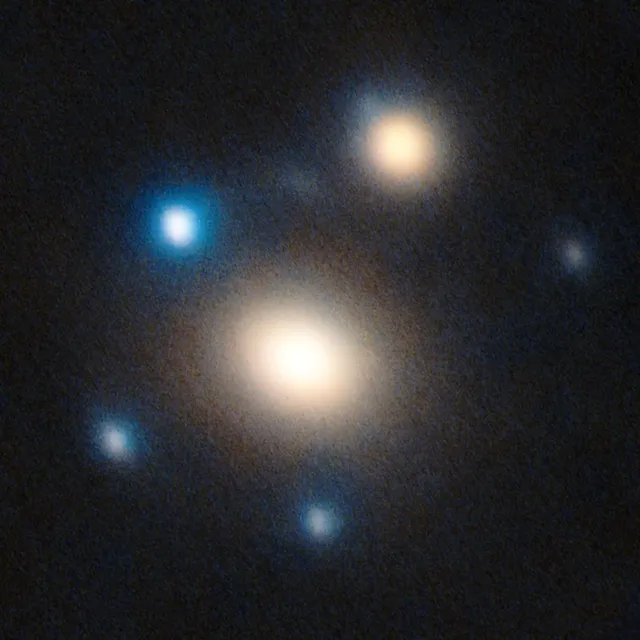
Infrared data from the SPHEREx survey, combined with adaptive optics imaging from LBT/LUCI, helped confirm quasar J1330−0905 at redshift z=2.22 as a quadruply lensed system dubbed Persephone's Torch. With an apparent magnitude of i=14.77 and an Einstein radius of just 0.45 arcseconds, it is the brightest lensed quasar system known to date.
An elliptical mass model with external shear reproduces the positions of the four images in a "circular kite" configuration and predicts a total magnification of about 56 times, though the individual image brightnesses deviate anomalously from expectations. Time delays between images of no more than two days, combined with these unusual flux ratios, make the system a promising target for future microlensing studies.
JWST detects CS₂ in an exoplanet atmosphere
Transmission spectroscopy of the warm giant planet WASP-80 b with JWST's NIRCam and MIRI, spanning 2.4-10 microns across three transits, revealed water, methane, carbon dioxide, ammonia, and carbon disulfide (CS₂) in its atmosphere. The measured CS₂ abundance turned out far higher than earlier sulfur-chemistry models predicted for hydrogen-rich atmospheres at this temperature.
Instead, the result matches newer kinetic networks that include efficient carbon-sulfur coupling via the intermediate compound CH₂S. This marks the first observational support for disequilibrium sulfur chemistry in a giant exoplanet atmosphere, positioning CS₂ as a tracer of such chemistry and a clue to a planet's formation history through its sulfur budget.