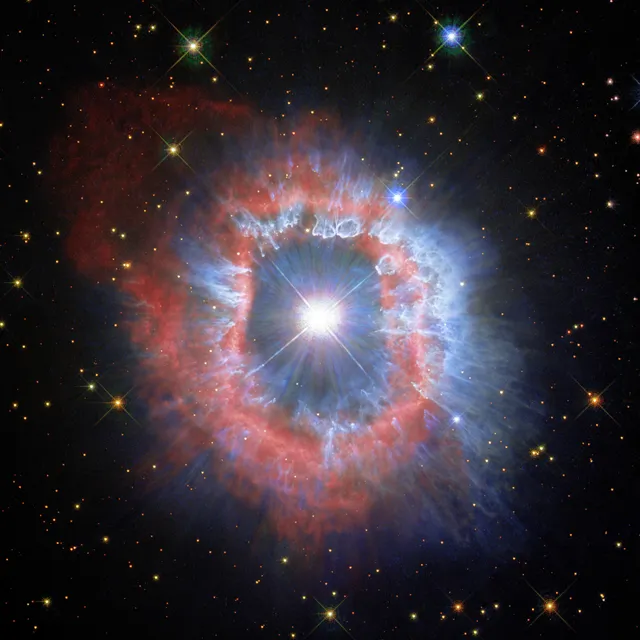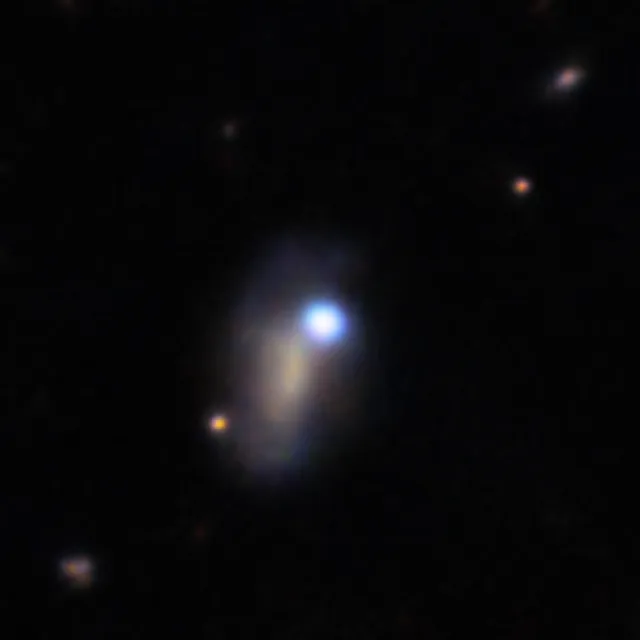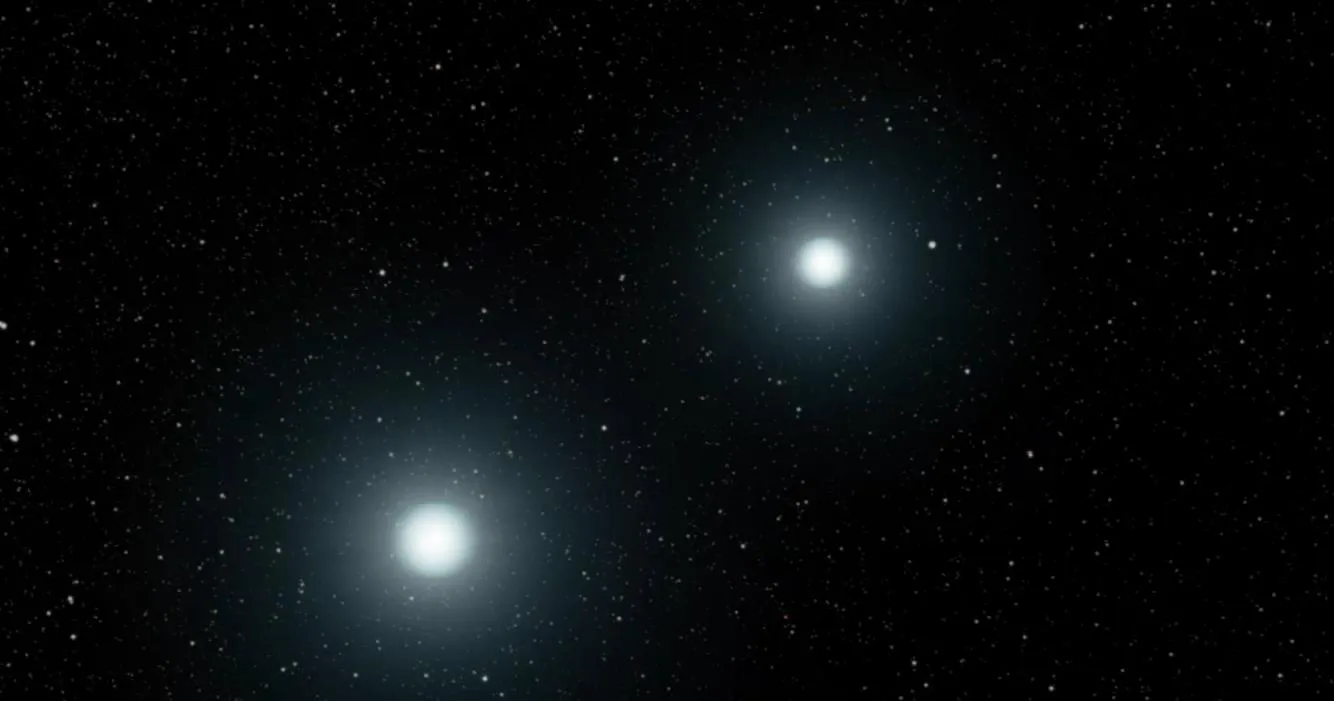
Type Ia supernovae rank among the brightest explosions in the Universe. They remain visible across billions of light-years, and their predictable brightness is exactly what allowed astronomers to measure how fast the Universe is expanding. Yet the mechanism that actually triggers the blast has never been fully settled.
A new study led by Vrutant Mehta (arXiv:2602.23414, submitted February 26, 2026) tests one of the leading candidates: the merger of two white dwarfs. To make sure the outcome wasn't an artifact of a single modeling approach, the team ran identical initial conditions through two independent hydrodynamic codes.
Double Detonation: Helium Ignites a Stellar Core
A white dwarf is what remains after a star runs out of fuel. It's roughly Earth-sized, yet its mass is comparable to the Sun's.
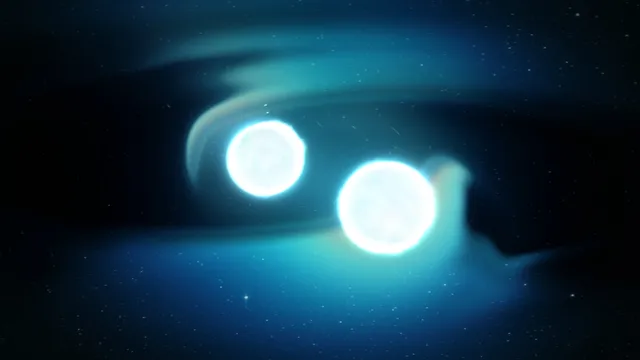
When two such objects orbit each other closely enough, matter — mostly helium — flows from the less massive companion onto the surface of the primary white dwarf. That helium shell ignites first, sending a shockwave through the star that detonates its carbon-oxygen core.
This is the double detonation: shell first, core second. It's the core explosion that produces the supernova visible across cosmological distances.
Hypervelocity White Dwarfs as Evidence
In the classic version of this scenario, the second white dwarf survives. The gravitational bond between the pair suddenly breaks, and it gets flung out of the galaxy at extreme speed.
Such objects — hypervelocity white dwarfs — were recently spotted by the Gaia space telescope. Their discovery provided direct observational evidence that this mechanism actually occurs. Researchers call this pathway the D6 scenario, short for dynamically driven double degenerate double detonation.
Two Codes, Two Outcomes, One Consistent Result
The team modeled two distinct binary white dwarf systems close to helium ignition. Both were run through two separate codes — AREPO and FLASH — which rely on different numerical solvers, different nuclear reaction networks, and different mesh strategies.
In the first model, the primary white dwarf fully detonates while the secondary survives and gets ejected at hypervelocity — the classic D6 outcome.
In the second model, the secondary's core also detonates. Both stars are completely destroyed, in what's called a quadruple detonation: two helium shells and two cores all explode.
Despite the fundamentally different numerical methods, AREPO and FLASH produced consistent results for both sets of initial conditions. The main discrepancies showed up only in nucleosynthetic yields — which chemical elements form during the explosion — and stem from the different nuclear reaction networks used. The overall agreement confirms the robustness of the modeling.
What This Means for Measuring Cosmic Distances
The authors show that which scenario plays out — total destruction of both stars or survival of one — depends strongly on the initial masses of the pair. That's a possible key to understanding why Type Ia supernovae aren't all identical: some are brighter, some dimmer, and that variation still complicates their use as precise cosmic distance markers.
The team also explored observational signatures that could confirm one scenario over the other, including X-ray signals detectable with the RESOLVE instrument on the XRISM telescope. That could offer a way to distinguish cases where the secondary white dwarf survives from those where both members of the pair are destroyed.