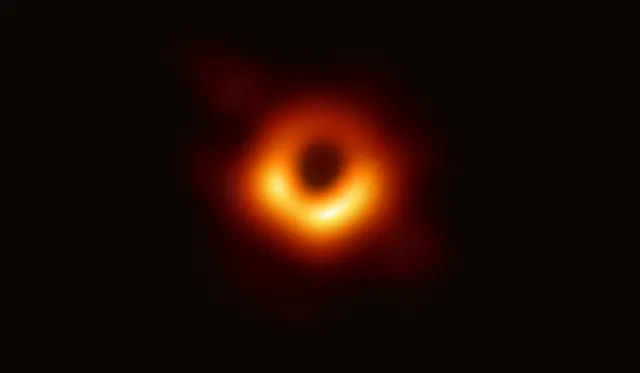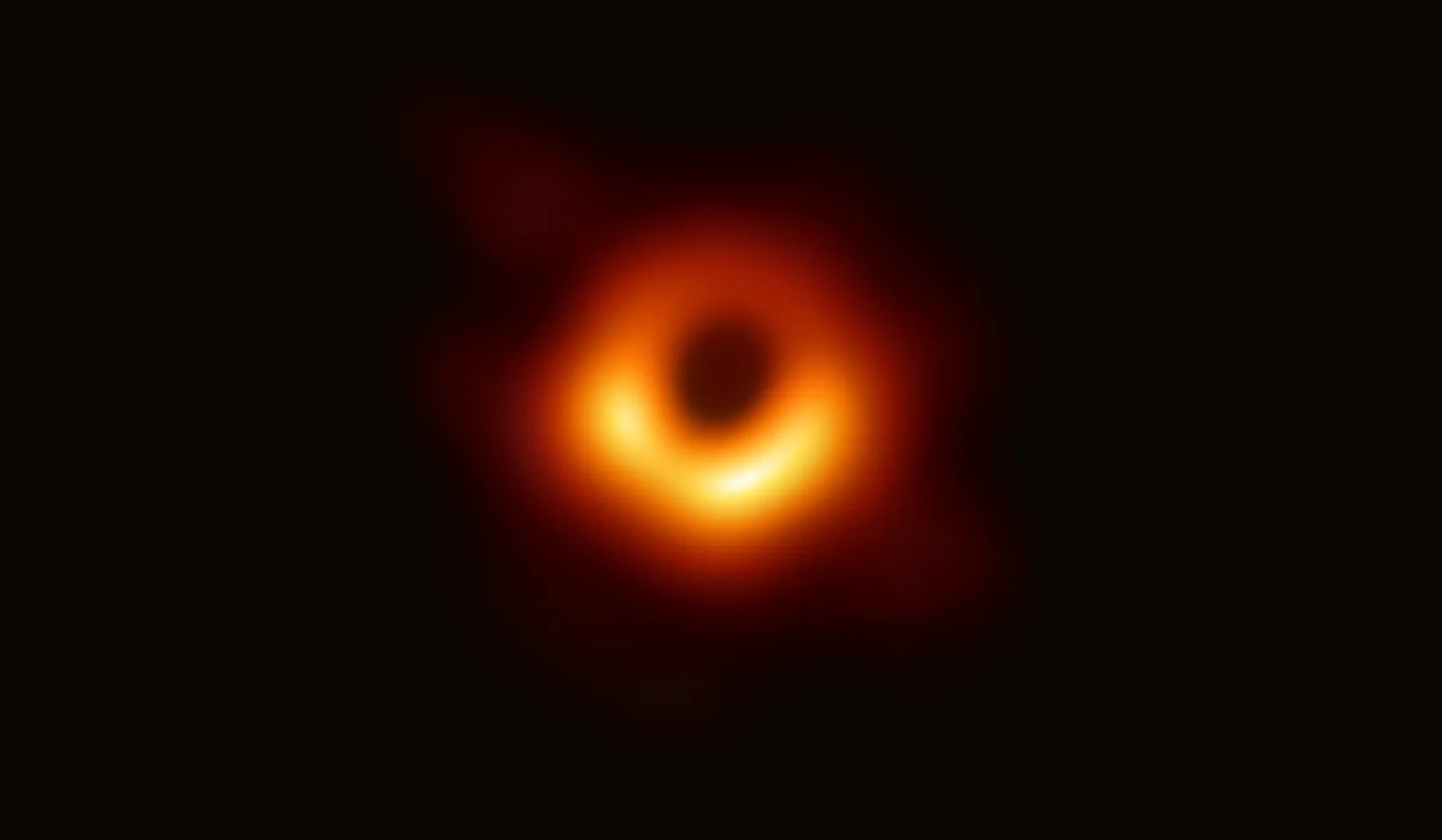
For more than a century, general relativity has predicted the existence of black holes — objects bound by an event horizon, a boundary from which not even light can escape. The Event Horizon Telescope has already imaged the shadows of M87* and Sagittarius A*, and both images match theoretical predictions closely. But a shadow alone doesn't prove a horizon exists — it only shows that light bends sharply near a massive compact object. That's why physicists have long sought a way to test whether an actual event horizon lies behind that shadow, or something else entirely.
A team led by researcher Saurabh has now run the first full three-dimensional magnetohydrodynamic simulation of accretion onto an object that looks almost like a black hole but lacks an event horizon. Earlier attempts to model such "black hole mimickers" relied on simplified setups where matter either piled up outside the object or was blown away in outflows. This is the first simulation where gas actually reaches the central object.
A spacetime with no horizon but a real singularity
The object under study is known as JMN-1 (Joshi–Malafarina–Narayan) spacetime, a theoretical construct arising from gravitational collapse with anisotropic pressure (pressure that acts differently in different directions) within general relativity. JMN-1 has a central singularity — a region of infinite density, just like in a black hole. But there's no event horizon: in principle, light and even matter can escape from near this singularity. The researchers chose a compactness parameter for which the singularity is "null" — a special limiting case of this configuration.
JMN-1 isn't meant as an alternative to black holes built from scratch. It's a test of how far gravitational collapse can proceed without forming a horizon, and whether the outcome would look any different from the familiar picture.
An accretion disk that behaves almost normally
The simulation showed that a stable accretion disk forms around JMN-1 in a magnetically arrested disk (MAD) state, where a strong magnetic field temporarily holds back infalling matter. This is the same regime used to model real black holes, including M87*.
For parameters matching M87* — the supermassive black hole (or, under this hypothesis, its mimicker) at the center of the galaxy of the same name — the accretion rate came out to (3.0 ± 0.5)×10⁻⁶ of the Eddington rate. That's nearly identical to estimates from models with an actual Schwarzschild black hole. Synthetic images at 230 GHz, computed with polarized radiative transfer, broadly match Event Horizon Telescope observations. In other words, based on current data, JMN-1 and a black hole are essentially indistinguishable.
Faint light inside the shadow as a possible key
The researchers found one crucial difference. Inside the "shadow" — the dark central region that EHT interprets as the projection of the horizon — the JMN-1 simulation produces faint but detectable emission.
This light originates near the central singularity itself, in a region that in a true black hole would be completely hidden behind the event horizon, incapable of emitting anything outward. The presence of this signal is a direct consequence of having no horizon: where a black hole has an impenetrable boundary, JMN-1 simply has a very hot, compact region of matter from which photons can travel outward and reach an observer.
We identify a key observational discriminant between a black hole and JMN-1: the presence of detectable brightness inside of the "observable" shadow of JMN-1from the abstract of arXiv:2604.15430
Current interferometric capabilities, including EHT, aren't sensitive enough to detect this faint signal — it falls outside the dynamic range of existing instruments. But the authors note that next-generation radio interferometers, based on their projected sensitivity, should be able to measure it. If no such signal turns up in real observations, that would strengthen the case for a classical event-horizon black hole. If it does appear, it would force a rethink of what actually lies behind the shadows of supermassive compact objects at galactic centers.