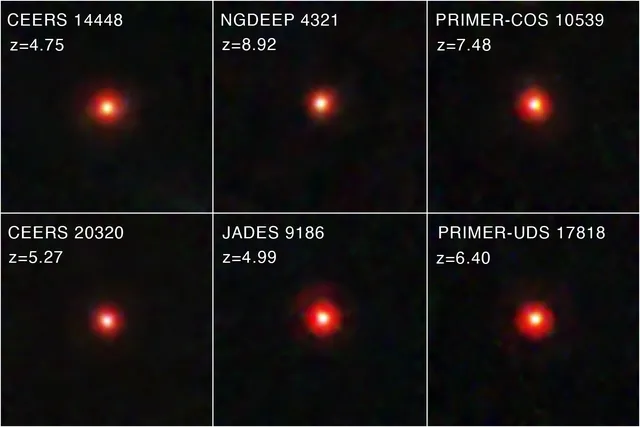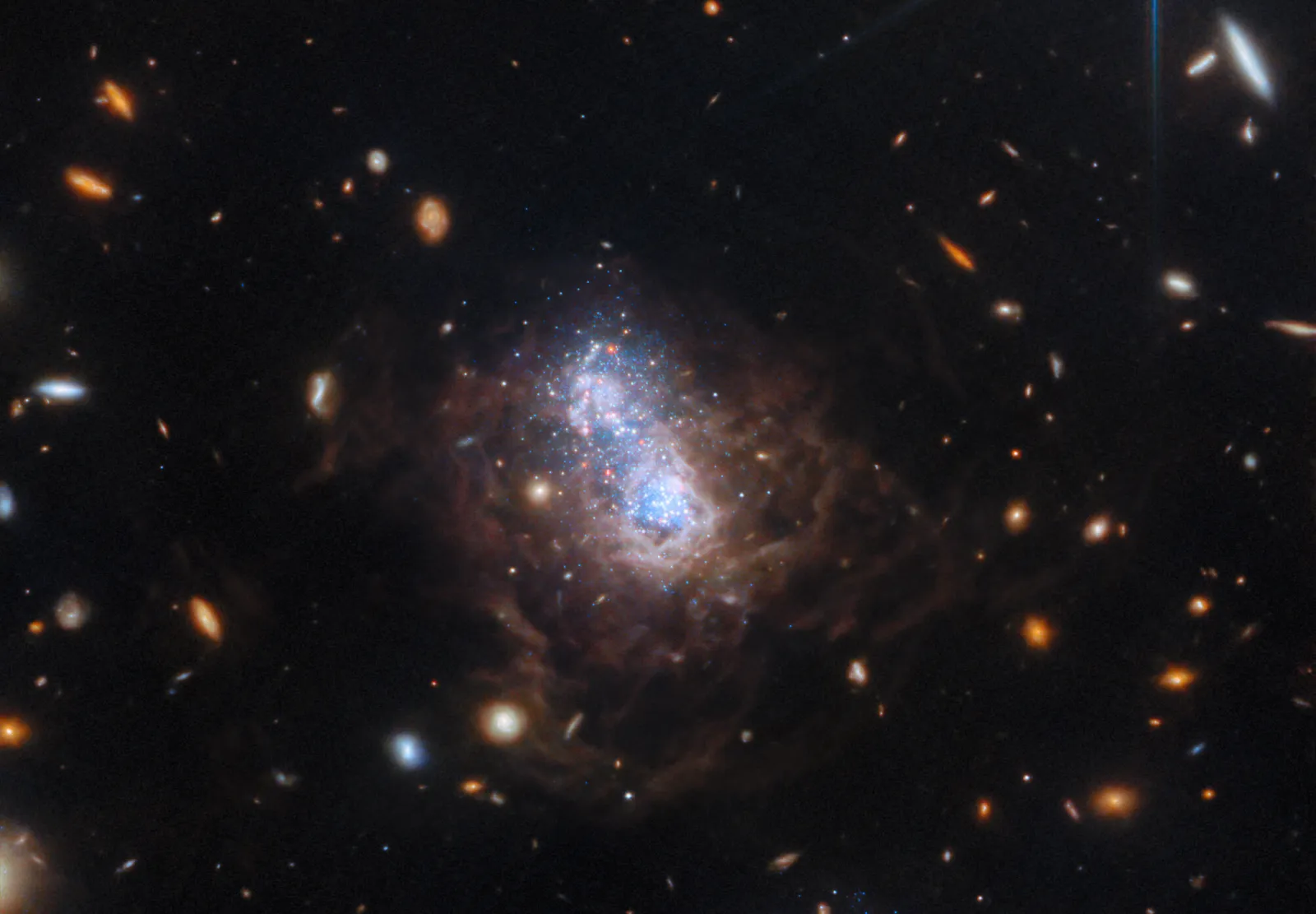
When the Universe was less than a billion years old, its galaxies were already forming stars at a startling pace. A team of astrophysicists has built a detailed reconstruction of how star formation evolved from cosmic dawn to the end of the Epoch of Reionization, arriving at numbers that help explain why James Webb Space Telescope images show galaxies in the early Universe looking so bright and seemingly massive.
The study does not rely on direct observations of individual stars — impossible at these distances — but on a combination of two computational tools. One tracks the evolution of dark matter halos, the other models how galaxies and stars form within them. Together they follow the fate of thousands of model galaxies across roughly a billion years of cosmic history.
Building a star formation model
The work is based on the GUREFT simulation suite, a set of cosmological calculations that reproduce only the distribution of dark matter in the Universe. Dark matter does not interact with light, but its gravity builds the scaffolding into which ordinary matter later falls. The simulations show how small clumps of dark matter merge with one another, gradually growing into ever larger halos.
Onto these halos, the researchers applied the Santa Cruz semi-analytic model. Rather than a full hydrodynamic simulation of gas, it is a set of simplified physical recipes describing how gas cools, falls into halos, and turns into stars. This approach is computationally cheaper, allowing thousands of individual galaxy histories to be run and analyzed statistically rather than examining only a handful of bright examples.
Combining the two tools let the team trace galaxies from a redshift of about z 14 (roughly the first 300 million years after the Big Bang) down to about z 6, near the end of the Epoch of Reionization.
Bursts, pauses, and rapid growth
On average, the star formation rate rose steadily and rapidly across galaxies of all masses throughout the studied period. This fits the broader picture: the young Universe had abundant cold gas, and galaxies were building up stellar mass at an increasing rate.
But this average hides considerable diversity among individual histories. Some galaxies in the model showed bursts of vigorous star formation followed by brief pauses — so-called mini-quenching episodes. This happened even among galaxies with the same final mass observed at the same redshift, meaning the path of any single galaxy proved hard to predict even from similar starting conditions.
The researchers note that this variability matches what astronomers already see in observations of real early-Universe galaxies: bursts and lulls rather than smooth, uniform growth.
Thirty million years for half a stellar population
The key result concerns the timescales of star formation. The team calculated how long it took galaxies to form half (t_50) and 90 percent (t_90) of their stellar populations.
For galaxies at z above 12 — within roughly the first 400 million years of cosmic history — the typical t_50 was under 30 million years, and t_90 was under 70 million years. For comparison, the Solar System itself is over 4.5 billion years old, making these timescales a blink of an eye on cosmic scales.
Importantly, these timescales depend mainly on the redshift of observation and only weakly on the galaxy's mass. Compared with similar galaxies near the end of the Epoch of Reionization, at about z 6, the earliest galaxies needed 3 to 4 times less time to assemble the same fraction of their stars.
What this means for reading James Webb images
Rapid star formation means the stellar populations of galaxies at very high redshift are dominated by young stars. This is not a minor detail: young and old stars emit light differently, which directly affects what a telescope observes.
The authors stress that obtaining accurate synthetic photometry — the calculated spectra compared against James Webb observations — requires careful modelling of these young stellar populations. Neglecting this could skew mass and age estimates derived from observations of distant galaxies.
This has practical implications for the many studies already relying on James Webb Space Telescope data to analyze the youngest known galaxies in the Universe. The results also give astronomers a benchmark for interpreting observational indicators of star formation rates and timescales.