NASA's Swift Observatory has captured a rare sight: a supermassive black hole tearing apart a star not at the center of its galaxy, but far out on the periphery. Until recently, such events — known as tidal disruption events — had only ever been observed in galactic cores. This case is only the second confirmed example of a "wandering" black hole found outside a galaxy's center, and the most distant one yet from the nucleus.
What happened
The event took place in the galaxy WISEA J014656.04-152214.7 in the constellation Cetus, roughly 750 million light-years from Earth. In November 2025, the ZTF (Zwicky Transient Facility) sky survey at Palomar Observatory detected an unusual bright flare on the outskirts of this galaxy. A new artificial intelligence algorithm helped spot it, recognizing a pattern typical of a tidal disruption event among the half a million flashes ZTF records every night.
What made the flare unusual was its location — not at the galaxy's center, but far out at its edge. For several months, the event outshone the entire host galaxy in ultraviolet wavelengths, radiating with an energy equivalent to roughly 10 billion Suns.
Confirming the nature of the flare
To determine what exactly occurred, astronomers brought in the SOAR telescope in Chile, which obtained a spectrum of the source pointing directly to a tidal disruption event. Then NASA's Swift spacecraft stepped in: its UVOT (Ultraviolet/Optical Telescope) instrument measured the flare's temperature at about 30,000°C. That figure, combined with the spectral data, allowed researchers to rule out other explanations and confidently identify the event as a tidal disruption.
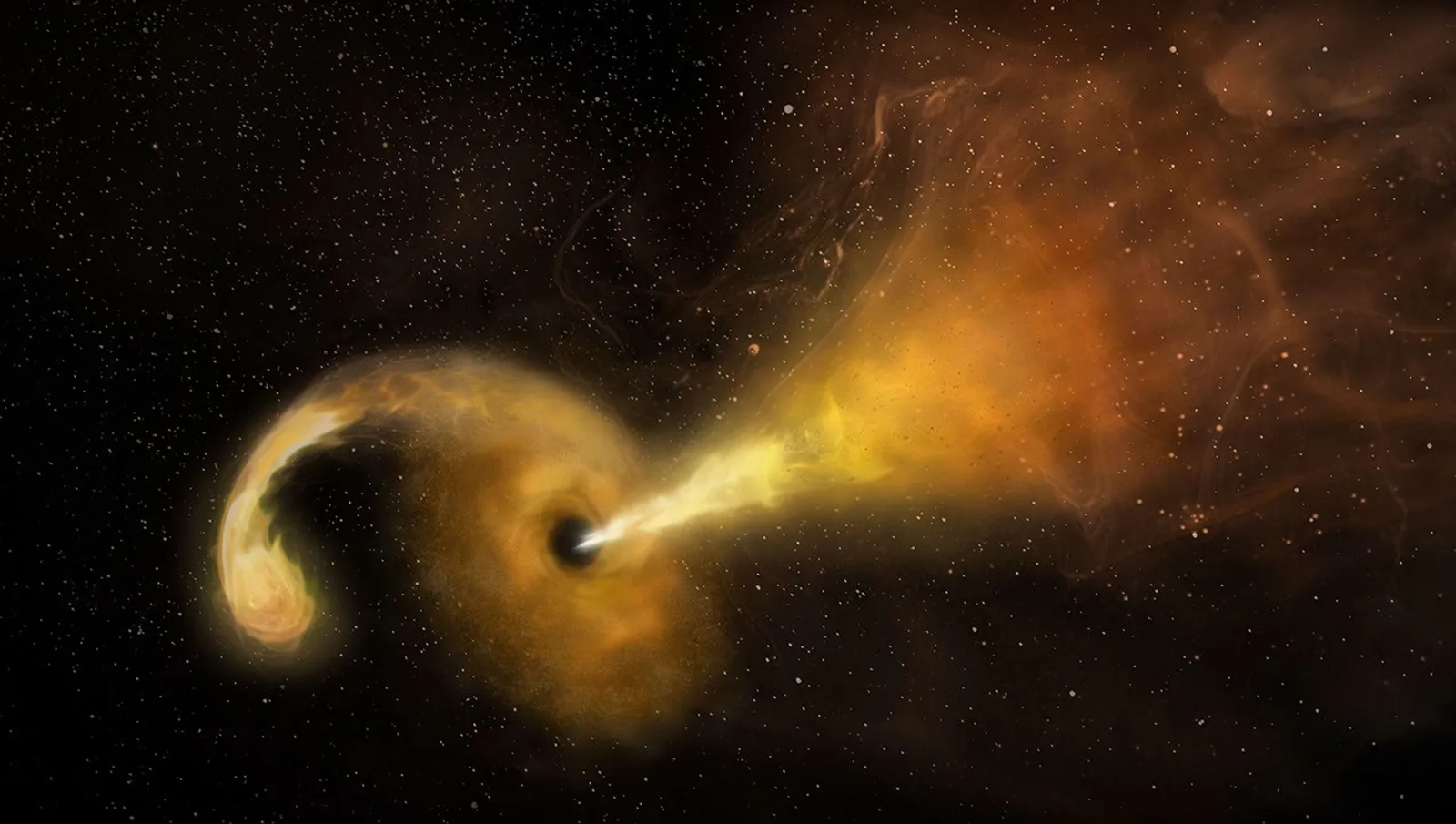
The black hole responsible weighs about a million solar masses. Such events occur when a star strays too close to a black hole's gravitational well — tidal forces stretch and shred the star, and the debris heats up, forming a bright disk around the event horizon. On average, a given galaxy experiences such an event roughly once every 100,000 years, and astronomers detect about 30 similar flares across the universe each year — but almost all of them occur in galactic nuclei.
Why the black hole ended up on the outskirts
The central puzzle is how a supermassive black hole could end up more than 30,000 light-years from its galaxy's center. Researchers believe it must have originally formed in the center of some galaxy — just not the one where it's observed today.
We think the host galaxy's supermassive black hole is still at its core, but the one eating the star could have started off in a small galaxy that merged with the big one we see todayRobert Stein, research fellow, University of Maryland and NASA Goddard
The team outlines two possible scenarios. First: three or more galaxies merged, and gravitational tug-of-war between their central black holes flung the lightest one out to the edge. Second: a dwarf galaxy is currently mid-merger with a larger one, and as the dwarf's stars fall into the bigger galaxy, one of them passed too close to the dwarf's own black hole.
This isn't entirely without precedent. Before 2024, such events had only been seen in galactic cores — partly because that's where astronomers looked, since that's where all known supermassive black holes reside. Then scientists spotted a star being shredded 2,600 light-years from a galaxy's center, prompting astronomers to widen their search beyond galactic cores. This new discovery pushed that distance record out more than tenfold.
What comes next
For now, Swift's pointed observations are temporarily suspended: the spacecraft, operating since 2004, is gradually sinking due to atmospheric drag, and an orbit boost is planned for this summer. Once operations resume, the telescope will continue hunting for more out-of-place black holes.
Researchers are pinning their hopes on new instruments. The Vera C. Rubin Observatory in Chile will conduct wide, deep sky surveys capable of revealing far more tidal disruption events, including off-center ones. NASA's upcoming Roman Space Telescope will extend the search even further, capable of spotting similar flares looking back through 9 billion years of cosmic history. Together, these instruments should bring astronomers closer to a complete census of the universe's supermassive black holes — including those wandering beyond galactic cores.