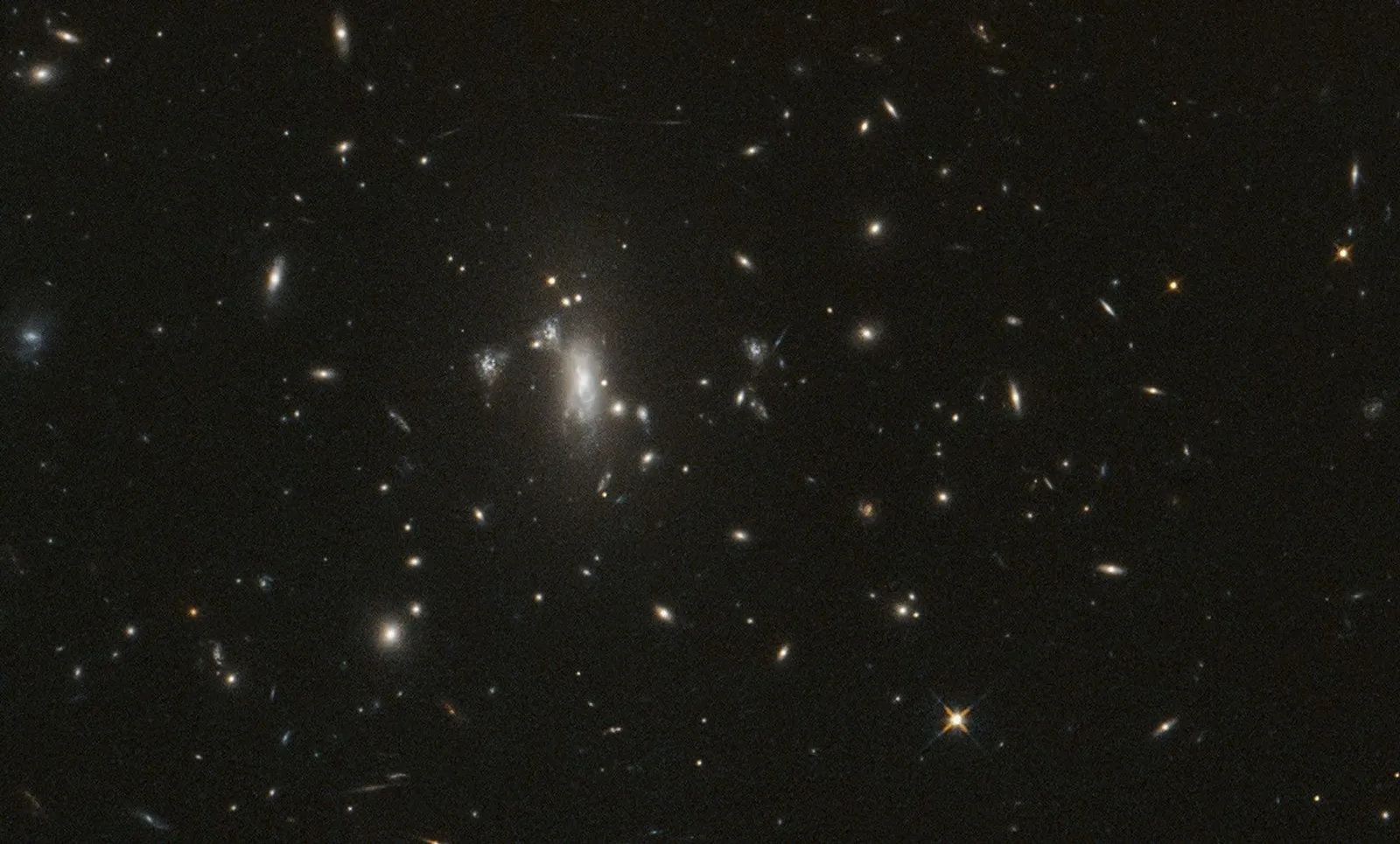
The image of galaxy cluster MACS J0417, captured by Hubble on September 19, 2026, looks at first glance like a typical deep-space photo — a swarm of faint smudges and bright points of light. But behind this frame lies a specific scientific goal: astronomers are tracking a supernova that has already vanished from view once and is expected to reappear soon.
The supernova is named Athena. It was discovered by the James Webb Space Telescope in 2025, and since then it has become an object of close scrutiny. The reason for the attention isn't the exploded star itself, but what lies between it and us.
What gravitational lensing is and why Athena disappears and reappears
MACS J0417 is a massive galaxy cluster whose combined mass is so large it warps the surrounding space. Light from objects far behind the cluster bends as it passes by — much like a beam of light refracting through a lens. This effect is called gravitational lensing.
One consequence of this warping is that light from the very same distant supernova can reach us along several different paths at once. Each path has a different length, so the light arrives with a different time delay. In practice, this makes it look as if the same supernova is flashing at different points in the sky at different moments.
That's why Athena has already disappeared from view once and, according to astronomers' predictions, should reappear sometime between now and early March 2027. Researchers continue monitoring MACS J0417 regularly specifically to catch the moment of this reappearance.
Why it matters
Precisely measuring the time delays between Athena's appearances gives researchers a rare tool: the ability to directly calculate how mass is distributed within the lensing cluster. A cluster consists not only of visible galaxies but also of a large amount of dark matter that can't be seen directly. The supernova's light delays let scientists "weigh" this invisible mass with high precision.
But the significance of this observation extends well beyond a single cluster. The same time-delay measurements allow researchers to refine the expansion rate of the universe, a value known as the Hubble constant. Different methods of measuring it today yield somewhat different results, and this discrepancy is one of the sharpest open problems in modern cosmology. Every new independent way of measuring this constant, including through lensed supernovae like Athena, helps determine whether there's a genuine problem with our models of the universe or whether the discrepancy stems from measurement inaccuracies.
Hubble's 200,000-orbit milestone
The MACS J0417 image is notable for another reason. On that same day, September 19, 2026, Hubble completed its 200,000th orbit around Earth. The telescope has been operating in orbit for more than three decades and remains one of the primary instruments for observing the distant universe, even in an era when its successor, the James Webb Space Telescope, is already at work.
Monitoring Athena is a good example of how the two space telescopes complement each other: Webb spotted the supernova thanks to its sensitivity in infrared light, while Hubble carries out the regular monitoring needed to track its repeated appearances.
The hunt for Athena continues, and the exact timing of its next flash remains unknown. But these observations are already adding data to one of the most important tasks in modern astrophysics: precisely determining how fast our universe is expanding.