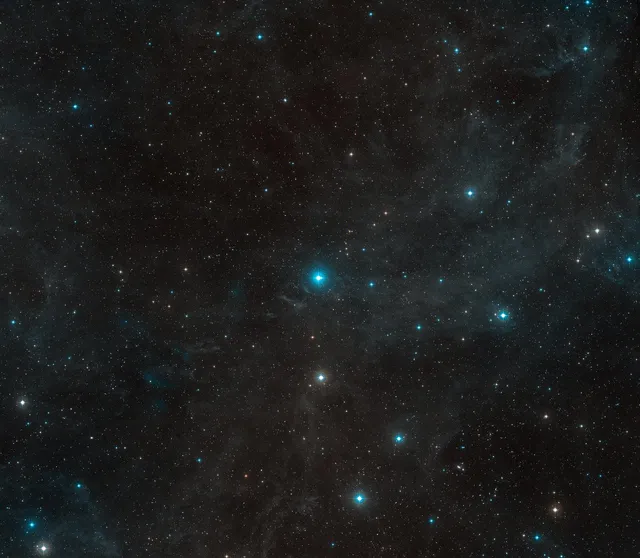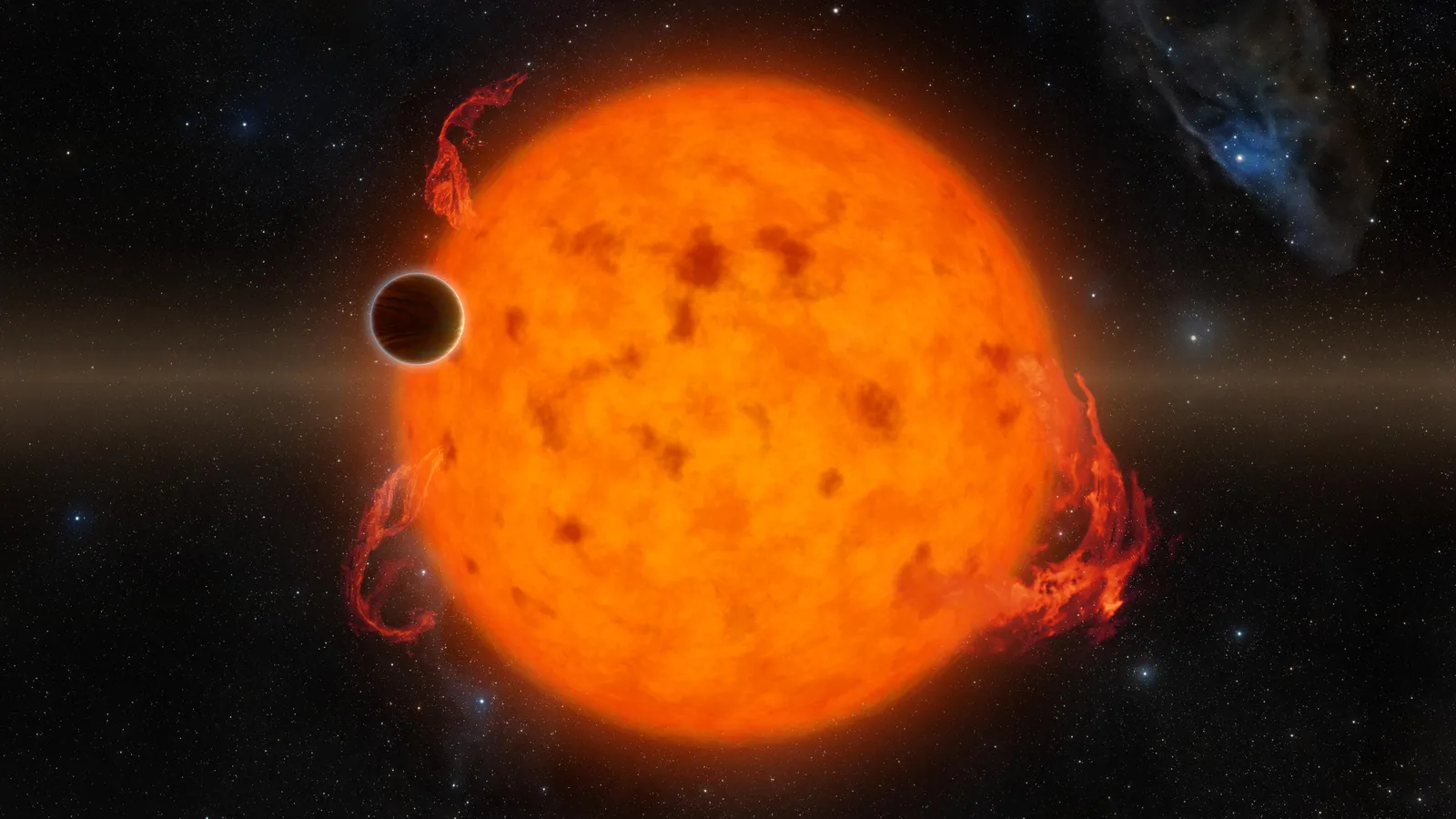
Multiplanet systems around faint stars are not unusual, but it is rare for one of the planets to be so dense that it defies expectations. That is the case with TOI-4311, an orange K-dwarf star around which an international team of astronomers has confirmed at least two planets and flagged a possible third.
The research combines data from three instruments: the TESS space telescope, which spotted the initial transit signals, the CHEOPS satellite, which refined the planetary radii, and the HARPS spectrograph, which measured masses through the Doppler shift of spectral lines in the star's light. The results are published in Monthly Notices of the Royal Astronomical Society.
Planet b: a day-long orbit and unexpected density
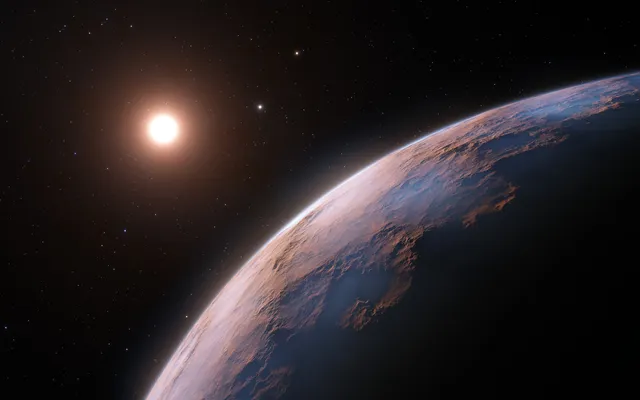
The inner planet, TOI-4311 b, belongs to the class of ultra-short-period planets, completing an orbit in under a day — specifically about 0.99 days. That places it extremely close to its star, closer than any planet in the Solar System sits to the Sun.
In size, planet b is only slightly larger than Earth, with a radius of 1.376 Earth radii. But its mass turned out disproportionately large: 4.5 Earth masses. That combination of radius and mass points to a high average density, well above what would be expected for a planet of that size.
This density is the central intrigue of the discovery. The researchers modeled the planet's internal structure using its precisely measured radius and mass, and concluded that the object is too dense given the chemical composition of its host star.
Planet c: confirmed with two observatories
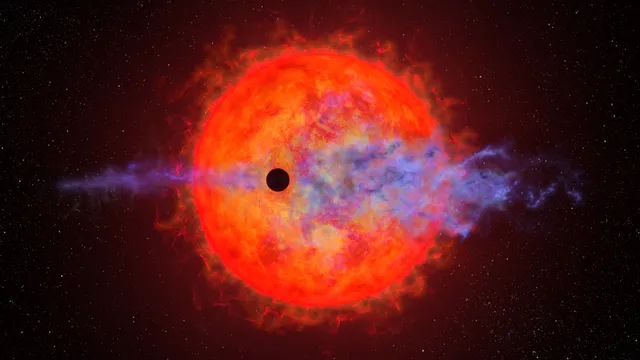
The second planet, TOI-4311 c, was first spotted by TESS through the transit method — the periodic dimming a planet causes as it crosses the face of its star. Its orbital period is roughly 15 days, and its radius is 2.47 Earth radii, placing it in the sub-Neptune class, planets intermediate in size between Earth and Neptune.
To refine its parameters, the team brought in CHEOPS, a European Space Agency satellite built specifically for high-precision radius measurements of already-known exoplanets. The HARPS spectrograph, mounted on ESO's 3.6-metre telescope at La Silla, added radial-velocity measurements of the star that confirmed the planetary nature of object c and helped separate its gravitational signal from that of planet b.
A third signal without a transit
In the HARPS data, the researchers found another periodic signal that could not be explained by the star's own activity, such as spots or rotation. This signal corresponds to a hypothetical planet with a period of about 38 days and a minimum mass of roughly 26.4 Earth masses.
No transit has been found for this candidate so far — possibly because its orbital geometry does not align it to pass directly between the star and observers on Earth. Its status therefore remains unconfirmed.
The authors also ran a separate dynamical stability analysis and found that such a hypothetical outer planet could exist on a stable orbit without disrupting the inner pair.
Stellar kinematics and a challenge to formation theories
The key argument in the study concerns not just planet b itself, but where TOI-4311 sits within the Milky Way. The star's orbit places it kinematically between the Galactic thick disc and the so-called Hercules stream, a group of stars sharing a common motion.
Given the host star's chemistry and kinematics, such a density is not expected.From the study by Yoshi Eschen's team, MNRAS
The density of rocky planets is usually tied to the chemical makeup of the protoplanetary disc they formed from, which in turn depends on the chemical enrichment of the part of the galaxy where the star was born. If TOI-4311 formed in an environment with a particular mix of heavy elements, its planets would be expected to show a predictable, moderate density.
Instead, planet b turned out denser than current planet-formation models allow. This may indicate that the mechanisms shaping rocky planets vary more strongly across the Galaxy than previously assumed, or that TOI-4311's system experienced atypical formation or evolutionary conditions.