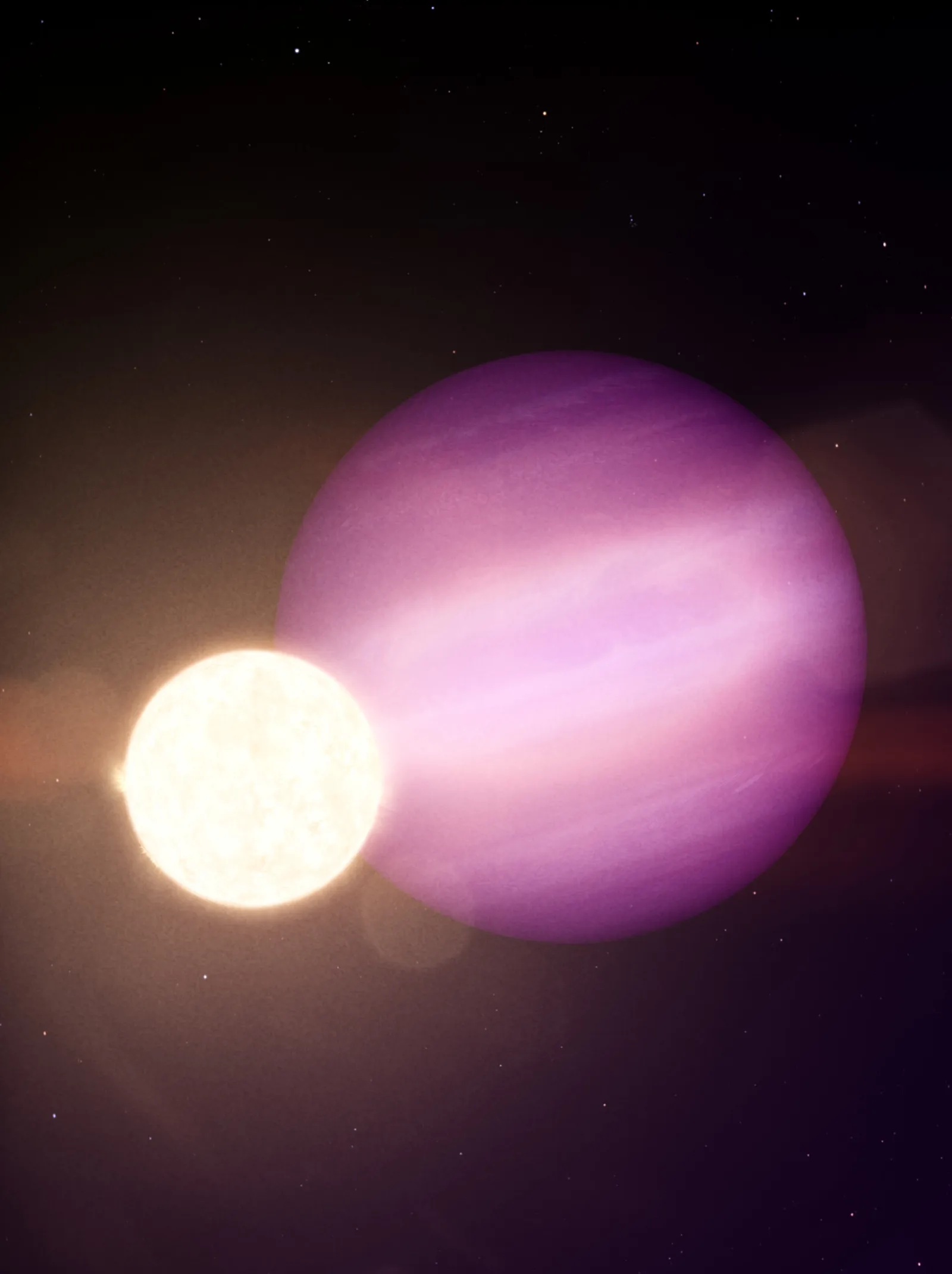
White dwarfs are what the Sun itself will eventually become. Stars with masses similar to the Sun shed their outer layers at the end of their lives, first swelling into red giants, then leaving behind a hot, dense remnant roughly the size of Earth. For a long time it seemed unlikely that planets could survive this transition intact — the red giant phase is destructive enough to engulf or strip nearby worlds. WD 1856 b showed otherwise: a gas giant that survived its star's transformation and still orbits the white dwarf today.
Now the James Webb telescope has looked into this planet's atmosphere. It is the first atmospheric detection for a white dwarf planet, and one of the most evolved systems of its kind studied so far — until now, atmospheric detections in transiting planets had only reached stars in the subgiant stage, not yet fully evolved into white dwarfs.
A planet that outlived its star
WD 1856 b orbits its white dwarf host on an extremely tight orbit, with a radius of just 0.02 astronomical units — several times closer than Mercury is to the Sun. The planet's mass is estimated at 4.3 to 10.9 Jupiter masses, placing it firmly among gas giants.
The very existence of such a planet next to a white dwarf is puzzling. When the star swelled into a red giant, its outer layers would have extended far beyond the planet's current orbit. That implies WD 1856 b once orbited much farther out and migrated inward only after the star had already become a white dwarf remnant.
Reading an atmosphere through starlight
The method behind the discovery is transmission spectroscopy. As a planet passes in front of its star, some starlight filters through the planet's atmosphere before reaching the telescope, and specific wavelengths get absorbed by gases and aerosols along the way. Analyzing which wavelengths are missing reveals what the atmosphere is made of.
The observations were carried out with Webb's NIRSpec PRISM instrument, covering wavelengths from 0.5 to 5 micrometres. That wide range allowed researchers to pick up signals from several molecules at once, along with thermal emission from the planet itself.
Methane and a haze of aerosols
The spectrum revealed hydrocarbons with high statistical confidence, with odds ratios ranging from 167:1 to 5,377:1. Among possible compounds, methane (CH₄) emerged as the most likely candidate, favored with odds of 17:1 to 30:1 over alternatives. Its abundance in the atmosphere is estimated at roughly 7%, pointing to a carbon-enriched atmosphere.
Beyond methane, the data also showed signs of aerosols — small suspended particles forming a haze, similar to hazes seen in some atmospheres within the Solar System. Finally, the observations captured thermal emission from the planet's nightside, the hemisphere never facing the star, detected with extraordinarily high statistical significance.
A planet reheated
The most striking result concerns temperature. Based on the planet's distance from its star and the star's brightness, the expected equilibrium temperature should be around 160 kelvin. Instead, the observed effective temperature came out significantly higher, between 390 and 412 kelvin.
The research team proposes an explanation: the planet went through a reheating event tied to its migration onto the current tight orbit. According to white dwarf cooling models, this likely happened 3.0 to 5.5 billion years after the star became a white dwarf. That timeline fits with tidal evolution — the gradual inward drift of a planet driven by tidal forces, occurring well after the star's active life had already ended.
Together, these findings offer a rare glimpse of a gas giant that not only survived its star's death but then changed orbits within its new surroundings. For the planets of the Solar System, it is an early sketch of a possible future — what may eventually happen to gas giants once the Sun itself becomes a white dwarf.