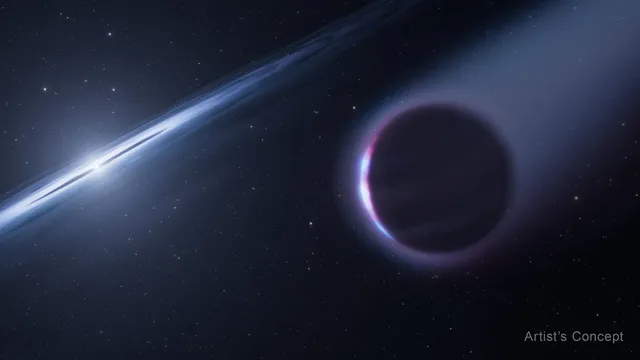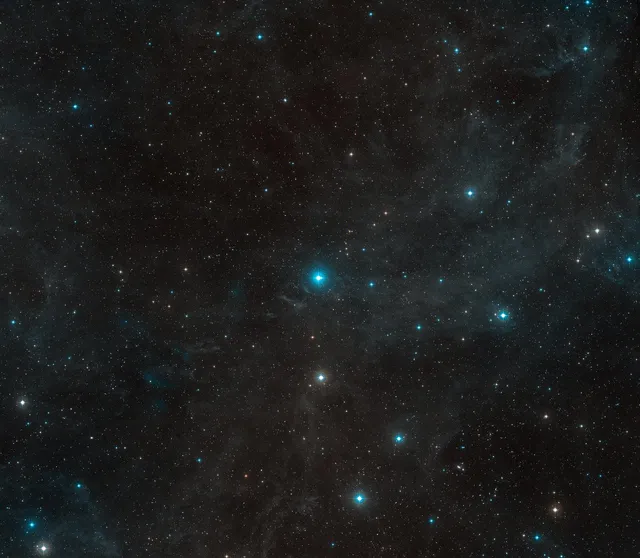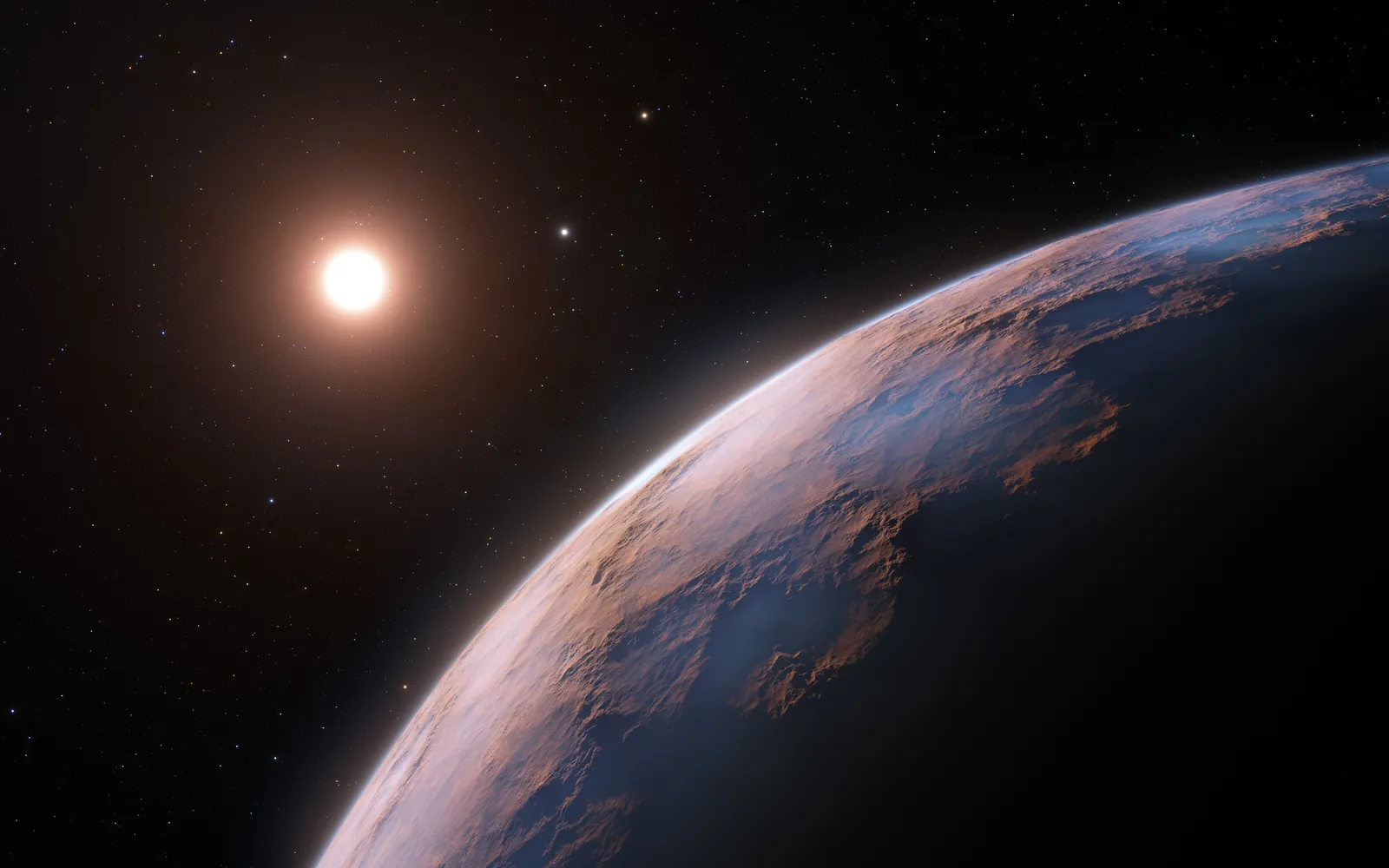
Proxima Centauri is a red dwarf star just 4.2 light-years from Earth, our nearest stellar neighbor. It is much smaller and cooler than the Sun, yet at least three planets orbit it, including two with masses comparable to Earth and Mars. A new study based on high-precision optical observations shows that these planets do more than simply orbit the star — they magnetically interact with it.
The research team measured the star's own rotation period around its axis: 84.9 ± 0.6 days, along with a "half-rotation" period of 44.3 ± 0.2 days. These figures match earlier estimates and served as a baseline for comparison with the planets' orbital periods. It turned out that stellar flares, which occurred during roughly 4.8% of the observing time, were not randomly distributed.
Flares locked to Proxima d's orbit
The system's inner planet, Proxima d, has a mass close to that of Mars and orbits closest to the star. Analysis of iron absorption lines (FeI) in the star's spectrum revealed that flares are statistically phase-locked to this planet's orbital position, with a confidence level exceeding 99.8%.
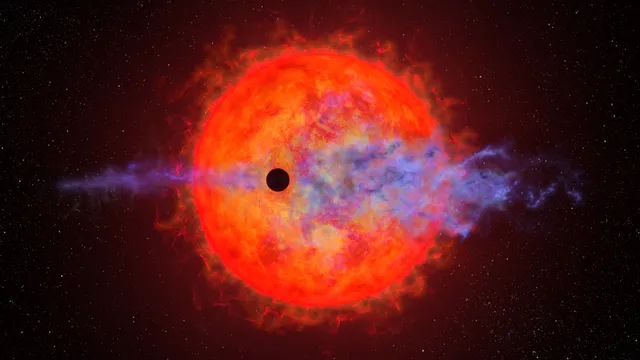
In practice, this means that when Proxima d reaches a certain point in its orbit, the likelihood of a stellar flare increases. The proposed mechanism is helicity-driven magnetic reconnection: the planet's magnetic field distorts the star's magnetic field, and the resulting stored energy is released as a flare.
The team modeled this process using the Poynting flux formalism, a framework describing energy transport by electromagnetic fields. From this model, they derived the first-ever magnetic field estimate for a terrestrial exoplanet: approximately 16 Gauss for Proxima d, assuming a Mars-sized radius.
The realistic range is much wider — from 3 to 280 Gauss — depending on whether the stellar magnetic field is modeled as radial or dipolar, and on whether the planet's radius is closer to that of Mars or Earth. For comparison, Earth's own magnetic field is only about 0.5 Gauss, meaning even the lower bound for Proxima d exceeds Earth's field several times over.
Proxima b alters flare intensity, not timing
The outer planet, Proxima b, has a mass close to Earth's and orbits farther from the star. Its interaction with Proxima Centauri looks different: there is no clear clustering of flares tied to its orbital phase. Instead, the intensity of the flares themselves changes depending on where the planet sits in its orbit.
Researchers reached this conclusion by applying a prewhitening analysis — sequentially removing dominant periodic signals — to the combined time series of chromospheric lines: Halpha, NaI D1 and D2, and CaII H and K. The analysis revealed a sequence of clear peaks: first at half the stellar rotation period, then at Proxima b's orbital period, followed by the full stellar rotation period, and finally at Proxima d's orbital period.
This set of signals suggests that both planets, b and d, show magnetic interaction with their host star, albeit of different kinds.
Star and planets rotate the same way
The team separately examined periods when the star was actively flaring. The periodogram of chromospheric lines during these episodes showed a peak matching the synodic period between half the stellar rotation and the mutual synodic period of Proxima b and Proxima d (a synodic period is the time between repeating configurations of two bodies moving at different rates).
This agreement indicates that the star rotates in the same direction as both planets orbit — a prograde configuration. The result helps refine the architecture of the whole planetary system and offers additional confirmation that the observed signals stem from genuine star-planet magnetic interaction rather than random noise.
The study offers a first example of how flare detection and chromospheric activity monitoring can be used to estimate the magnetic fields of terrestrial exoplanets — a parameter that cannot yet be measured directly.