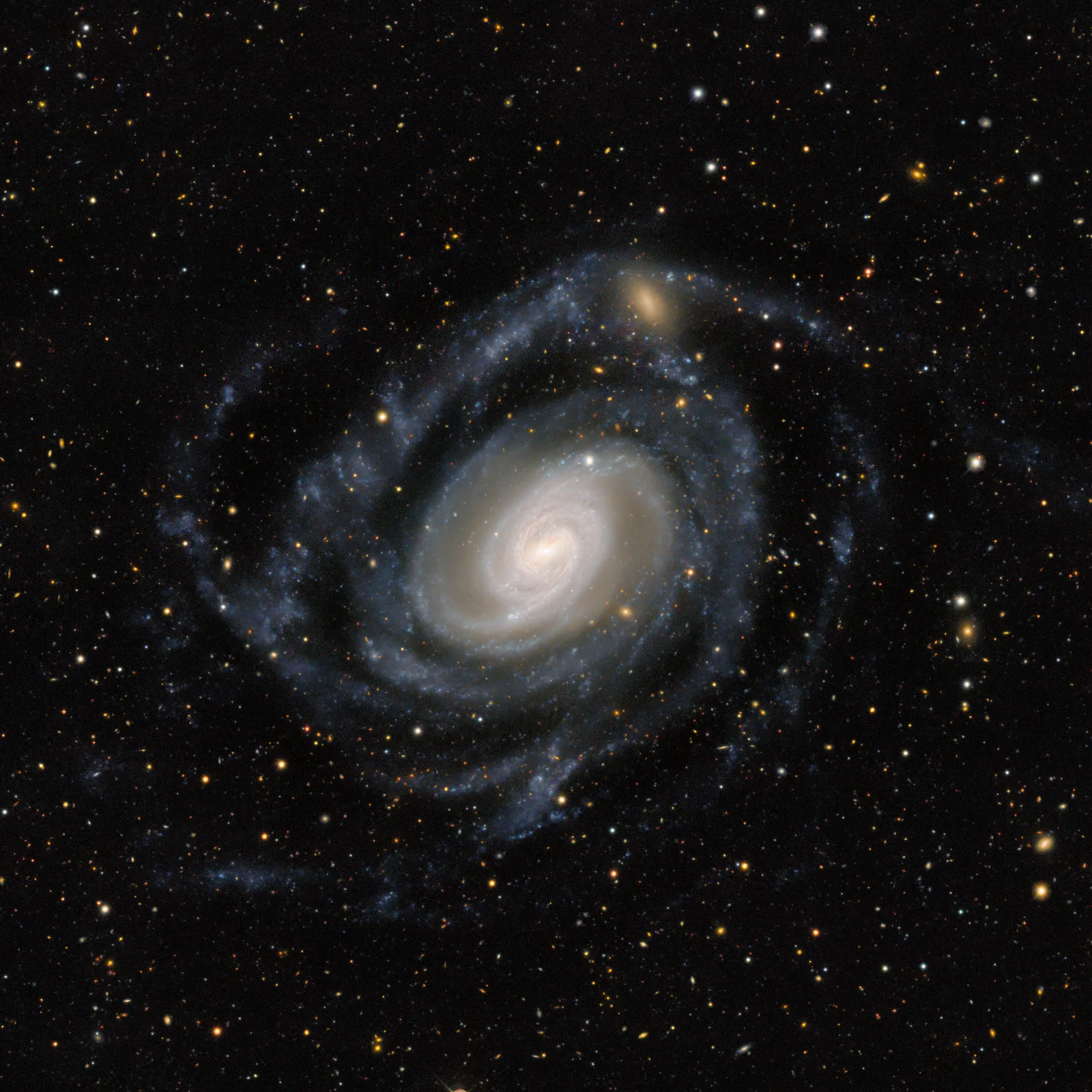
Our best model of the Universe doesn't match reality. Not somewhere at the edge of the visible cosmos — but in the hearts of the most ordinary small galaxies. The computer says one thing, the telescope stubbornly shows another, and it's been this way for thirty years. One of them is wrong — and which one it is determines what 85% of the matter in the Universe is made of.
We know almost nothing about dark matter — but we can predict how it should be distributed. Simulations of cold dark matter give a clear answer: density must rise sharply toward the center of every halo, forming a so-called cusp — a peak where density grows inversely with distance from the center. This isn't an assumption but a direct consequence of gravity: the famous Navarro–Frenk–White profile showed in 1996 that cusps form in halos of any mass.
Now the observations. The best testing ground is dwarf galaxies: dark matter makes up to 99% of their mass, and there are so few stars they barely interfere. Rotation curves of such galaxies have been measured dozens of times, and the result is consistent: no cusp. Instead there's a "core" — a plateau of nearly constant density. Simulations say "peak," telescopes say "shelf." This is the cusp-core problem, one of cosmology's oldest unsolved puzzles.
There are explanations, and both are intriguing. First: bursts of star formation. Supernovae repeatedly blow gas out of the galactic center, the gravitational potential "trembles" — and over billions of years this rocking pushes dark matter outward, turning the cusp into a core. The second explanation is bolder: the cusp vanishes because dark matter isn't a simple "cold" particle. If its particles occasionally collide with each other, the halo's center heats up and smooths itself out. And if the particle is ultralight, it behaves like a wave thousands of light-years long — a cusp becomes impossible in principle, blurred away by quantum mechanics.
So the rotation curve of an unremarkable dwarf galaxy may turn out to be a measurement of the properties of an elementary particle no collider has ever seen. The answer about the microworld may come from telescopes first.