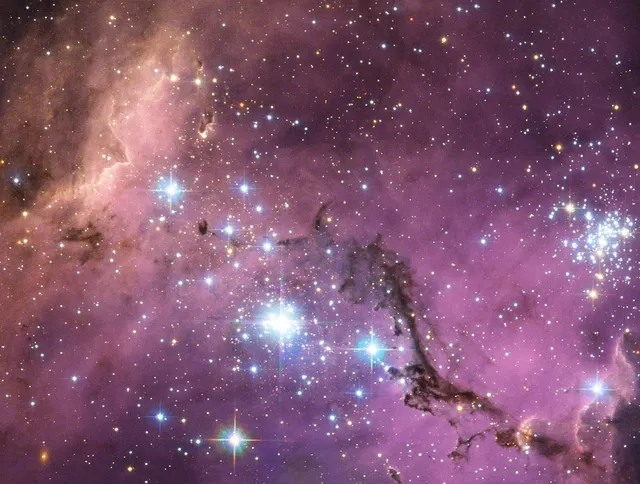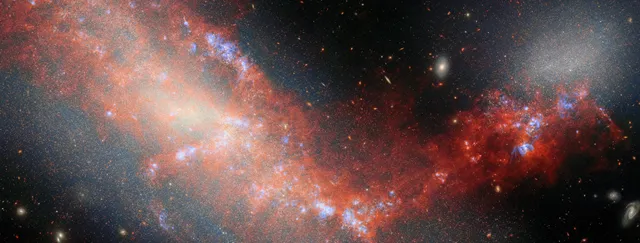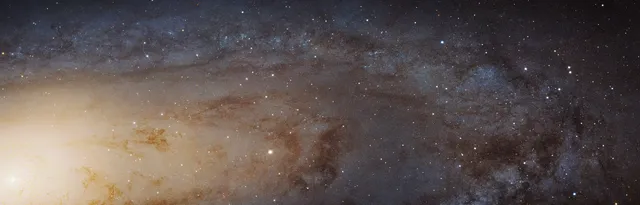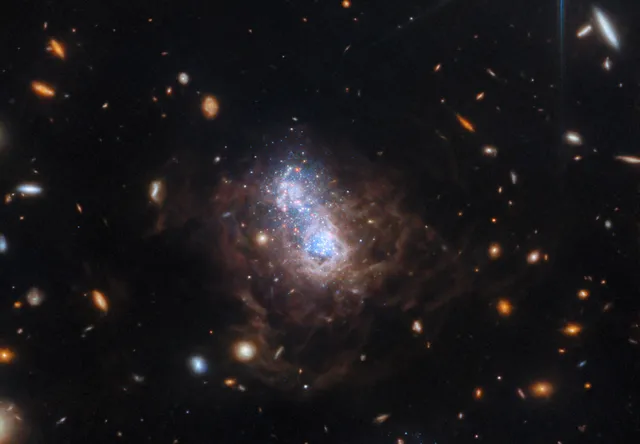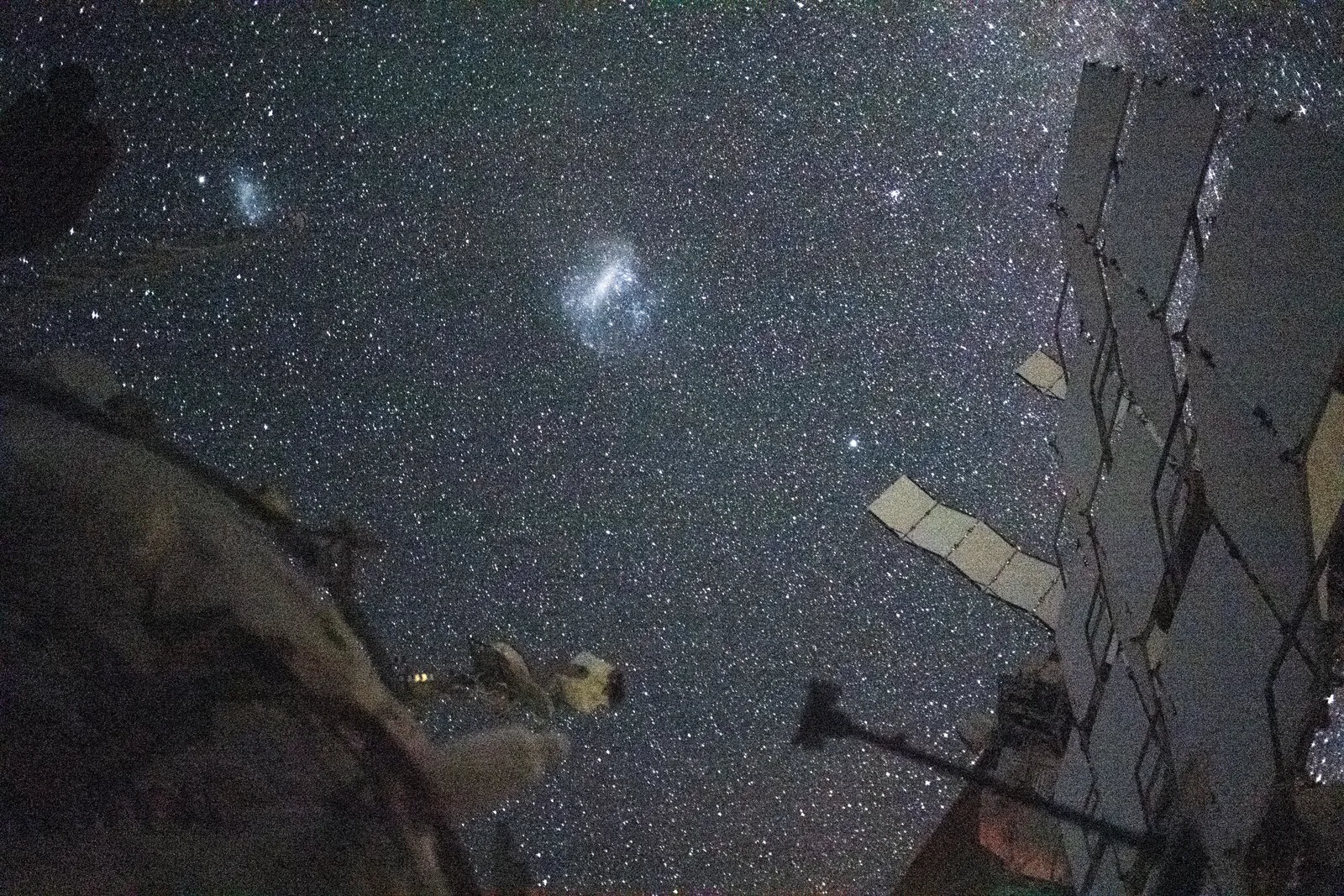
The Large Magellanic Cloud is the largest satellite of the Milky Way, visible to the naked eye in the Southern Hemisphere as a hazy patch of light. For a long time it was treated as a scenic but passive feature of our galactic neighborhood. New data tell a different story: this dwarf galaxy is massive enough to physically shift our home galaxy during its recent close passage.
This is not a figure of speech. When a massive body sweeps through the outer layers of a galaxy, it drags the galaxy's center of mass along with it, while stars in the far outskirts keep moving as if nothing happened. The difference between these two motions is called reflex motion — and astronomers have now measured it directly, using the kinematics of stars in the Milky Way's outer stellar halo.
The outer halo as a witness to the encounter
The outer stellar halo is a sparse sphere of old stars surrounding the Milky Way's disk, extending tens of thousands of light-years outward. This is where the effects of gravitational interaction with the Magellanic Cloud should be most visible, since these stars move slowly and retain a memory of any disturbance.
Researchers combined data from three major sky surveys — H3, SEGUE, and MagE — covering stars out to 160,000 light-years from the Galactic center. For each star, what matters is not position but velocity: radial (along the line of sight) and tangential (across it).
The statistics of these velocities — their means and spreads (dispersions) — became the input for the model. By comparing the observed velocity pattern with predictions from simulations, researchers could reconstruct how strongly, and in which direction, the Galaxy's center of mass had shifted.
32,000 simulations and a neural network for inference
To turn observed velocities into concrete numbers, the team built 32,000 simulations of the Milky Way–LMC pair. In each one, the Galaxy's stellar halo evolved under the combined gravity of both systems up to the present day.
To analyze this large set of models, the researchers used Simulation Based Inference — training a neural network to recognize which combination of parameters (galaxy masses, reflex velocity, orbital anisotropy) corresponds to a given pattern of stellar velocities.
The result: the Milky Way's center of mass is moving, relative to halo stars at 100,000 light-years, at 38.6 (+8.3/−7.8) km/s. This is the direct measurement of reflex motion — evidence that the Galaxy has not yet settled after its encounter with a massive companion.
Refined masses, and equilibrium in question
A secondary but equally important result concerns the masses of both galaxies. Within 50,000 light-years of the center, the Milky Way's mass comes out to 3.36 ± 0.15 × 10¹¹ solar masses, while the LMC's mass within the same radius is 8.76 (+1.94/−1.77) × 10¹⁰ solar masses.
This implies the LMC's total mass must be at least about 20% of the Milky Way's — far more than a passive decoration in the night sky.
Separately, the team constrained the velocity anisotropy of the stellar halo before the LMC's infall: β₀ = 0.68 ± 0.02. This parameter shows how stretched (radial) stellar orbits in the halo are compared to circular ones, giving a "before" baseline against which the current, disturbed state can be measured.
The authors also showed that models ignoring the LMC systematically overestimate the Milky Way's mass. This means many earlier mass measurements of the Galaxy need to be revisited with this companion taken into account.
The main takeaway goes beyond the specific numbers. The Milky Way has long been treated as a system near dynamical equilibrium — a convenient simplification for models. It is now clear that we live in a galaxy still recovering from a gravitational encounter with a massive satellite, a fact that future estimates of its mass, structure, and history will need to account for.