The Milky Way's stellar halo works like an archive. Stars captured during the disruption of smaller galaxies keep a chemical signature of their origin and move along orbits that betray their foreign birthplace. The trouble is reading that archive directly: the mass and infall time of a progenitor galaxy aren't written down anywhere, they have to be reconstructed from indirect traces.
A new study tackles this with a statistical, simulation-driven approach. Rather than fitting bespoke models to each stellar stream, the authors trained an algorithm on artificial galaxies and then applied it to real data from our own Galaxy.
Training an algorithm on synthetic mergers
At the core of the method are normalizing flows, a class of machine-learning models built to estimate probability distributions of complex data. They were trained on the Auriga suite — a set of cosmological simulations of Milky Way-like galaxies.
In each simulation, everything is known: which galaxy merged with which, when it happened, how much stellar mass and dark matter the progenitor system carried. The algorithm learned to connect the chemical composition and kinematics (motion patterns) of stellar debris to these merger parameters.
Once trained, the model was applied to real Milky Way stars — those already confidently assigned, by chemistry and orbit, to known accretion streams. The output isn't a single number but a probability distribution: infall time, progenitor stellar mass, halo mass ratio at the time of merging.
Eight progenitors and a mass that vanished into the halo
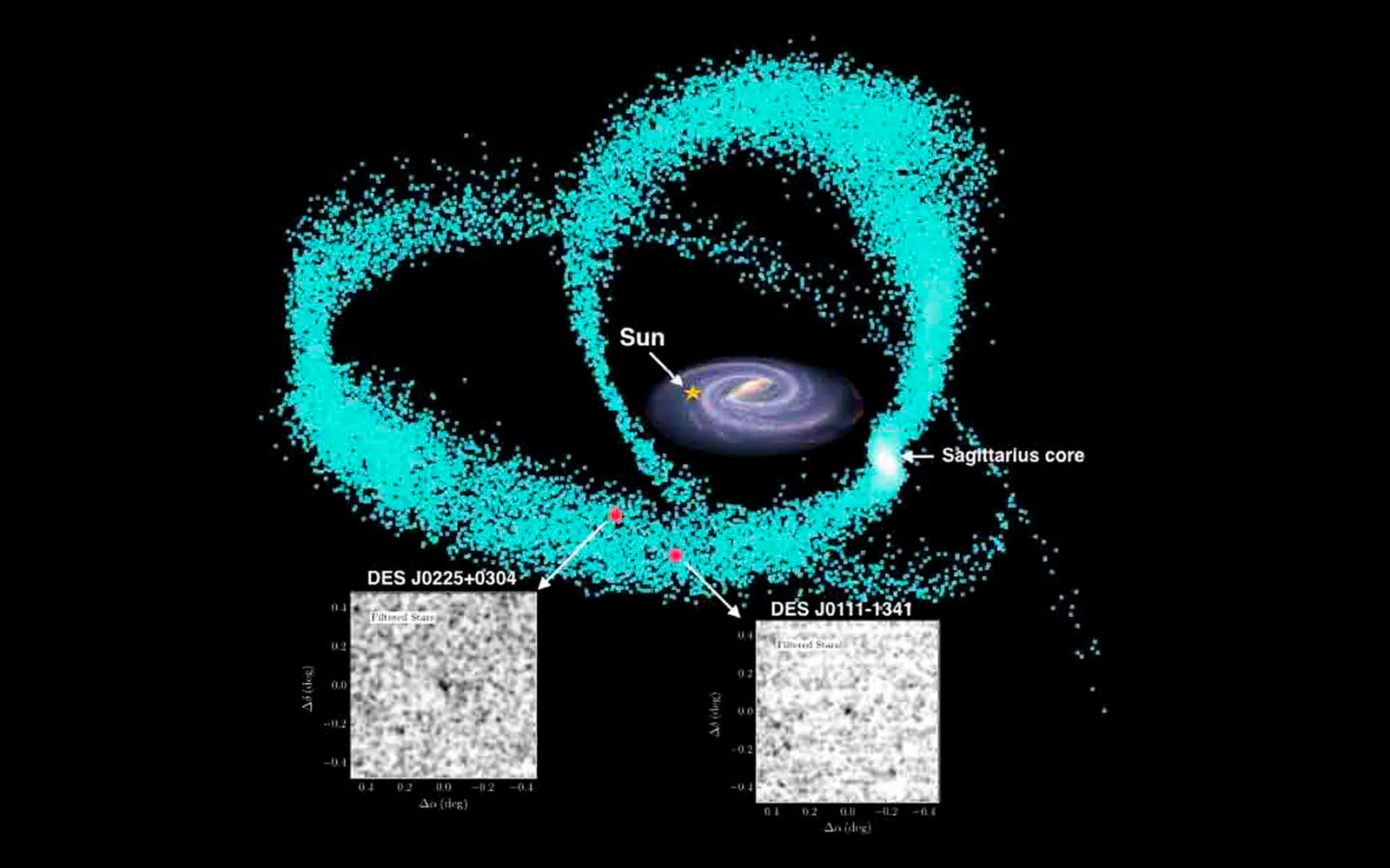
The method recovered the parameters of eight known accretion events: Gaia-Enceladus-Sausage, the Helmi streams, Heracles, I'itoi, LMS-1/Wukong, Sagittarius, Sequoia, and Thamnos. The inferred infall times and masses broadly agree with earlier estimates, as does the expected relationship between progenitor mass and the metallicity (heavy-element content) of its debris across different redshifts.
The combined stellar mass accreted through these eight mergers comes out at 2.2 × 10⁹ solar masses, with uncertainty spanning roughly 1.6 to 3.3 billion. Gaia-Enceladus-Sausage and Sagittarius contribute the most — consistent with their standing as the two most significant mergers in the Galaxy's history.
Separately, the study estimates the stellar mass locked in fully disrupted progenitors — dwarf galaxies whose debris has mixed so thoroughly with the rest of the halo that it can no longer be traced to a single event. That dissolved mass adds up to another 1.3 × 10⁹ solar masses, consistent with prior measurements of this halo component.
For the Milky Way's halo mass itself, the authors offer a snapshot at one specific moment: after the Sagittarius merger but before the infall of the Magellanic Clouds. That mass is estimated at 5.9 × 10¹¹ solar masses.
A gap between the first merger and z ≈ 2
The most intriguing result concerns not a single merger but the overall mass budget. The authors tracked how the Galaxy's halo mass grew from the time of its first known merger (redshift z ≈ 5) to the epoch z ≈ 2.
The mass gained over that interval turns out to exceed the combined mass of all known progenitors accreted during the same period. The difference can't be accounted for by any of the eight documented events.
The simplest explanation is that unidentified structures merged with the Milky Way early in its history, leaving traces too faint or too blended to isolate with current methods. This isn't the first hint that the early Milky Way formed more chaotically than a tidy list of eight names suggests, but quantifying the gap gives that picture a concrete number to work with.
What this means for the search ahead
The study shows that simulation-based inference can deliver more than a qualitative label like "this star is foreign" — it yields quantitative estimates of merger mass and timing with defined uncertainty ranges. That matters, because classical reconstruction methods often rely on simplified assumptions about orbits and chemical evolution.
The mass gap identified here points to where to look next: if traces of one or more additional mergers are hiding in the halo, they're likely among stars with intermediate properties that don't yet fit neatly into any of the eight known streams.