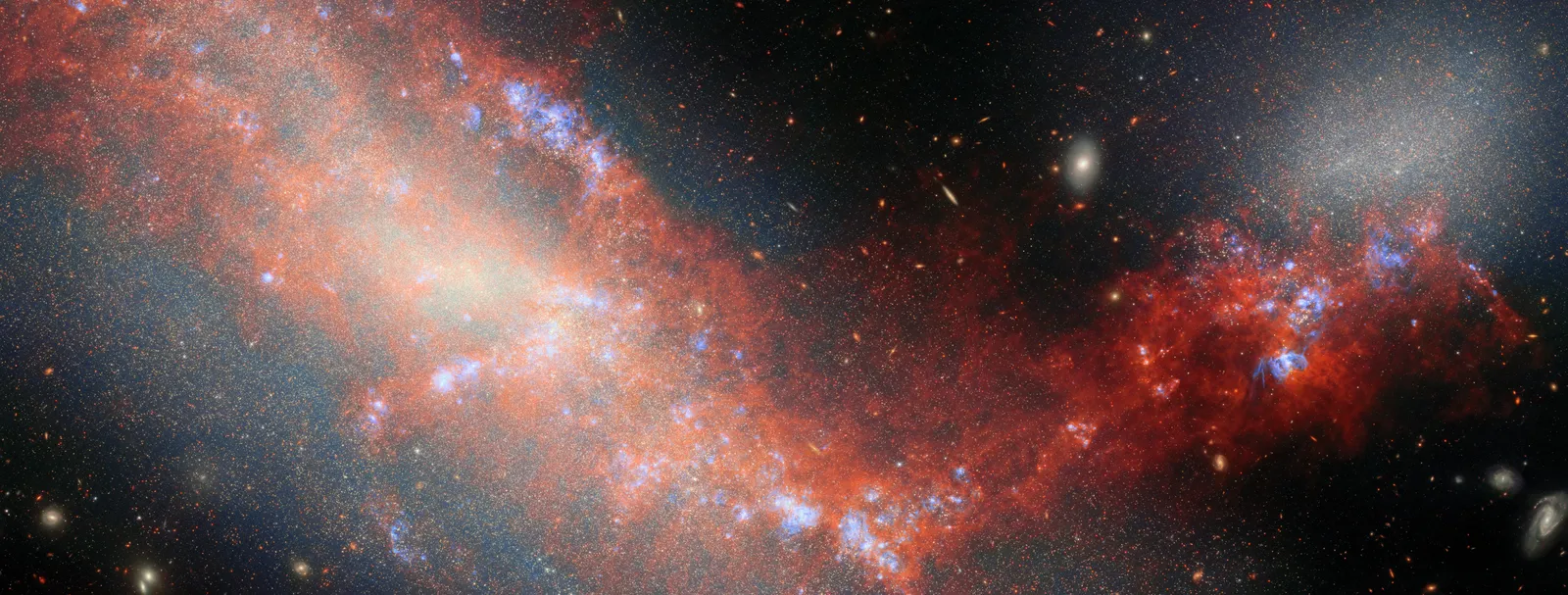
Dozens of tiny satellite galaxies orbit the Milky Way, known to astronomers as ultra-faint dwarfs (UFDs). Some contain only a few thousand stars, yet their total mass exceeds the visible matter by hundreds or even thousands of times. That gap is filled by dark matter, which is why ultra-faint dwarfs are considered among the cleanest laboratories for testing its properties.
A new study by Moritz S. Fischer and Hai-Bo Yu, published in the Cosmology and Nongalactic Astrophysics section of arXiv, tests one specific hypothesis: what happens to dark matter if, besides gravity, its particles also occasionally collide with one another.
SIDM and the feedback loop inside a halo
The standard cosmological model treats dark matter as "cold" and collisionless — particles interact with each other only through gravity. An alternative model, self-interacting dark matter (SIDM), adds another channel of interaction: direct scattering between particles, similar to collisions between molecules in a gas.
The consequences unfold in two stages. Initially, collisions transfer energy from the outer parts of the halo (the region where dark matter is concentrated) toward the center, causing the core to expand and become less dense. But this process does not continue indefinitely: once the central region loses enough heat, it begins to contract under its own gravity, heats up further, and contracts again.
The authors call this self-reinforcing cycle gravothermal collapse, drawing on an analogy with the gravothermal catastrophe known from the physics of star clusters. As a result, the central dark matter density can keep rising without bound, rather than staying constant as the standard model predicts.
Simulations tested against real Milky Way satellites
To check whether this picture matches reality, the researchers ran high-resolution N-body simulations (computer models in which the motion of millions of simulated particles reproduces the behavior of a halo) of a Milky Way-like system under the SIDM model. They then compared the properties of the simulated satellites to real measurements — the dark matter distribution properties inferred from stellar kinematics (the motion of stars within a galaxy).
The result: the diversity of dark matter densities observed among Milky Way satellites matches well what gravothermal evolution under SIDM predicts. Most of the studied dwarfs show high central densities — a sign that their halos have already passed the phase of maximum core expansion and entered the collapse phase.
The depth to which different halos have "fallen" into collapse varies substantially from one galaxy to another. According to the authors, this variation is exactly what explains the observed diversity in densities: some satellites are still in the early stages of contraction, while others have progressed much further.
Tidal stripping as a collapse accelerator
The researchers found an additional, independent argument supporting the model. Satellites that pass closer to the Milky Way's center during their orbit experience stronger tidal stripping — the gravitational "peeling away" of a halo's outer layers caused by the host galaxy's tidal forces.
It turns out that galaxies with smaller pericentre distances (their closest approach to the Milky Way's center) show the highest central dark matter densities. This fits the model's logic: tidal stripping accelerates gravothermal evolution, pushing halos further into collapse.
The authors estimate that the observed densities are consistent with a fairly large self-interaction cross-section — around 80 cm²/g at a velocity of about 20 km/s. This is a relatively strong interaction by the standards of SIDM models, and according to the researchers' calculations, it is what's needed to reproduce the observed pattern for most of the Milky Way's ultra-faint dwarfs.
If these findings hold up under further observations and more precise measurements of stellar kinematics in dwarf galaxies, they would become one of the most concrete pieces of evidence that dark matter is not merely passive mass, but a substance with its own inner dynamics, capable of interacting with itself.