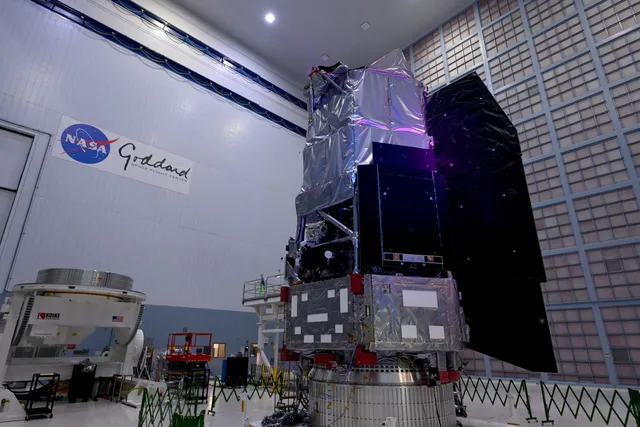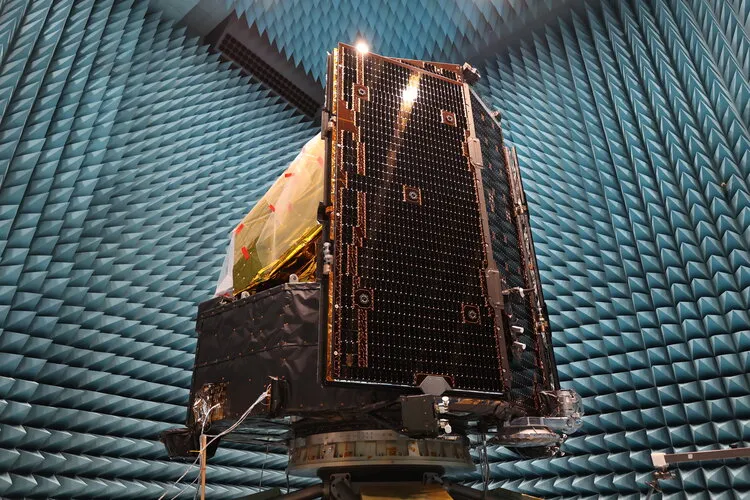
The European Space Agency's Plato space telescope has passed another milestone test ahead of launch. Designed to search for Earth-like planets beyond the Solar System, the spacecraft must prove it can withstand the conditions of space before it ever leaves the ground. This time, the test wasn't about mechanical stress or temperature swings, but about how its electronics behave.
The testing took place in the Maxwell Test Chamber at ESA's ESTEC centre in the Netherlands. This specialised facility recreates the electromagnetic isolation of space, a condition that cannot be fully replicated in an ordinary lab. The result: all of Plato's electronic systems work together without interfering with each other.
A 9-metre Faraday cage
The Maxwell chamber is a shielded enclosure whose metal walls, floor, and ceiling form a Faraday cage. This structure blocks all external electromagnetic signals, so anything measured inside comes solely from the spacecraft itself.
The chamber's interior stands 9 metres high and is lined entirely with foam spikes that absorb electrical signals and sound. Combined with the metal shielding, this recreates conditions close to the void of space, where there is no atmosphere to scatter or reflect signals.
It was in this artificial replica of open space, rather than an ordinary workshop, that engineers put Plato through its paces.
Crosstalk: why it matters
Once the chamber was sealed, engineers remotely switched on Plato's equipment and operated it from outside the shielded space. The goal was to confirm that the spacecraft's complex instruments and modules do not interfere with each other or with its communication systems.
This phenomenon is known as crosstalk, when one electronic component unintentionally affects the signals of a neighbouring one. In a tightly packed spacecraft, where dozens of systems operate side by side, the risk of such interference is real.
The challenge is that in a vacuum, electronics can behave differently than they do on a standard test bench on Earth. Without testing under space-like conditions, the consequences can be unpredictable, ranging from instrument malfunctions to equipment damage once in orbit.
The tests in the Maxwell chamber confirmed that Plato's systems are electromagnetically compatible: they can all operate at once without interfering with one another.
Three exams down
The electronics test was the last major exam in the series the spacecraft had to pass before being cleared for launch. Earlier, in January, Plato underwent vibration and acoustic tests, which simulate the stresses of a rocket launch. It then spent a month inside the Large Space Simulator, where its resilience to the vacuum and temperature extremes of space was checked.
With all three major exams now complete, Plato is ready for the next stage of preparation. Its launch on an Ariane 6 rocket is planned by Arianespace for March 2027.