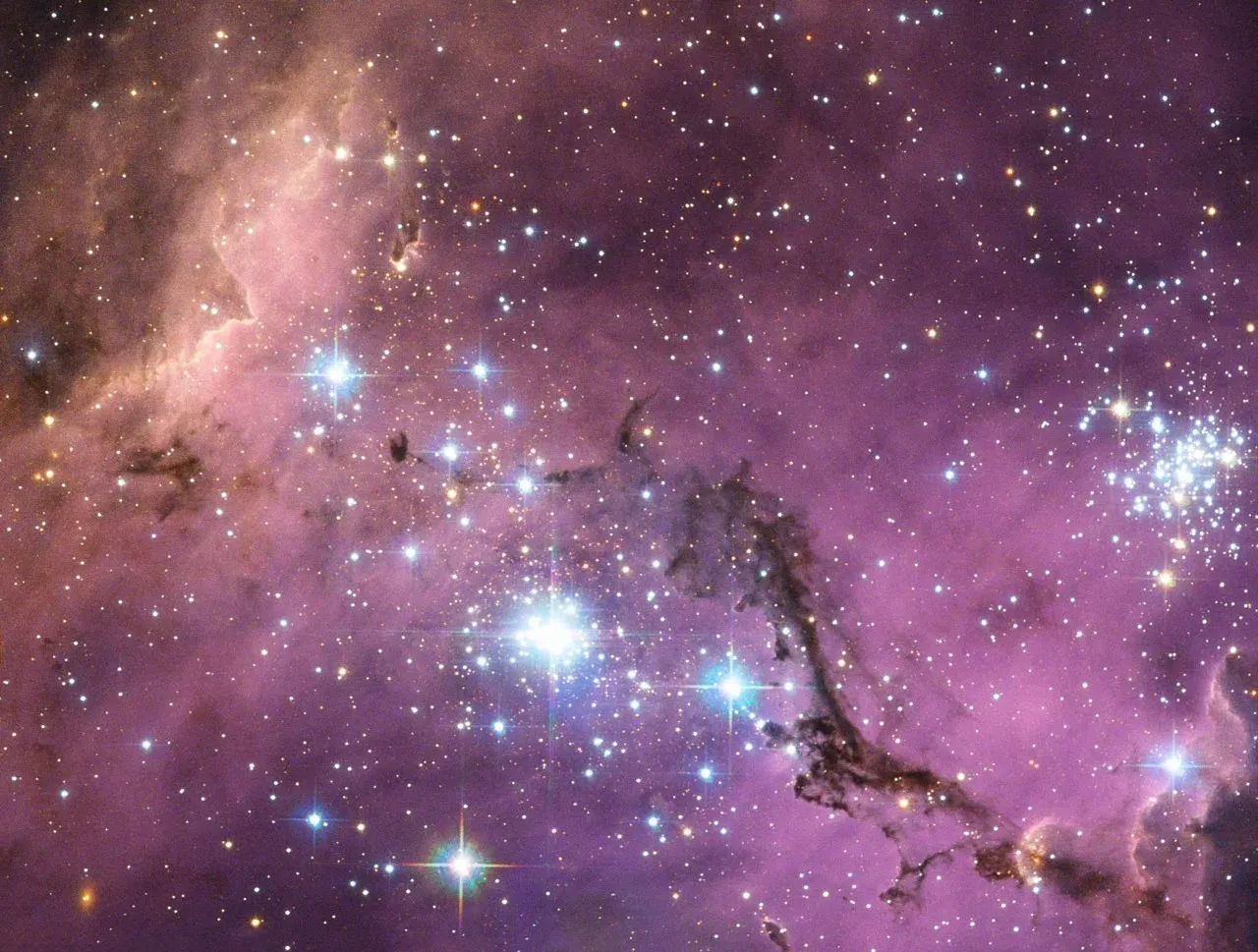
The Milky Way is not an isolated island in empty space. The galaxy is wrapped in a vast halo of diffuse gas with temperatures reaching millions of degrees — the circumgalactic medium, or CGM. This gas envelope acts as the galaxy's own atmosphere, extending far beyond the visible stellar disc and holding a large share of the baryonic matter that once could have formed stars.
This gaseous halo is far from static. It constantly exchanges material with the disc: pulling in streams of cold gas from outside, absorbing outflows from supernovae and stellar winds from within. By studying its temperature and density, astronomers effectively read the history of how the galaxy grew and evolved over billions of years.
eROSITA measures a 12% gap
The eROSITA X-ray telescope, designed to map hot gas across the universe, allowed researchers to measure the temperature of the Milky Way's CGM in detail across different directions of the sky. The result was unexpected: the southern hemisphere of the halo is, on average, hotter than the northern one.
The difference amounted to roughly 12% in temperature averaged over the entire circumgalactic medium. The number sounds modest, but for a structure of this scale — gas surrounding an entire galaxy — it is a statistically significant anomaly. It did not fit the standard picture of a smoothly cooling halo and demanded a separate explanation.
A team of researchers from several institutions — Alexandru Oprea, Filippo Fraternali, Else Starkenburg, Thor Tepper-Garcia, and Joss Bland-Hawthorn — set out to test whether the Milky Way's nearest satellites, the Large and Small Magellanic Clouds, could be responsible.
The Magellanic Clouds push the galactic disc
The researchers' hypothesis is simple to state, though demanding to calculate. The Magellanic Clouds — two dwarf satellite galaxies that have been orbiting and slowly approaching the Milky Way for billions of years — carry enough mass to gravitationally influence the entire galaxy.
This interaction does more than pull gas from the satellites toward our galaxy. It shifts the Milky Way's own disc relative to the surrounding hot halo, at velocities of up to 40 km/s. The disc effectively moves through the gas envelope that surrounds it.
The authors built a hydrodynamical model combined with an N-body simulation — a numerical calculation of gravitational interactions between bodies — to test the consequences of this shift. It turned out that the disc's motion compresses the CGM gas specifically in the southern hemisphere. And compressed gas, by basic physics, heats up.
The temperature difference produced by the model between the two hemispheres came out to 13–20%, a range consistent with the 12% value observed by eROSITA.
An asymmetry only 100 million years old
One of the study's most notable findings concerns timing. According to the authors' estimates, the thermal asymmetry began forming relatively recently — around 100 million years ago.
On galactic timescales, that is a brief moment: the Milky Way has existed for billions of years, yet the visible imprint of the Magellanic Clouds' gravitational influence on its gas halo appeared only recently. This fits with the fact that the Clouds are in a late stage of their approach to our galaxy, not yet having merged with it.
The result demonstrates that even relatively small satellite galaxies passing nearby can leave a clear, measurable mark on the hot gaseous halo of a massive spiral galaxy. The study has been accepted for publication in Monthly Notices of the Royal Astronomical Society and adds further evidence that the Milky Way and the Magellanic Clouds are locked in active gravitational interaction long before any eventual merger.