CHRONOS: a gravitational wave detector for the "blind zone" between LIGO and LISA
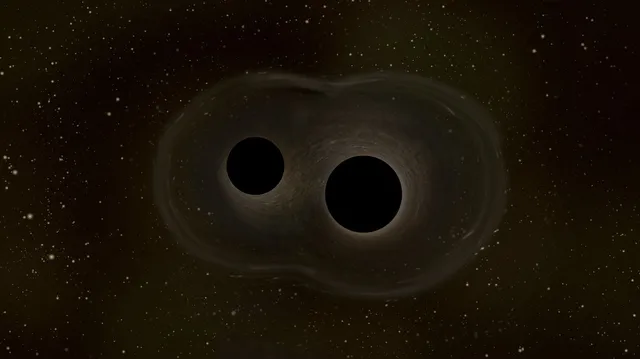
The CHRONOS collaboration has released the science case for a new ground-based gravitational-wave detector designed to bridge the frequency gap between space missions like LISA and ground interferometers such as LIGO. The instrument relies on cryogenic torsion bars cooled close to absolute zero, read out with a quantum non-demolition speed meter that lets it beat the standard quantum limit.
Operating in the 0.1–10 Hz band, CHRONOS could track compact binaries long before merger, improving source localization and tests of general relativity, while also probing the stochastic gravitational-wave background — traces of inflation, phase transitions, or cosmic strings. As a bonus, the detector could catch gravitational signals from earthquakes ahead of destructive seismic waves, useful for early-warning systems.
The PLATO telescope is being tested in space — on the ground
Europe's PLATO exoplanet telescope is undergoing final pre-launch testing inside ESA's Large Space Simulator (LSS), the continent's largest vacuum chamber, standing 15 meters tall. Engineers sealed the spacecraft inside on 18 February, and since early March it has been exposed to conditions mimicking open space, including pressure a billion times lower than at sea level.
Powerful heating elements raise the side carrying the solar panels to +160 °C, while the opposite side, holding 26 ultra-sensitive cameras and the optical bench, is cooled by circulating liquid nitrogen down to –80 °C, replicating the chill of deep space. Those cameras will eventually watch more than 150,000 stars simultaneously in search of Earth-sized worlds. Testing wraps up by the end of March, with launch on an Ariane 6 rocket planned for January 2027.
Pollux: one instrument to search for oceans and signs of life at the same time
Researchers outlined how Pollux, a spectropolarimeter candidate for the US Habitable Worlds Observatory (HWO), could investigate ocean worlds in our solar system. With high spectral resolution (R > 40,000), the instrument covers everything from hard ultraviolet (~100 nm) to near-infrared (~1.9 μm) light while also measuring polarization.
That combination would let it probe the surface composition and reflectance of moons like Europa and Enceladus, characterize their faint airglow emissions, and constrain the microphysical properties of atmospheric aerosols. The same instrument is also designed to search for biosignatures in exoplanet atmospheres, making Pollux a rare case of a single tool serving both solar-system science and the hunt for life around distant stars.
A new kind of math for detecting extraterrestrial life
A team led by Sara Walker has proposed applying Assembly Theory to the search for biosignatures in exoplanet atmospheres, a framework developed with the Habitable Worlds Observatory (HWO) in mind. The method estimates the minimum combinatorial complexity needed to build the observed mix of molecules, effectively measuring how much selection and evolution is encoded in an atmosphere's chemistry, without assuming any particular biochemistry or metabolism.
Rather than a binary alive-or-dead verdict, the approach yields a continuous complexity score that could be applied to thousands of planets at once and checked against existing spectroscopic data. The authors also plan to use it to directly inform HWO's instrument requirements, indicating which molecules the telescope needs to distinguish and at what precision.
The Habitable Worlds Observatory will be able to weigh planets
Researchers show that the future Habitable Worlds Observatory (HWO), with a 6-meter mirror, could measure the masses of about 40 Earth-sized habitable-zone planets to roughly 10% precision — the accuracy needed to unambiguously interpret an atmospheric spectrum. Mass would be inferred astrometrically, by tracking the tiny wobble a planet induces in its host star relative to background reference stars.
The main challenge is that precision is limited by the number and brightness of reference stars in the field of view, especially near the galactic poles. The authors calculate that reaching the required sensitivity would take at least 100 observations per star over a 200-day campaign in the Gaia G band, fitting within HWO's five-year prime mission and its 6-by-6-arcminute field of view.