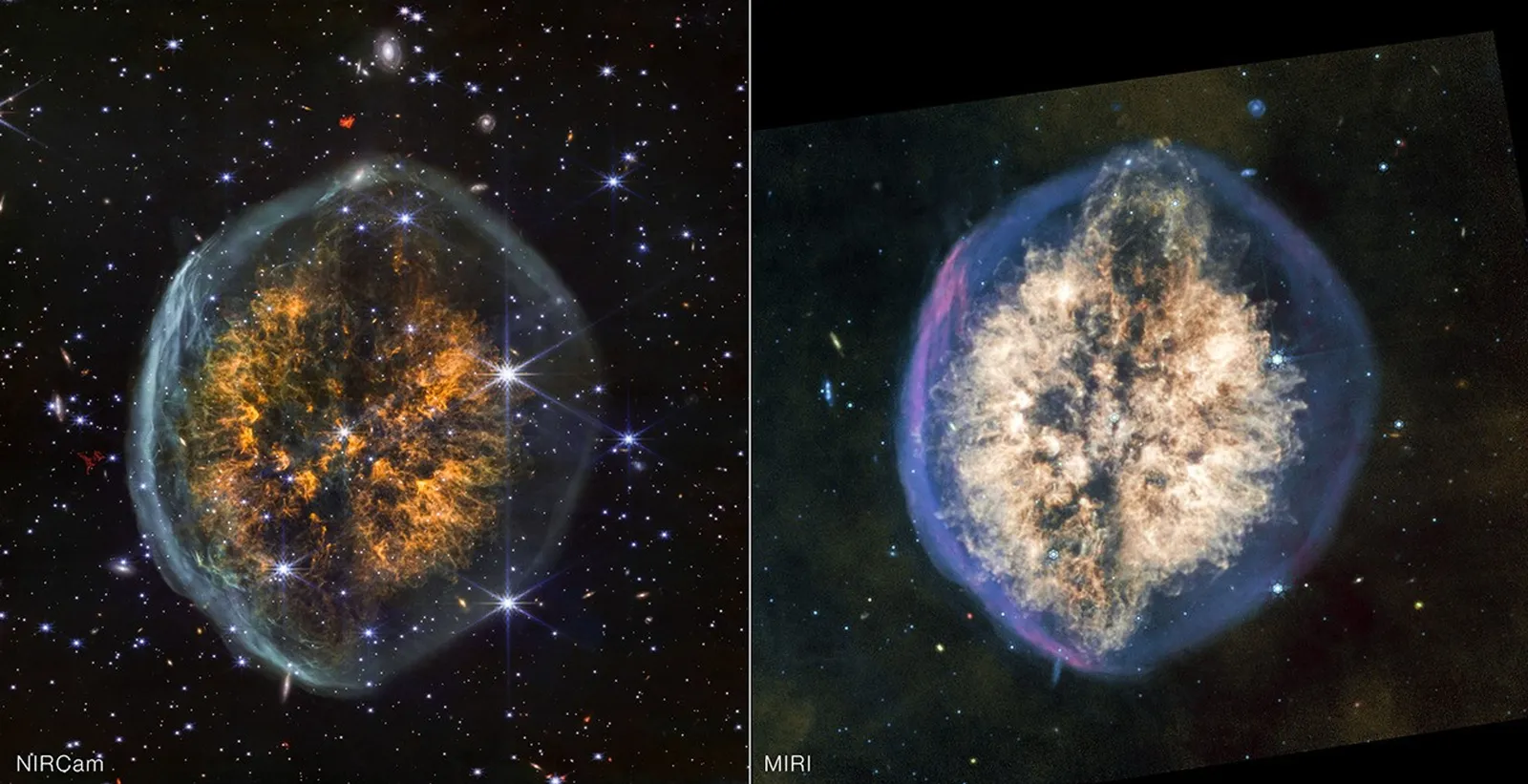
NASA's James Webb Space Telescope continues to study planetary nebulae — clouds of gas and dust that stars shed in the final stages of their lives. This time the target was PMR 1, a nebula that had received little attention until now. Its unusual appearance, resembling a brain inside a transparent skull, earned it the nickname the "Exposed Cranium" nebula.
PMR 1 was first captured in infrared light by Webb's predecessor, the now-retired Spitzer Space Telescope, more than a decade ago. Webb has now returned to this object with far more advanced instruments — NIRCam and MIRI — revealing detail that was previously hidden.
NIRCam and MIRI reveal different layers
Webb's two instruments operate in different parts of the infrared spectrum, producing distinct views of the same object.
NIRCam, the Near-Infrared Camera, lets more starlight and background galaxies shine through the nebula, visible faintly behind the gas shell.
MIRI, the Mid-Infrared Instrument, instead highlights cosmic dust, which glows more prominently in its images.
Together, the two instruments reveal a structure made up of two regions corresponding to different phases of the nebula's evolution. The outer shell, composed mostly of hydrogen, was blown off first. The inner cloud, with a more complex structure and a mix of different gases, formed later.
A dark lane splits the nebula into two hemispheres
Both NIRCam and MIRI capture the same striking feature — a dark lane running vertically through the center of the nebula. It divides the cloud into two sections resembling brain hemispheres, reinforcing the skull-like look.
Webb's resolution suggests this lane could be linked to an outburst or outflow from the central star. Such ejections typically occur as twin jets bursting out in opposite directions.
This is especially visible at the top of the nebula in the MIRI image, where the inner gas appears to be pushed outward.
Supernova or white dwarf — the star's fate
Much about this nebula remains to be understood, but one thing is already clear: it is being shaped by a star nearing the end of its fuel-burning life. In their final stages, stars expel their outer layers in a process that is dynamic and, by cosmic standards, fairly fast.
Webb has captured only a single moment in this star's long decline. What happens next depends on the star's mass, which astronomers have yet to determine.
If the star is massive enough, it will end in a supernova explosion. If it is closer to the Sun in mass, it will continue shedding layers until only a dense core remains — a white dwarf that will cool slowly over billions of years.