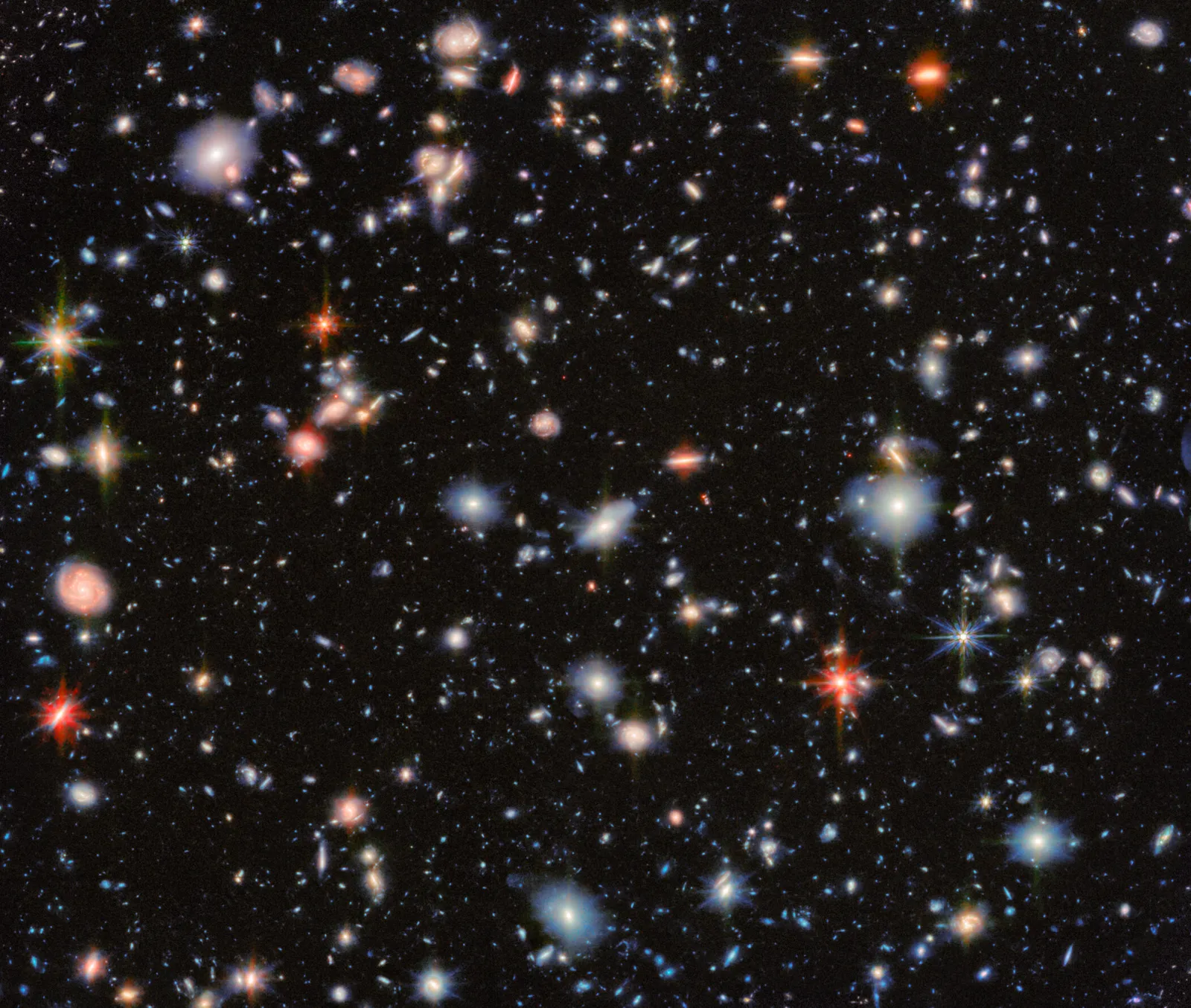
A galaxy is more than the sum of its stars. Between them hangs a thin veil of dust — solid particles smaller than a micrometre, formed from heavy elements forged inside stars. This veil is not passive. It absorbs and scatters starlight in a wavelength-dependent way, which means what a telescope records often differs from what the galaxy actually emits.
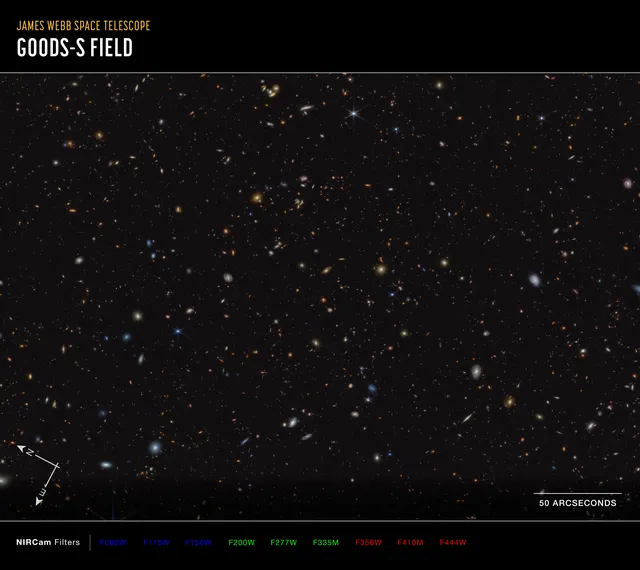
A team led by Vladan Markov, together with colleagues from Italian research institutions, published a study in Nature Astronomy that for the first time traces how dust properties changed over billions of years of cosmic history. The work is based on data from 173 galaxies observed by the James Webb Space Telescope across redshifts z = 2–12 — spanning from a relatively mature Universe back to just a few hundred million years after the Big Bang.
The attenuation curve as a dust fingerprint
In the present-day Universe, the wavelength-dependent light attenuation caused by dust, denoted Aλ, is typically described as the sum of two components: a smooth power-law slope and a so-called ultraviolet "bump" — a localized absorption peak produced by small, carbon-based grains. This bump is well documented in dust within our own Galaxy and nearby galaxies.
The open question was whether this bump existed in the early Universe, and if so, when it first appeared. Answering it required observing galaxies at extreme distances — and therefore extreme redshifts — made possible by JWST's infrared sensitivity. The researchers also drew on ALMA (Atacama Large Millimeter/submillimeter Array) observations to complete the picture.
A bump at z ≈ 7.55, and its gradual disappearance
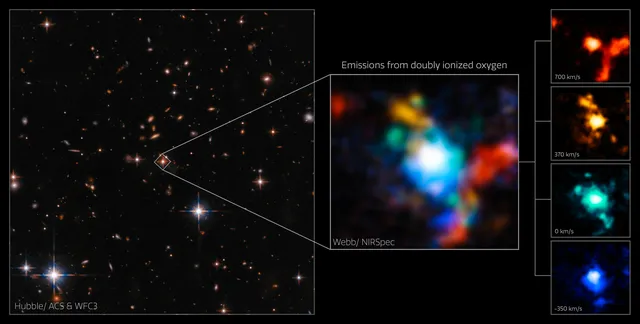
The study's key finding is the detection of the ultraviolet bump in a galaxy at redshift z ≈ 7.55. That means we are seeing this galaxy as it appeared just about 700 million years after the Big Bang — less than 5% of the Universe's current age.
Analysis of the full sample of 173 galaxies revealed a clear trend: both the bump strength and the slope of the power-law component decrease toward higher redshift, meaning toward earlier cosmic epochs. In other words, the older the galaxy, the flatter and simpler its dust attenuation curve appears.
Supernovae as the earliest dust factories
The authors propose an explanation rooted in the physics of grain formation. In the early Universe, supernovae — explosions of massive stars — are the dominant source of dust, enriching the interstellar medium with heavy elements. Supernovae mainly eject large dust grains.
The problem is that these grains have not yet undergone processing in the interstellar medium — a process that breaks large particles into smaller ones and adds chemical complexity. There simply hasn't been enough time: a Universe only 700 million years old has not had the cosmic history needed to "mature" its dust. That is why the attenuation curve appears flat, and the bump weak or absent.
Later, as galaxies mature, dust grains are gradually broken down and chemically transformed through ongoing interstellar processing. That is when the familiar ultraviolet bump emerges — the same feature observed in present-day galaxies, including our own.
This work represents the first systematic attempt to trace the evolution of dust attenuation from the earliest galaxies to later cosmic epochs. The result matters beyond its own scope: it provides a framework for interpreting JWST observations of other early galaxies, where incorrect assumptions about dust could distort estimates of brightness, stellar mass, or star formation rates.