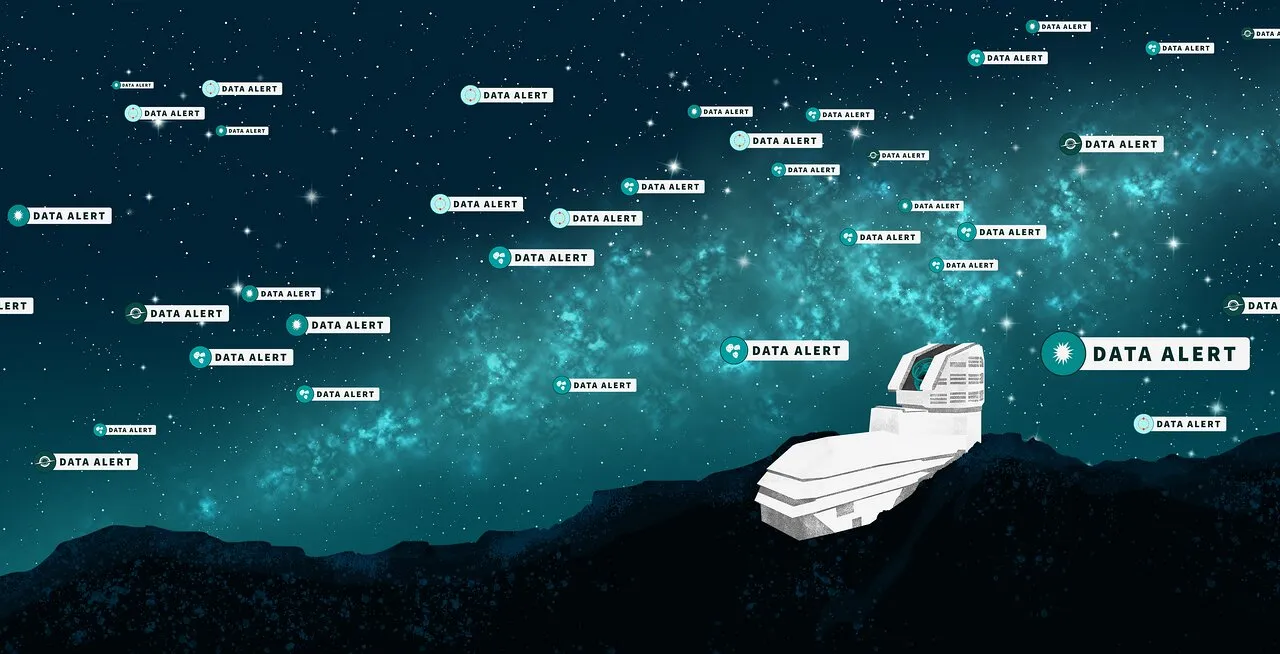
Rubin Observatory Launches Real-Time Alert System
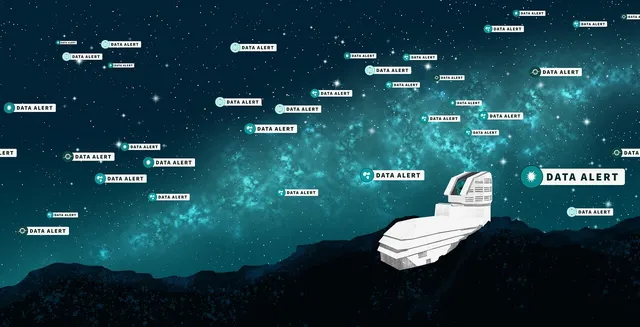
On February 24, 2026, the NSF–DOE Vera C. Rubin Observatory issued its first scientific alerts about changes in the night sky — 800,000 events in a single night. The telescope images a new patch of sky every 40 seconds, compares it with a prior image of the same field, and generates an alert within two minutes. Early detections included supernovae, variable stars, active galactic nuclei, and Solar System asteroids.
At the heart of the system is the 3,200-megapixel LSST camera, the largest digital camera ever built; data travel from Chile to the SLAC data center in California within seconds. At full capacity it will produce up to 7 million alerts per night, with a network of machine-learning brokers filtering and routing them to researchers. Within just the first year of the decade-long LSST survey, Rubin will record more objects than all optical observatories in human history combined, informing studies of dark matter and dark energy.
How Long Do Civilizations Last?

A new study by Sohrab Rahvar and Shahin Rouhani, accepted in MNRAS Letters, uses the Fermi paradox to constrain how long technological civilizations persist in our Galaxy. Under an optimistic assumption — that intelligent life emerges relatively often on Earth-like planets — the sheer absence of any detected contact places a limit on the lifespan of such civilizations.
Under their most optimistic scenario, the authors derive a bound of no more than 5,000 years. They note that our current light cone encompasses the entire Galactic history over roughly the past 100,000 years, which makes the silence particularly puzzling for long-lived civilizations. The researchers stress that these figures should be read as upper bounds derived from the Fermi paradox, not as predictions of actual lifespans.
The Chemical Fingerprint of Supernovae in Dwarf Galaxies
A team led by Mairéad E. Heiger introduced a new galactic chemical evolution model, DLEIY, which uses an observed star formation history and metallicity distribution to reduce confounding factors. Applying it to the dwarf spheroidal galaxies Sculptor and Fornax, they derived simultaneous constraints on population-averaged yields and galactic outflows.
The iron yield from core-collapse supernovae matches existing theoretical models, while the measured magnesium yield came out a factor of 2–4 higher, corroborating earlier suggestions that models under-predict [Mg/Fe]. In addition, the Type Ia supernova rate in these galaxies is enhanced by about a factor of 5 relative to field galaxies, and the delay-time distribution goes as t⁻², much steeper than the t⁻¹·¹ measured from supernova surveys. This may point to a metallicity dependence of the Type Ia rate and delay-time distribution.
FRB 20220529A: First Direct Evidence for an FRB Engine Inside a Supernova Remnant
During a 3.2-year monitoring campaign with CHIME/FRB, astronomers observed a gradual decline in the dispersion measure of the repeating fast radio burst FRB 20220529A — about −0.881 pc·cm⁻³ per year, implying at least a 3.5% decrease in the total electron column in the source environment. The trend matches the expansion of a supernova remnant through which the signal travels.
The researchers also caught a short-lived excursion in which the dispersion measure rose by roughly 1 pc·cm⁻³ just before a sharp jump in Faraday rotation measure. At that moment the local line-of-sight magnetic field reached 3.4 milligauss, one of the most strongly magnetized FRB environments known. Overall the observations point to a young supernova remnant — years to centuries old — as the source, offering direct support for one of the leading theories of FRB origins.
Landsat 9: More Than Just a Picture
Launched in 2021, Landsat 9 continues the 50-plus-year NASA and US Geological Survey partnership — the longest continuous satellite record of Earth's land surface. Working in tandem with Landsat 8, the pair now collect nearly 1,500 scenes per day and produce a complete map of the planet's land surface every eight days, letting scientists track seasonal crop shifts, wildfire spread, storm aftermath, and rapid changes in glaciers and coastlines.
The key upgrade is a 14-bit radiometric resolution instead of Landsat 8's 12-bit — roughly quadrupled sensitivity. That matters most over the brightest surfaces, like snow and ice, where it reveals subtle shifts in ice extent, changes in surface reflectance, and the growth of glacial lakes. Combined with ESA's Sentinel-2 satellites, the constellation delivers near-daily global coverage at 30-meter resolution.