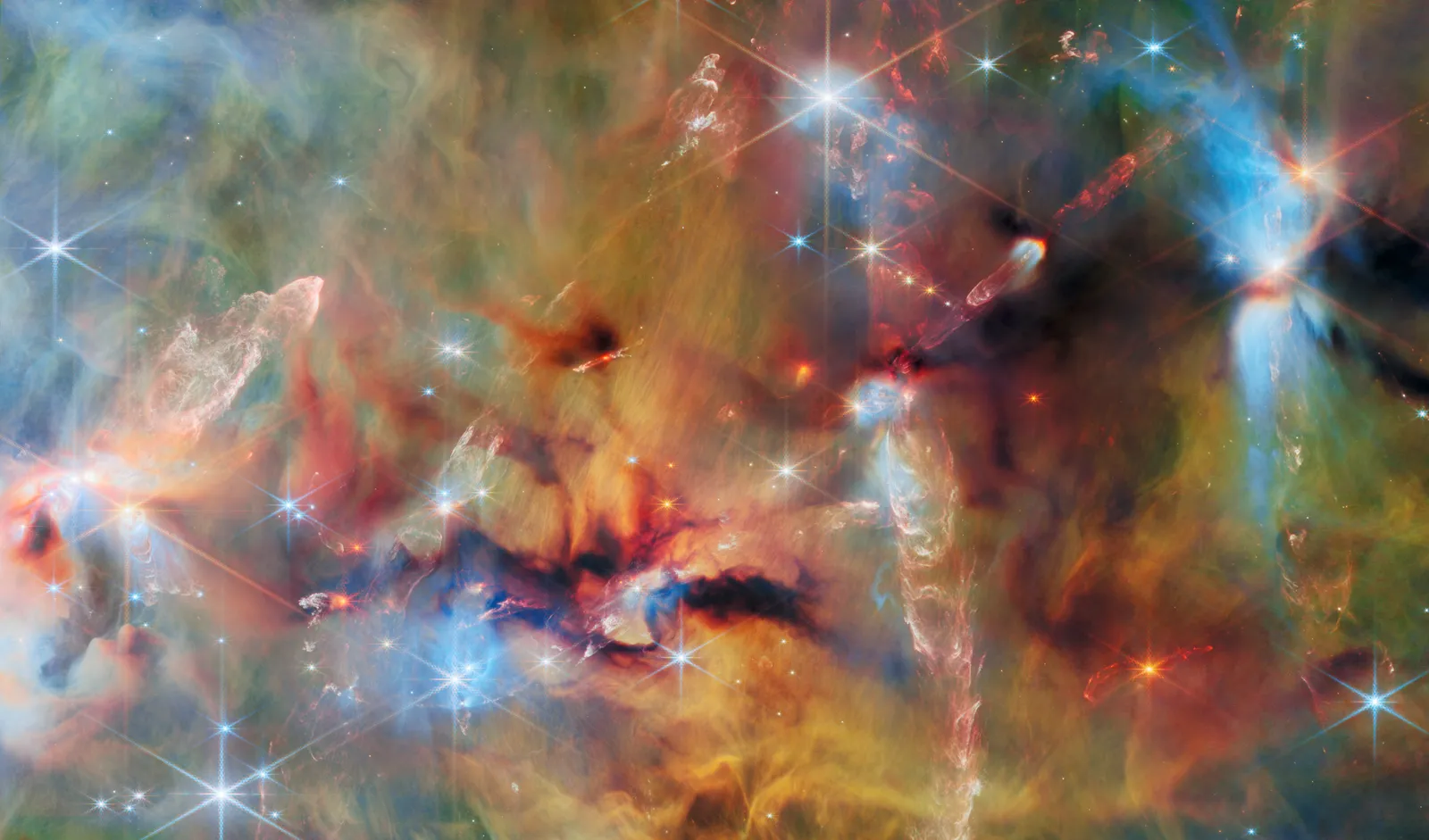
Orion is one of the richest star-forming regions visible from Earth, and the James Webb Space Telescope has already pointed its instruments there more than once. This time the target is not the Orion Nebula (M42) itself, but what lies hidden directly behind it — the molecular cloud OMC-2, located 1,280 light-years from Earth.
The image spans a region 150 light-years across and reads almost like a textbook of stellar evolution: within a single frame it captures the earliest stellar embryos, protostars surrounded by discs of gas and dust, and young stars that have already cleared the material around them. Astronomers rarely get to see every one of these stages laid out so clearly in one compact area.
The cloud hidden behind Orion
The Orion Nebula is only a small part of a much larger structure, the giant molecular cloud Orion A. Behind its glowing gas and dust stretches a long, dense filament of cold material known as the Orion Molecular Clouds, divided into four sections labelled OMC-1 through OMC-4.
OMC-1 sits immediately behind M42. To its north lie OMC-2 and OMC-3, while OMC-4 extends to the south. It is a small northern portion of OMC-2 that Webb has now captured in detail.
At visible wavelengths, this region is completely inaccessible. The dense gas and dust of the Orion Nebula block any light coming from OMC-2, and within the cloud itself, thick dust cocoons hide the protostars astronomers are most interested in. Only infrared light, to which this dust is largely transparent, reveals them.
How stars form inside the cloud
Molecular clouds are dense clumps of gas, far denser than the surrounding interstellar medium. This density shields complex molecules from external radiation and allows gravity to compress the material into new stars.
The earliest stage of this process is a protostar — a growing star that feeds on gas from its surrounding cloud through a spinning disc. As gas falls onto the protostar, it heats up and begins to glow, and it is this glow that Webb detects.
The immense energy gathered during this accretion process is released through powerful jets of gas launched from the protostar's poles. These jets slam into the surrounding dense material at high speed, producing shockwaves — visible in the image as bright red ridges.
By tracing these outflows, astronomers can locate protostars that remain completely hidden within their dusty cradles and cannot be seen directly by any other means.
What the colours reveal
Every colour in the image corresponds to a distinct physical process. Dark clumps mark the coldest, densest dust, which absorbs nearly all light, including infrared.
Orange, brown, and some red tones indicate warmer dust that both absorbs light and emits its own. The yellow-to-green glow comes largely from polycyclic aromatic hydrocarbons (PAHs), complex organic molecules common in interstellar space.
The blue and cyan haze is starlight scattered by dust grains. The intricate, bright ridges throughout the image trace gas heated by shockwaves from protostellar jets.
What astronomers plan to study next
The data was collected with Webb's NIRCam instrument as part of observing programme #5804, designed to study star formation in both OMC-2 and its neighbour, OMC-3. Their proximity to Earth makes these clouds excellent laboratories for investigating the earliest stages of stellar evolution.
Researchers plan to use the data to examine how the many outflows in these regions affect ongoing star formation, and how ultraviolet radiation from young stars influences the chemistry of circumstellar discs that may one day form planets.
Astronomers also hope to better understand how gas and dust accrete onto the tens of protostars scattered throughout this part of the sky.