Halzen of IceCube Wins Physics Nobel
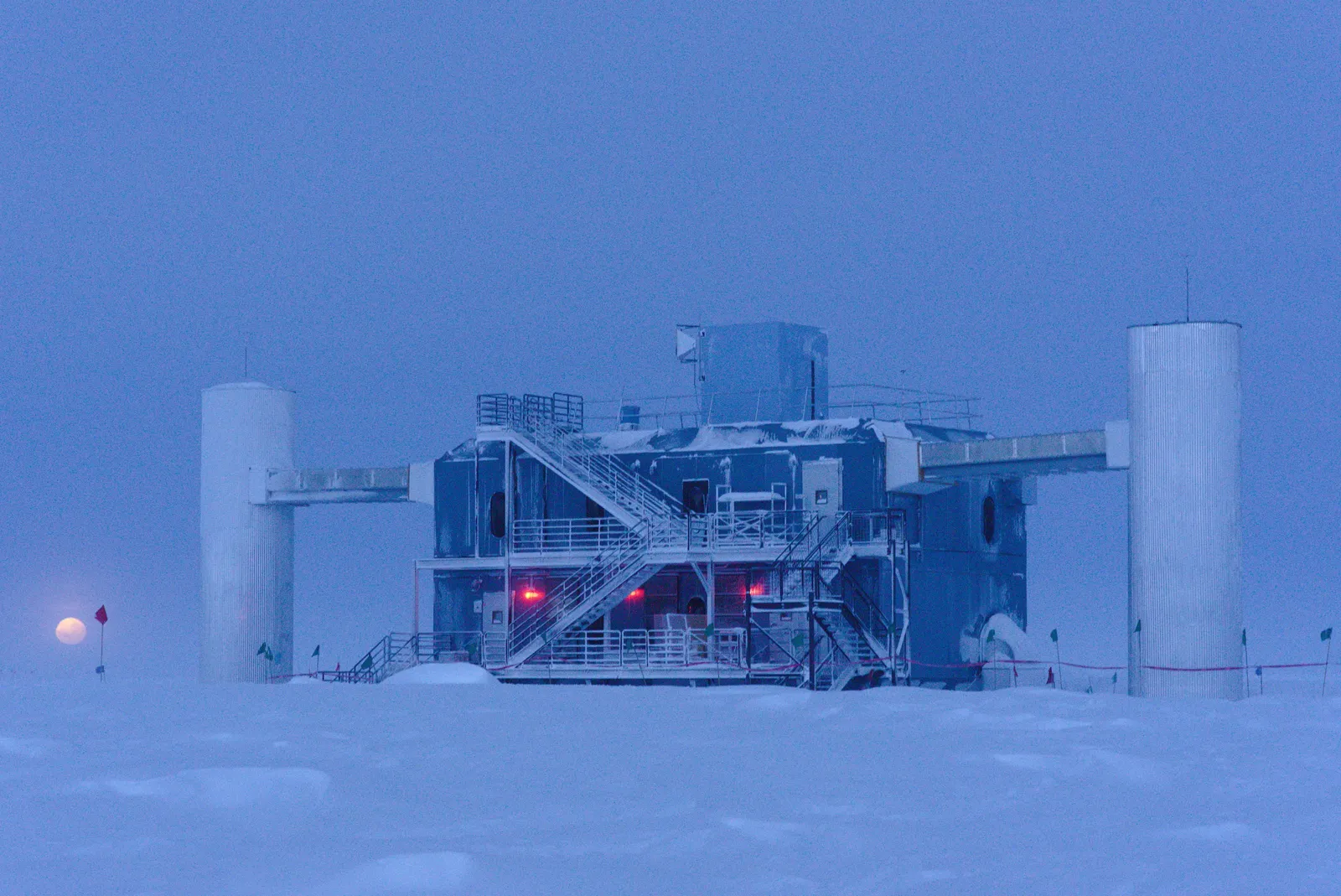
The Royal Swedish Academy of Sciences has awarded the 2026 Nobel Prize in Physics to Francis Halzen, principal investigator of the IceCube Neutrino Observatory, for decisive contributions to IceCube and the discovery of high-energy neutrinos of astrophysical origin. Halzen proposed and showed that ice could serve as a detection medium for such particles, then drove the creation of the collaboration.
The detector fills a cubic kilometre of glacial ice at the South Pole and is run by more than 450 scientists at 58 institutions in 14 countries. After the 2013 discovery of astrophysical neutrinos, IceCube found evidence of emission from the galaxies TXS 0506+056 and NGC 1068, and in 2023 detected neutrinos from the Milky Way. Neutrinos now join visible and invisible light as a tool for astronomy. First IceCube Upgrade data are expected this year.
Webb Pinpoints Most Distant Fast Radio Burst
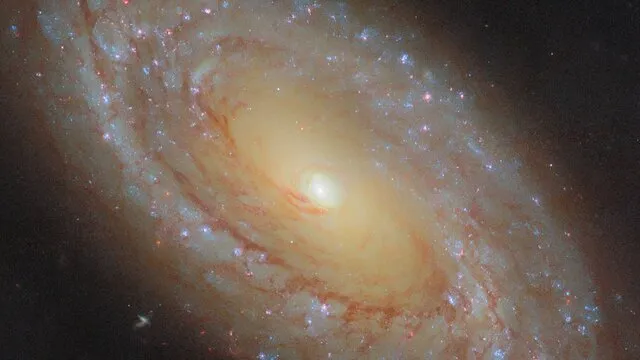
The James Webb Space Telescope has identified the host galaxy of the most distant fast radio burst known, FRB 20240304B, detected by the MeerKAT radio telescope on 4 March 2024. The largest ground-based telescopes saw nothing at the burst's position. Webb's NIRCam found the galaxy, and its NIRSpec instrument measured a redshift of 2.148, placing the burst just 3 billion years after the Big Bang.
The galaxy turned out to be a dwarf, roughly 1,000 times less massive than expected, yet actively forming stars: most of its stars may have formed within just 30 million years. So little time passes between star formation and the first bursts. That favours young neutron stars called magnetars over neutron star mergers, which take billions of years to occur. The study is published in Science.
Abell 2744 Has More Substructure Than Simulations
Researchers built a combined strong and weak gravitational lensing mass model of Abell 2744 (z = 0.308), a massive merging galaxy cluster. Strong lensing constrains the core, while weak lensing from deep Hubble and James Webb imaging extends the map out to the cluster outskirts. From the resulting mass map the team identified substructures and constructed the subhalo mass function.
To interpret it, they ran the same detection methods on projected mass maps of massive clusters from the BAHAMAS simulations and found a systematic excess of substructures in Abell 2744. The authors attribute this to the cluster's exceptionally disturbed dynamical state, with complex ongoing mergers, rather than to tension with ΛCDM or self-interacting dark matter predictions. Confirming that will require a larger sample of clusters in a range of dynamical states.
Lensed Supernova 2025wny Magnified 19 Times
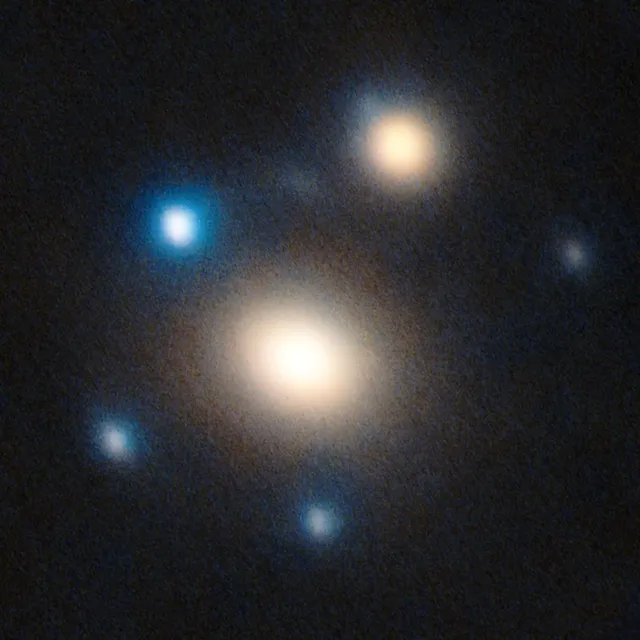
Astronomers followed up the strongly lensed hydrogen-poor superluminous supernova 2025wny at z = 2.0155. Keck II/KCWI integral-field spectroscopy yielded rest-frame ultraviolet spectra from 11 to 61 days after maximum light. Pan-STARRS photometry constrains the brightest image's magnification to 19.4 ± 1.6, a factor of about 2–4 higher than mass-modelling estimates.
A magnetar model with a spin period of about 4.1 ms reproduces the light curve near maximum with parameters typical of local SLSNe-I, although the late-time plateau suggests an additional power source. The ultraviolet spectra show virtually no iron-group line blanketing, and narrow interstellar lines point to a sub-solar-metallicity host. Overall, the supernova matches lower-redshift SLSNe well, and LSST and Roman should find more to test that at the population level.
First Stars Help Seed Supermassive Black Holes
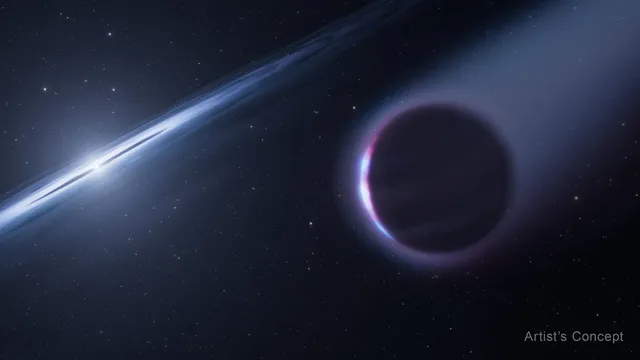
In the conventional direct-collapse scenario, forming the supermassive stars that seed supermassive black holes requires an extremely strong external far-ultraviolet (FUV) field to suppress H2 cooling and fragmentation. Cosmological radiation-hydrodynamic simulations now show that such stars can form in metal-free atomic-cooling haloes even under weaker backgrounds, J21 = 1–100.
H2 cooling first produces ordinary Population III stars. Their FUV radiation destroys H2 and halts fragmentation, and the warm surrounding gas collapses with inflow rates of 0.1–1 solar masses per year. The protostars reach 20,000–60,000 solar masses and are expected to grow to about 100,000 before forming direct-collapse black holes. Their estimated abundance is high enough to explain Little Red Dots and present-day supermassive black holes.