Today's star clusters in the Milky Way look dense, but compared to what happened in the Universe's first billion years, they are practically empty. In the proto-globular clusters and nuclear star clusters of that era, stars were packed so tightly that physical collisions between them were not rare accidents but a routine feature of how these systems evolved.
These are exactly the conditions modeled in a new paper led by Claire Williams. The team builds an analytic framework for stellar dynamics in environments where collisions could shape the entire fate of a cluster — from the birth of very massive stars to the buildup of dense gas envelopes around black holes.
Dense star clusters at cosmic dawn
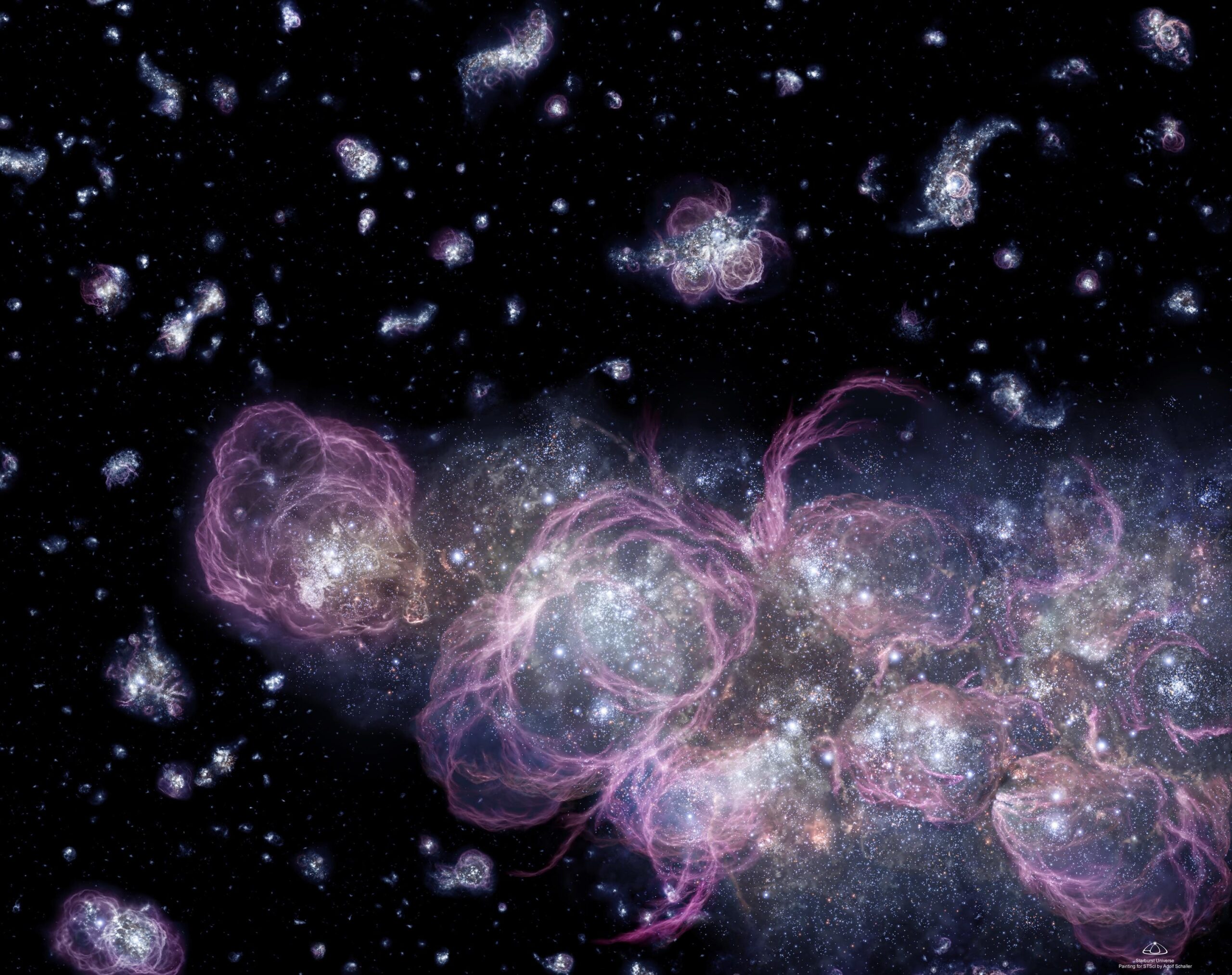
Cosmological simulations and observations have long hinted that the early Universe hosted compact stellar systems with extreme densities. These include proto-globular clusters — the progenitors of today's globular clusters — and nuclear star clusters that form at galactic centers, often alongside black holes.
In such systems, the distances between stars shrank enough that close encounters and direct collisions became far more likely. The authors cover the full range of possible configurations: clusters without black holes, clusters with intermediate-mass black holes, and clusters hosting a central supermassive black hole. This spans regimes where collisions play a minor role and regimes where they dominate the cluster's evolution entirely.
An analytic model tested against Monte Carlo simulations
A key methodological feature of the work is pairing an analytic approach with numerical verification. The researchers built a radially-resolved model describing how stellar density and collision rates change with distance from the cluster's center.
The model's initial conditions — masses, sizes, cluster densities — are not arbitrary assumptions but come from high-resolution cosmological simulations. This anchors the calculations in a realistic cosmological context: the clusters in the model share properties with objects that actually form in simulations of the Universe's evolution.
To test how well the analytic predictions hold up, the authors compared them against Monte Carlo simulations — direct statistical modeling of the dynamics of large numbers of stars. The agreement between the two approaches was good across key regimes, which supports using the analytic model to scan a wide parameter space quickly, without running heavy numerical simulations every time.
Runaway collisions build very massive stars
The model's central finding is that stellar collisions were ubiquitous in the dense environments of the early Universe. In many scenarios, these were not isolated chance events but a systematic process built into the cluster's dynamics.
A particularly important consequence involves runaway collision sequences, where a single star repeatedly absorbs mass from several neighboring stars in succession. The authors show that such chains naturally lead to the formation of extremely massive stars very early in cosmic history. This offers an alternative pathway for producing the massive objects that could later become intermediate-mass or larger black holes, without relying solely on the direct collapse of individual massive gas clouds to explain their origin.
Gas around black holes and "Little Red Dots"
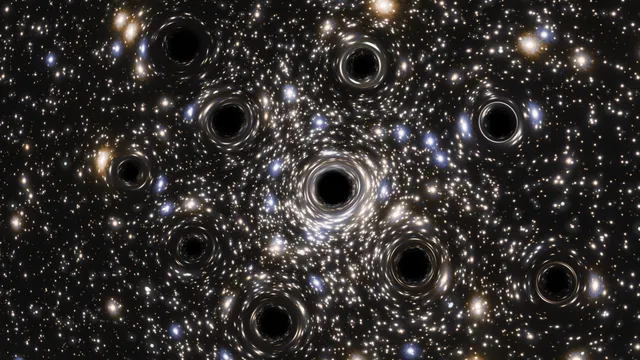
The second major consequence concerns not the stars themselves but the environment surrounding massive black holes. The researchers show that high rates of destructive collisions can rapidly build up dense gaseous envelopes around such black holes — material produced by disrupted stellar layers and ejected debris.
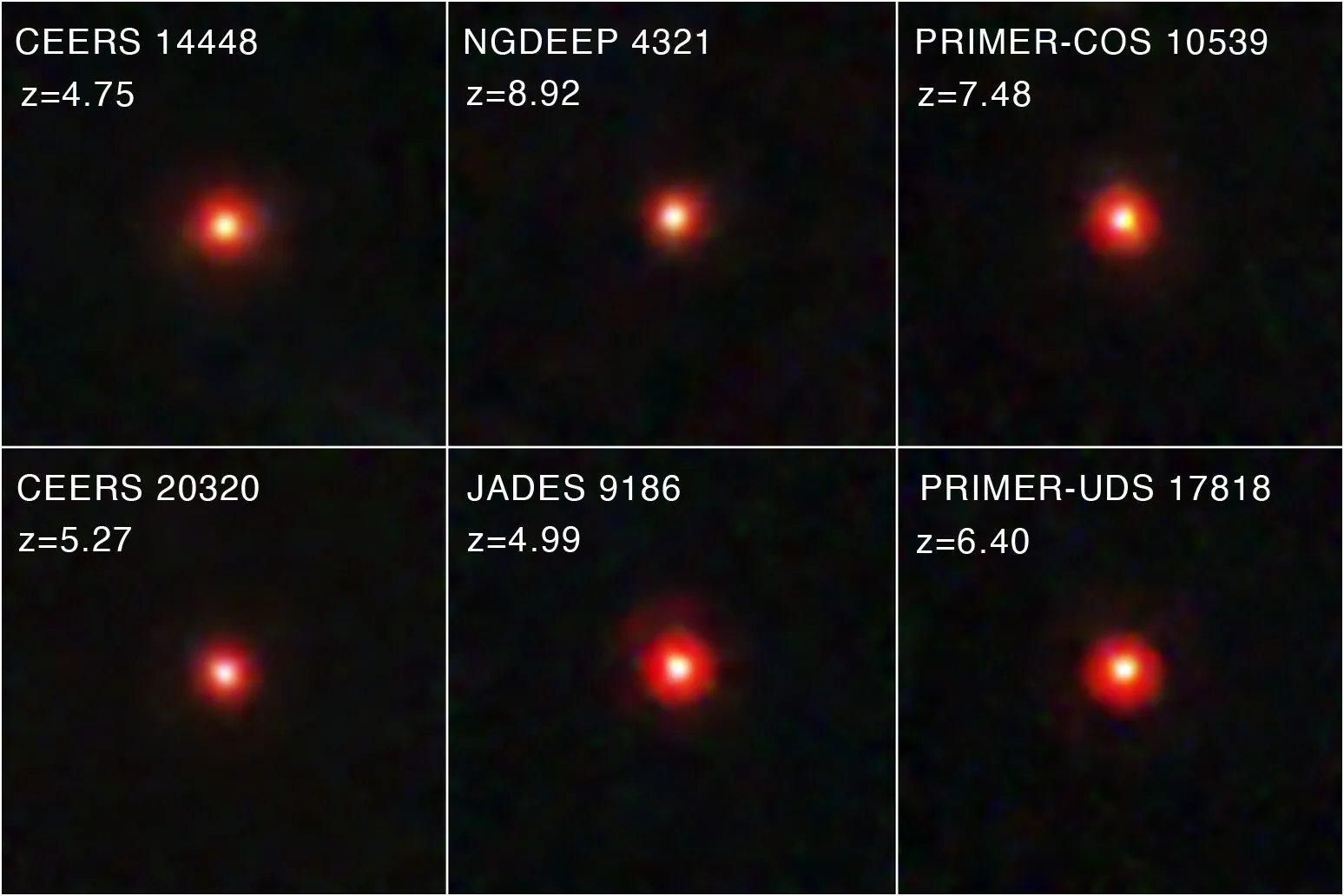
The authors connect this to a puzzling class of objects that JWST has detected at high redshift, known as Little Red Dots. These compact, very red sources still lack a widely accepted explanation for their nature. The paper offers one possible physical scenario: a dense gaseous environment produced by mass stellar collisions near a black hole could reproduce the observed properties of these objects.
The authors are careful to frame this as an analogue rather than a definitive explanation. The paper, posted on arXiv on March 27, 2026, runs 25 pages with 8 figures, and its conclusions remain open for further testing through future observations and simulations.