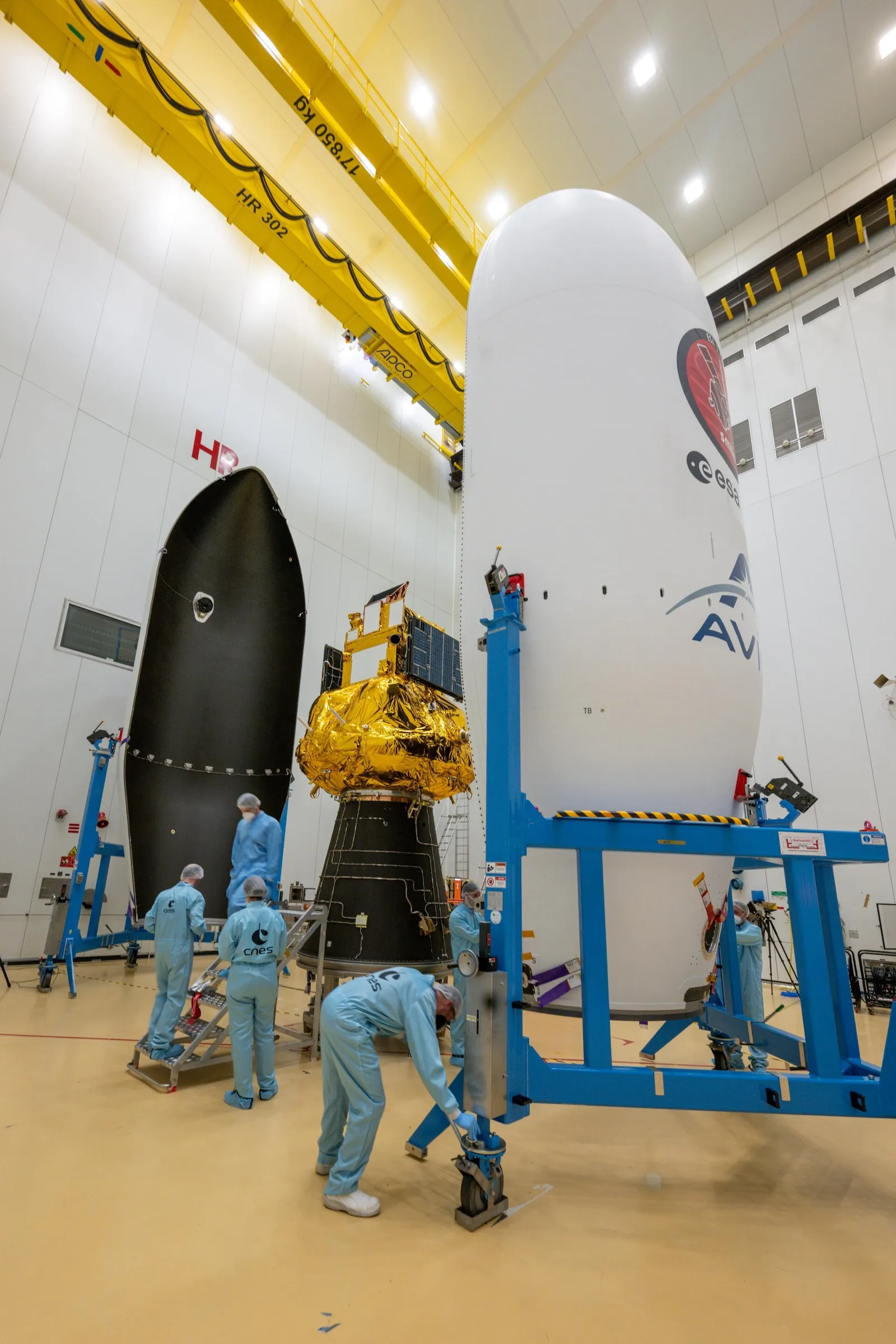
On 26 March 2026, at Europe's Spaceport in Kourou, French Guiana, the Smile spacecraft was seen by human eyes for the last time. Engineers wrapped it inside the two halves of the Vega-C rocket fairing, a procedure formally known as encapsulation. From this point on, the spacecraft stays sealed away until it emerges again, in orbit.
The comparison to a cocoon is almost unavoidable. Just as a caterpillar hides inside before becoming a butterfly, Smile now sits enclosed within its protective shell, waiting for the moment it will be released in space to begin its work.
The fairing as the last barrier
The fairing is the rocket's nosecone, split vertically into two halves. Its job is simple and critical: shield the spacecraft from aerodynamic forces, vibration and heat as it climbs through the dense lower atmosphere.
Encapsulation took place a day after Smile had been fixed to the adapter, the structure that connects the spacecraft to the launch vehicle. Together, these two steps completed the main phase of payload preparation before liftoff.
For a team that has worked on the mission for nearly a decade, the closing of the fairing carried real weight. It marked the last time anyone will physically see the spacecraft they designed, built and tested for years.
Liftoff from Europe's Spaceport in Kourou is scheduled for 9 April 2026.
What Smile is actually built to study
The mission's name stands for Solar wind Magnetosphere Ionosphere Link Explorer. It is a joint project between the European Space Agency and the Chinese Academy of Sciences.
Earth's magnetosphere is the region around the planet dominated by its magnetic field. It deflects streams of charged particles from the Sun that would otherwise strike the surface unopposed. The ionosphere, the upper atmospheric layer ionised by solar radiation, interacts closely with these processes.
Smile will gather data on how the solar wind and solar storms affect this system. These are the phenomena grouped under the term "space weather," which can disrupt satellites, communication and navigation systems, and pose risks to astronauts in orbit.
According to the mission team, the data collected is meant to fill a clear gap in understanding how the Solar System responds to solar activity, helping protect technology and future astronauts.
Vega-C returns to service
Smile will be carried into orbit by Europe's Vega-C rocket, capable of launching more than 3,000 kg into space, from small CubeSats to a single large payload.
Vega-C is the evolution of the earlier Vega rocket family, offering greater lift performance, increased payload volume, and improved competitiveness in the launch market.
The Vega-C programme is led by ESA, with Avio serving as prime contractor and design authority. Together they secure Europe's independent and flexible access to space.
The launch carrying Smile marks the first full commercial mission for Vega-C following the VV22 anomaly in 2022 and a successful return-to-flight mission in 2024. On 9 April, it is not only the spacecraft being tested, but the rocket itself, confirming its return to regular operations.