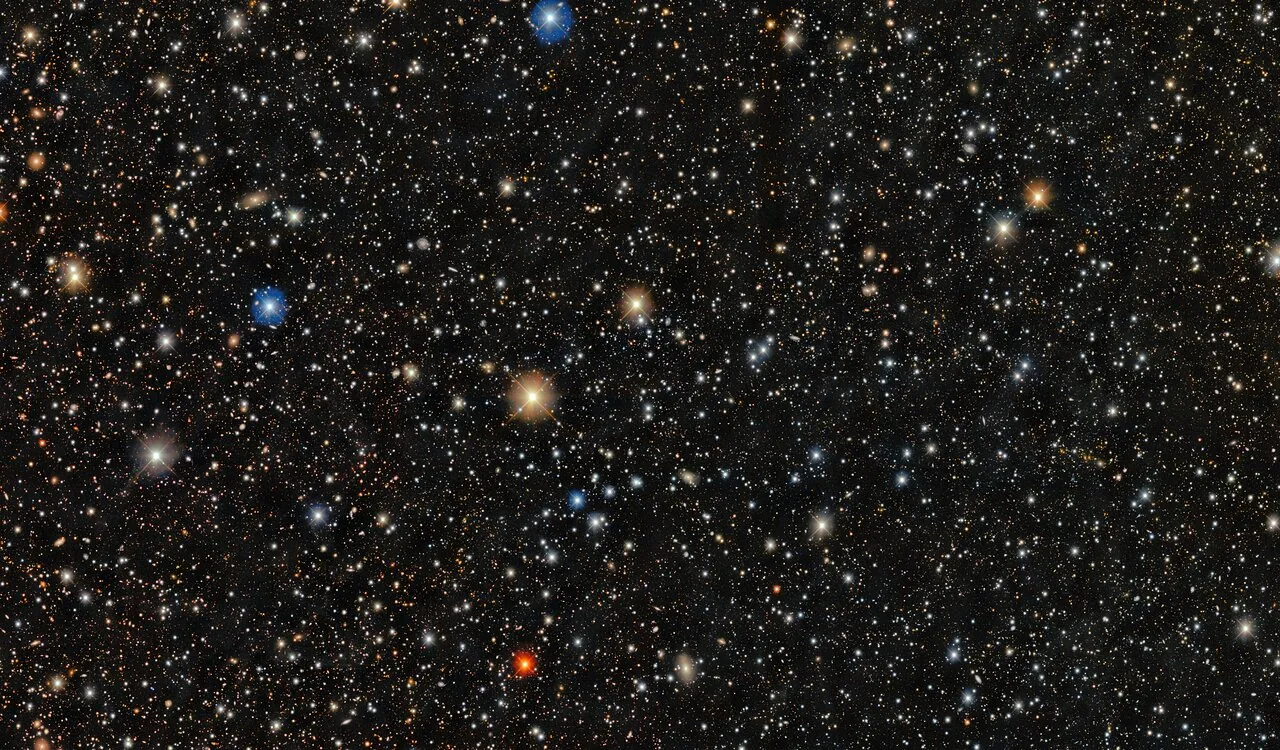
Astronomers have identified PicII-503, a star in the ultra-faint dwarf galaxy Pictor II, located in the constellation Pictor. This tiny system contains only a few thousand stars and is more than 10 billion years old. PicII-503 sits on the outskirts of the galaxy and carries less iron than any other star ever measured outside the Milky Way.
Alongside its record-low iron content, the star shows an extreme carbon overabundance. This combination makes it the first unambiguous example of a star preserving the chemical fingerprint of the Universe's first stars within an intact, primordial dwarf-galaxy environment. The study, led by Anirudh Chiti of Stanford University, appears in Nature Astronomy.
Finding a Needle in a Field of Stars
The discovery was made possible by the DECam MAGIC survey (Mapping the Ancient Galaxy in CaHK), a 54-night observing program using the Dark Energy Camera mounted on the 4-meter Víctor M. Blanco Telescope at Cerro Tololo Inter-American Observatory in Chile. The survey's goal is to find the oldest and most chemically primitive stars in the Milky Way and its dwarf-galaxy companions.
Researchers used a narrow-band filter sensitive to calcium absorption features, allowing them to estimate metal content for thousands of stars from imaging data alone, without individual spectroscopy for each object. Among hundreds of stars near Pictor II, MAGIC data singled out PicII-503 as an exceptionally metal-poor candidate.
According to Chiti, without data from MAGIC it would have been impossible to isolate this star among the hundreds of others in the vicinity of Pictor II.
Follow-up observations with the Magellan/Baade Telescope and ESO's Very Large Telescope confirmed that PicII-503 has the lowest iron and calcium abundances ever measured outside the Milky Way.
The Chemical Signature of a Low-Energy Explosion
The iron abundance of PicII-503 is more than 40,000 times lower than the Sun's. At the same time, its carbon-to-iron ratio exceeds the Sun's by more than 1,500 times. This contrast — a near-total absence of heavy elements alongside a carbon excess — points to a specific formation mechanism.
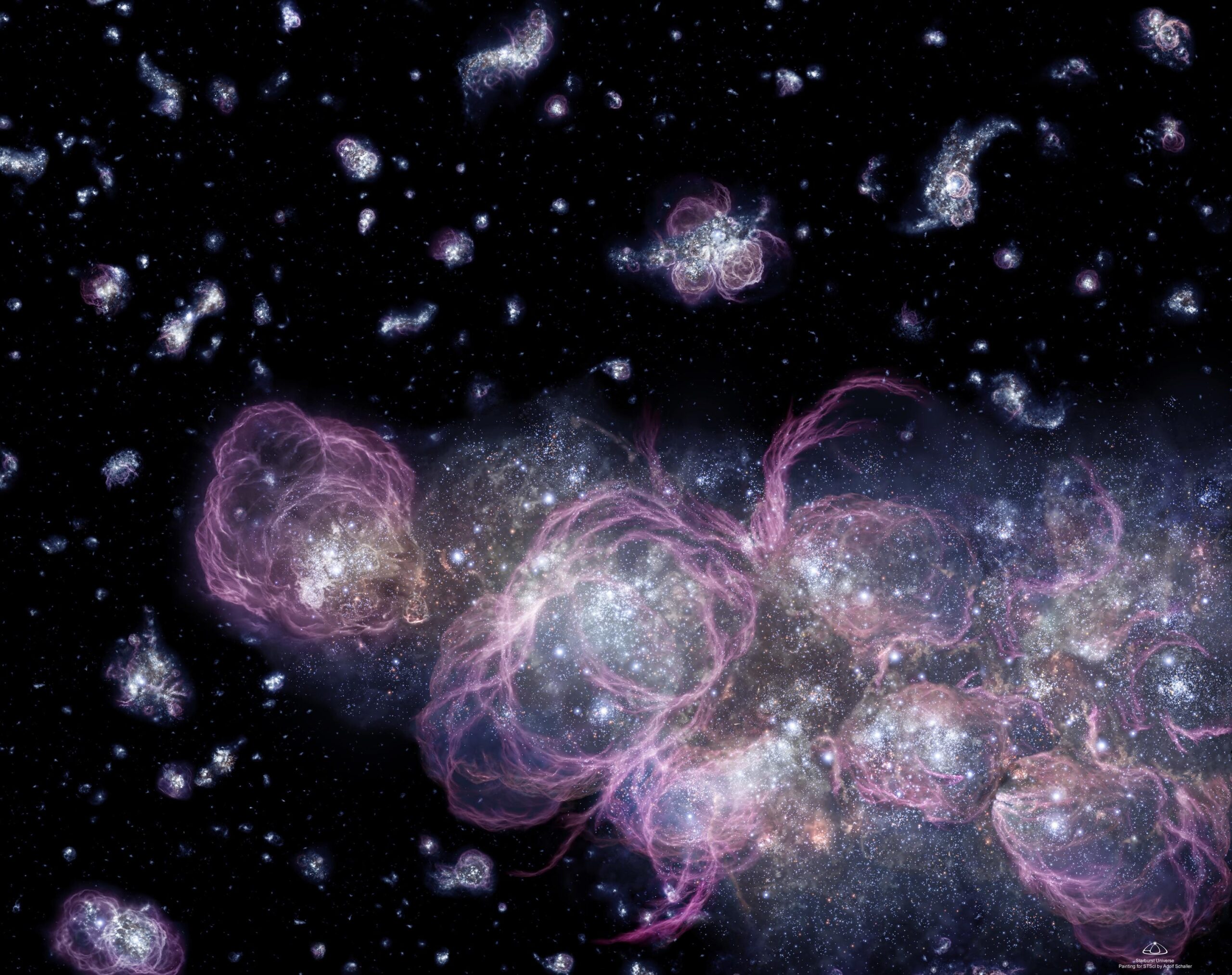
The Universe's first stars formed from pure hydrogen and helium. Within their cores, they synthesized the first heavier elements — carbon, calcium, iron. When they exploded as supernovae, they scattered these elements into the interstellar medium, from which the next generation of stars would eventually form.
One hypothesis explains the chemistry of PicII-503 through a low-energy supernova explosion. In this scenario, heavy elements formed closer to the star's core, including iron, fall back onto the compact remnant, while lighter elements from the outer layers, including carbon, are ejected outward and enrich the surrounding gas.
The fact that PicII-503 remained gravitationally bound to one of the smallest known dwarf galaxies supports this interpretation. Had the explosion been high-energy, the ejected material would have escaped Pictor II's weak gravitational field entirely.
Discovering a star that unambiguously preserves the heavy metals from the first stars was at the edge of what we thought possible, given the extreme rarity of these objects.Anirudh Chiti, Stanford University
Solving a Milky Way Halo Mystery
For years, astronomers have observed so-called carbon-enhanced metal-poor stars in the Milky Way's halo — objects with extremely low iron content and anomalously high carbon abundance. The origin of these stars had remained unknown.
PicII-503 shows exactly the same chemical signature, but in a context where its connection to enrichment by the first stars can be traced directly, inside a primordial dwarf galaxy. This suggests that similar stars in the Milky Way halo likely originated in ancient dwarf galaxies that merged with our own over billions of years.
Researchers describe the finding as an example of "cosmic archaeology" — the search for rare stellar fossils that preserve the fingerprint of the Universe's first stars. The Legacy Survey of Space and Time at the Rubin Observatory, set to begin later this year, is expected to uncover more such objects and refine the picture of chemical evolution in the early Universe.