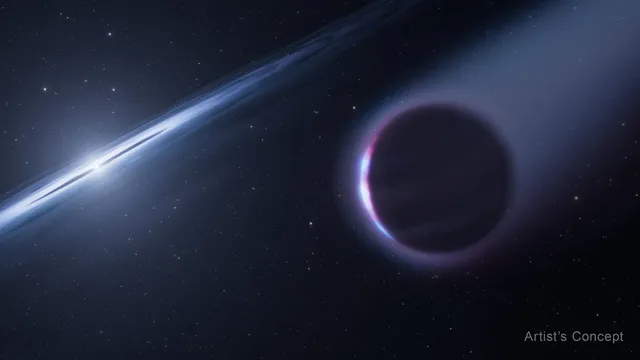
AN Col is a shell Be star. This is a hot, massive star with a gas disk around its equator. When such a disk is seen nearly edge-on, it partly absorbs the starlight and leaves characteristic "shell" lines in the spectrum. Earlier, transient spectral features of a hot, evolved companion on an orbit lasting a few months were noticed in AN Col. Now the authors of a preprint have confirmed this companion and measured the masses of both stars.
The work is an arXiv preprint and has not yet been peer reviewed. The data come from the GRAVITY interferometer, including near-infrared observations, as well as spectroscopy and light curves from the TESS mission.
How the orbit was separated from the disk oscillations
The main obstacle is the Be star's own disk. Its density oscillates across the whole disk. These oscillations produce the strongest spectral cycles. Orbital changes are much weaker and get lost beneath them.
So the researchers first characterised the disk cycle. Since 2010 the disk has completed three full cycles, each about 5.1 years long. Only then could the periodic orbital signal be isolated.
Two orbits combined into one
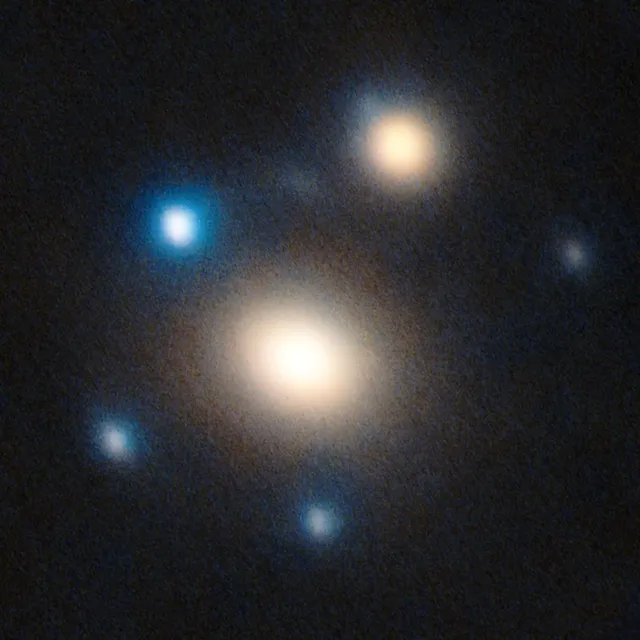
GRAVITY can see what an ordinary telescope cannot: very small angular separations between components. A time series of observations confirmed the companion and traced its relative orbit on the sky.
Then, knowing the period, the astronomers identified spectral lines that follow the motion of each star separately. By measuring radial velocities (motion along the line of sight), they obtained a double-lined spectroscopic orbit. Combining the two methods gave a full three-dimensional solution. The orbital period is 87.7 days. A dynamical parallax, the distance to the system derived from its motion, was also obtained from the orbit.
What the masses show
The Be star's mass is 8.39 ± 0.67 solar masses. The companion's mass is 0.81 ± 0.22 solar masses.
A weak He II 4686 absorption line and He I lines belong to the companion. They indicate an effective temperature close to 30,000 K and slow rotation.
What it means
Be stars in such pairs are thought to have been spun up after receiving matter from a companion. The companion lost its outer layers and became an OB-type subdwarf. This is the post-mass-transfer scenario. If the conclusion holds, AN Col joins a small but growing group of such systems.
The authors note that, as in other Be + sdOB binaries, the estimated efficiency of past mass transfer is unexpectedly high. In other words, the Be star seems to have accreted a larger share of the matter than expected. Dynamical masses measured directly from the orbit give models of binary evolution a rare anchor point.
How solid is the result
The orbit is compatible with an edge-on view. However, TESS light curves show no eclipses, so the inclination cannot exceed 88.4°. This upper limit matters for the mass estimates. The uncertainty on the companion's mass is still noticeable: ±0.22 solar masses.
Peer review will give the final verdict on the result.