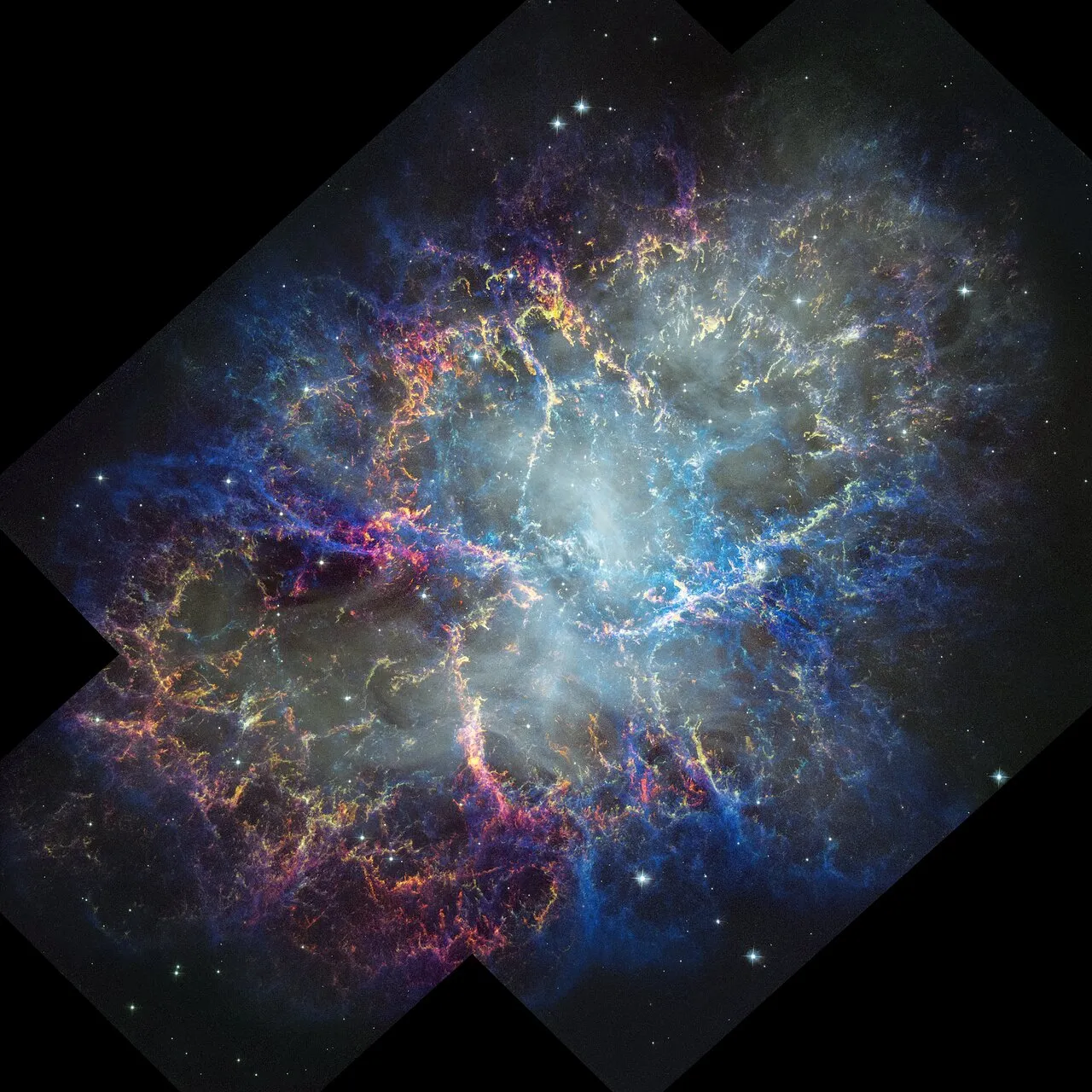
In 1054, Chinese court astronomers recorded the appearance of a new star in the sky — one bright enough to remain visible in daylight for weeks. What remains today is the Crab Nebula, an expanding cloud of gas located 6,500 light-years from Earth in the constellation Taurus. The Hubble Space Telescope has now returned to this object for a full observation for the first time in 25 years, and comparing the two eras offers a rare opportunity to watch an ancient stellar catastrophe continue to unfold in real time.
The results of the new observation are published in The Astrophysical Journal. Researchers paired the fresh data with a reprocessed image of the nebula that Hubble had captured back in 1999–2000, ensuring the comparison would be as precise as possible.
A Chinese record meets a neutron star
The Crab Nebula was discovered in the mid-18th century, but for a long time its connection to the "new star" recorded in 1054 remained only a hypothesis. In the 1950s, Edwin Hubble — along with other astronomers — noted the close correlation between the nebula's position and historical chronicles of the supernova. The puzzle was finally solved when a pulsar was discovered at the nebula's heart — a rapidly rotating neutron star left behind after the star's core collapsed. This object, it turned out, is what powers the nebula's ongoing expansion, finally aligning modern observations with millennium-old records.
Filaments moving as one
The new image allowed astronomers to trace the motion of the nebula's filamentary structure with striking precision. The outermost filaments are moving outward at roughly 5.5 million kilometres per hour. Filaments near the periphery of the nebula have shifted noticeably more than those closer to the centre — yet rather than stretching out, they appear to have simply moved outward as a coherent whole.
This behaviour sets the Crab apart from most other supernova remnants. Typically, such objects expand as the shockwave from the initial explosion erodes shells of gas the star had shed before collapsing. The Crab Nebula works differently: it is a pulsar wind nebula. Its expansion is sustained by synchrotron radiation, generated by the interaction between the central pulsar's magnetic field and the surrounding material. Colour variations across the Hubble images reflect differences in the gas's temperature, density, and chemical composition across the nebula.
Shadows reveal a three-dimensional structure
The higher resolution of the new observations offered a glimpse into the nebula's three-dimensional structure — something nearly impossible to determine from a flat, two-dimensional image. Shadows cast by some of the filaments are visible against the glow of synchrotron radiation inside the nebula.
Not every bright filament casts a shadow, though. Researchers note that some of the brightest filamentary structures show no visible shadow at all — indicating they lie on the far side of the nebula, beyond the illuminated region. This "negative" result proved just as informative as the shadows themselves, helping to reconstruct the spatial arrangement of gas structures within the object.
What future comparisons will reveal
Researchers stress that the real value of the new Hubble observations still lies ahead. The data can be combined with the James Webb Space Telescope's 2024 infrared images of the Crab Nebula, as well as with observations from other facilities across different wavelengths.
Comparing this multiwavelength data will help build the most complete picture yet of how the aftermath of a supernova continues to develop — an explosion astronomers first witnessed nearly a thousand years ago, still unfolding before today's telescopes.