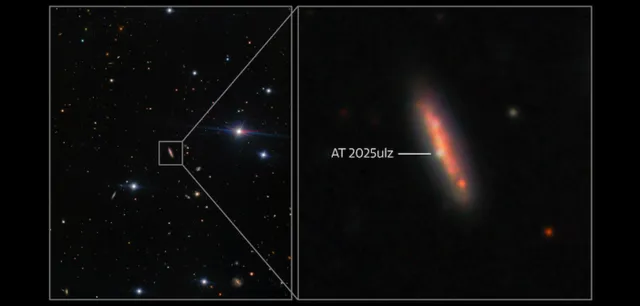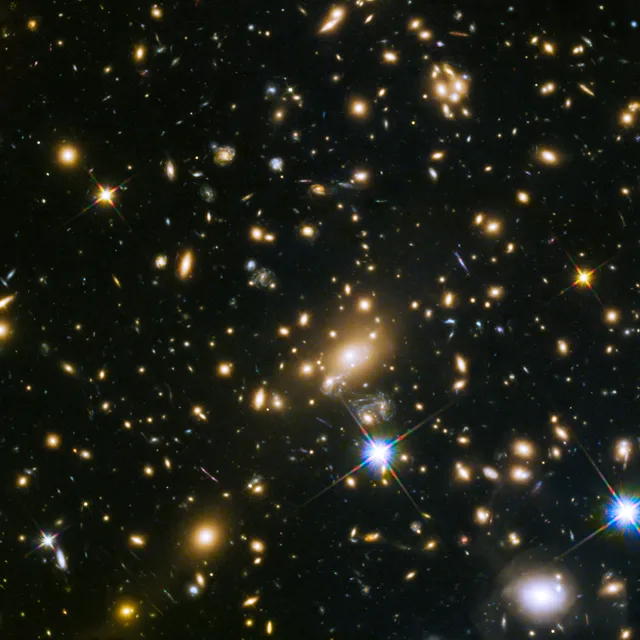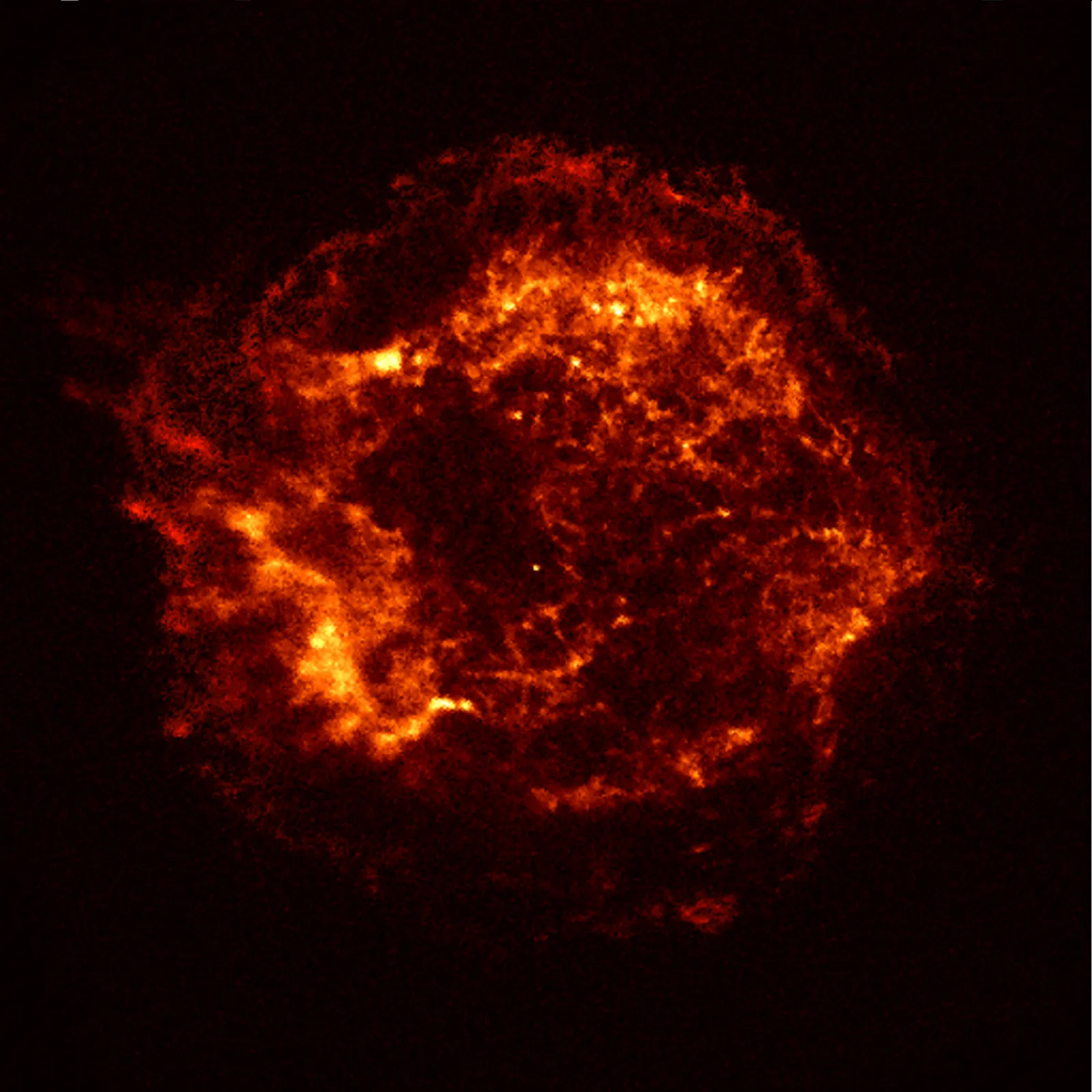
When a massive star explodes as a supernova, something compact is left behind at its heart — a neutron star or a black hole. Witnessing that moment of birth directly is impossible: light from the explosion takes weeks and months to travel outward, and the core collapse itself is hidden behind a veil of glowing debris. But theory predicts that the collapse should produce a brief burst of gravitational waves — ripples in spacetime that, unlike light, pass through matter almost unimpeded.
That's exactly the signature a team of researchers went looking for in LIGO data, focusing on one of the closest and brightest supernovae of recent years: SN 2023ixf.
What the LIGO Search Was Looking For
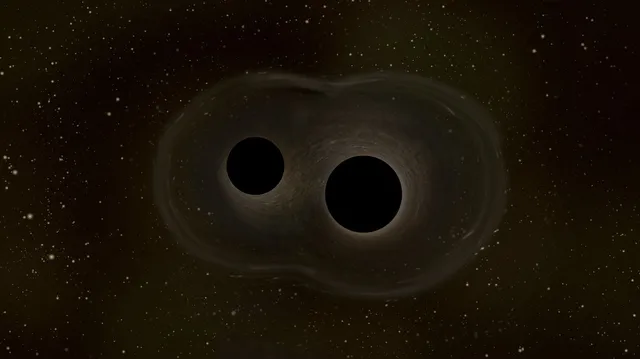
The method used in this study is called multi-messenger — it combines different "messengers" of information about the same event: electromagnetic radiation (light) and gravitational waves. The idea is simple: if a supernova forms a black hole, the collapse process may be accompanied by a noticeably stronger gravitational-wave signal than if it forms a neutron star.
The researchers ran what they call a "model-independent" search — not tied to a single theoretical collapse scenario, but capable of catching signals of various shapes. They looked for two kinds of emission: a short "chirp" — a burst with rapidly rising frequency, and a more diffuse, noise-like emission below 1 kHz.
Search sensitivity is expressed in units of energy equivalent to mass via Einstein's E=mc². For chirp signals the threshold was about 10^-5 solar masses converted to energy; for noise-like emission it was about 10^-2 solar masses. The analysis covered a 2.5-day window before the first official discovery of SN 2023ixf, using two detectors of the LIGO network — at Hanford and Livingston. A joint signal appearing in both detectors simultaneously is a necessary condition to distinguish a genuine gravitational wave from local instrument noise.
The Result: A Silence That Means Something
No joint H1-L1 signal associated with SN 2023ixf was found during that window. At first glance this might seem like a simple negative result — "nothing found." But within the multi-messenger framework, the absence of a signal carries information too.
The researchers combined this null result with optical observations of the supernova — photometry (brightness measured over time) and spectroscopy (analysis of the light's spectrum). Based on this data, the progenitor star's mass is estimated at likely below about 20 solar masses. That's consistent with neutron star formation: stars of this mass, according to current core-collapse models, more often leave behind a neutron star rather than a black hole.
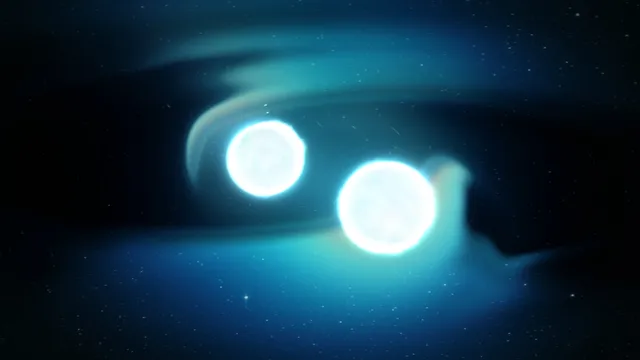
An additional argument came from comparing the case to GW170817B — a hypothetical gravitational-wave signal associated with processes surrounding the merger that produced the famous GW170817 event. By scaling the expected black-hole signal energy by analogy with that case, the authors showed that their search's sensitivity threshold should have been able to detect gravitational waves if SN 2023ixf had indeed formed a black hole of the corresponding mass. Since no signal was found, this strengthens the case for a neutron star.
Why It Matters
The central physical trigger that launches a massive star's collapse and determines whether it ends as a neutron star or a black hole remains one of the open problems in supernova astrophysics. Directly observing a compact object at the moment of its birth would help test theoretical collapse models that currently rely mostly on computer simulations.
SN 2023ixf became a convenient test case precisely because of its proximity and because it occurred while gravitational-wave detectors were operating and could "listen" to it. Still, it's important to understand the method's limits: the absence of a signal is not direct proof but a statistical argument resting on sensitivity thresholds and comparisons with other events.
Combined searches of this kind — light plus gravitational waves — are becoming an increasingly important tool for nearby supernovae. Each new event of this type, captured simultaneously by optical telescopes and gravitational-wave detectors, brings astronomers closer to answering what exactly determines the fate of a collapsing stellar core — becoming a neutron star or falling into a black hole.