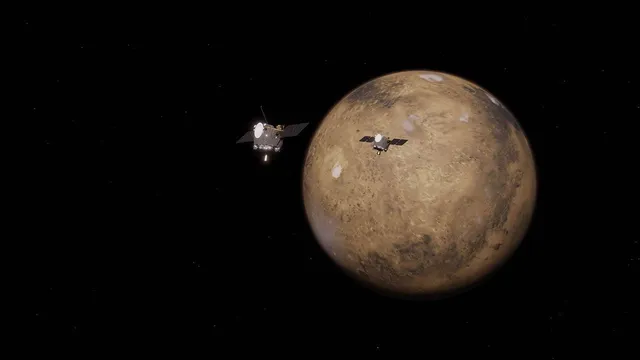
Mars today is a cold desert with an atmosphere so thin its surface pressure is less than one percent of Earth's. Yet earlier research suggests the planet may once have had liquid water flowing on its surface and a far denser atmosphere. Where that atmosphere went is one of the central questions NASA's MAVEN (Mars Atmosphere and Volatile Evolution) mission has spent more than a decade trying to answer, studying the upper layers of the Martian atmosphere and its interaction with the solar wind.
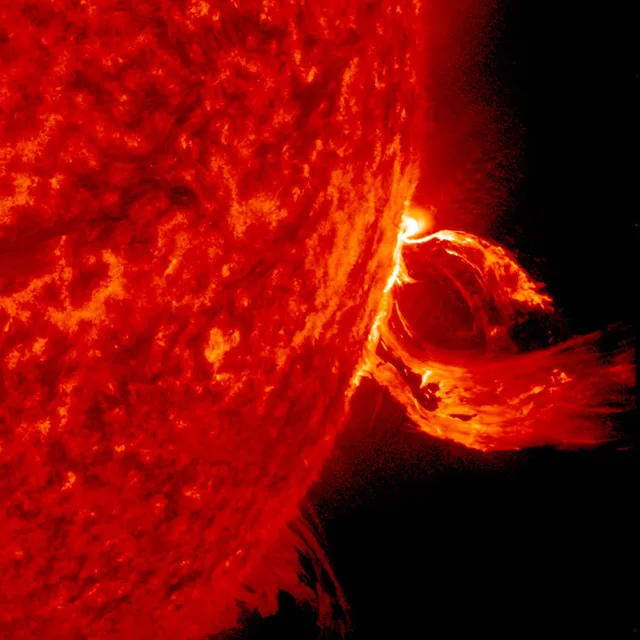
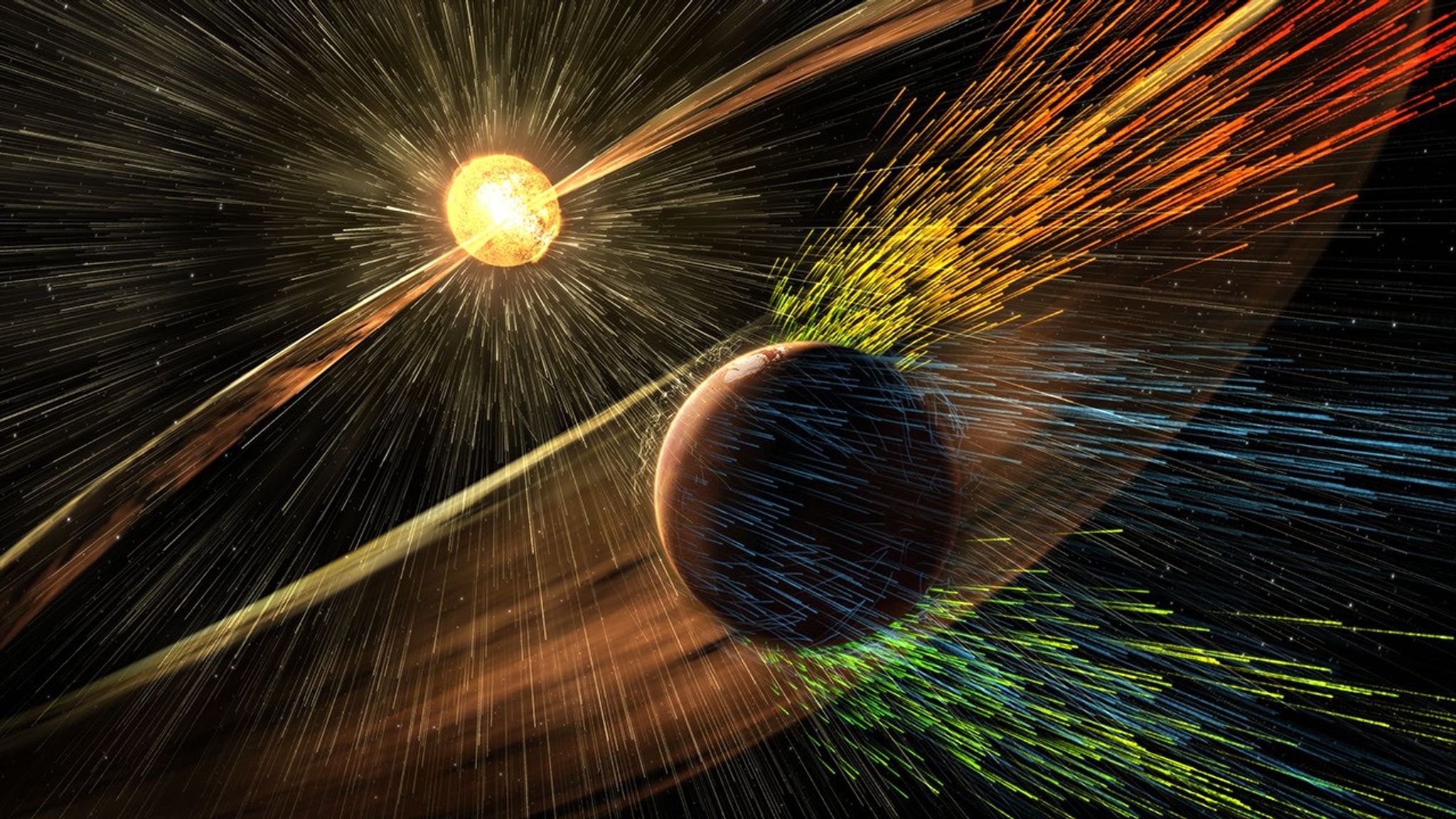
A new study from the MAVEN team adds another piece to that puzzle: certain types of auroras on Mars, it turns out, form through the same basic mechanism as auroras on Earth. An illustration released by NASA on July 29, 2026, depicts one of the key processes involved — charged particles from a solar storm colliding with the Martian atmosphere and stripping away its charged particles, gradually carrying them off into space.
How auroras form on Earth
On our planet, the aurora mechanism is well understood. Earth has a strong global magnetic field that acts both as a shield and as a "conductor" for charged particles from the solar wind. These particles travel along magnetic field lines toward the polar regions, where they enter the atmosphere and collide with oxygen and nitrogen molecules. The energy from these collisions makes the molecules glow — producing the familiar green and red auroral lights seen at high latitudes.
How Mars differs — and why that matters
The key difference is that Mars lacks a global magnetic field like Earth's. Billions of years ago, it likely had one, but it faded over time, leaving behind only isolated patches of magnetized crust — remnants of magnetism scattered mostly across the southern hemisphere.
Because of this, scientists long assumed Martian auroras must form through a different process than Earth's, since without a global magnetic field there's no clear mechanism to funnel charged particles toward the poles. But MAVEN researchers have now found that for certain types of auroras, the underlying process on Mars is essentially similar to Earth's: charged particles still enter the atmosphere and trigger gas molecules to glow, even without the organized "magnetic funnel" that channels particles on Earth.
The link to atmospheric loss
This finding matters most in the context of MAVEN's broader mission: understanding how Mars loses its atmosphere. The illustration from July 23, 2026, accompanying NASA's announcement shows exactly this process — during a solar storm, a stream of charged particles strikes the upper layers of the Martian atmosphere and strips away its charged particles, which are then carried off into interplanetary space.
Auroras are, in effect, a visible trace of that same interaction between the solar wind and the planet's atmosphere. By observing where and how these glows occur, researchers gain an additional tool for tracking how intensely — and in which locations — the Martian atmosphere is affected by solar activity.
Understanding this connection helps scientists build a more precise picture of atmospheric loss rates throughout Mars' history, particularly during powerful solar storms, which can accelerate the process dramatically compared to quieter periods. That, in turn, brings researchers closer to answering how the thicker, warmer atmosphere of ancient Mars became the thin, cold environment we observe today.