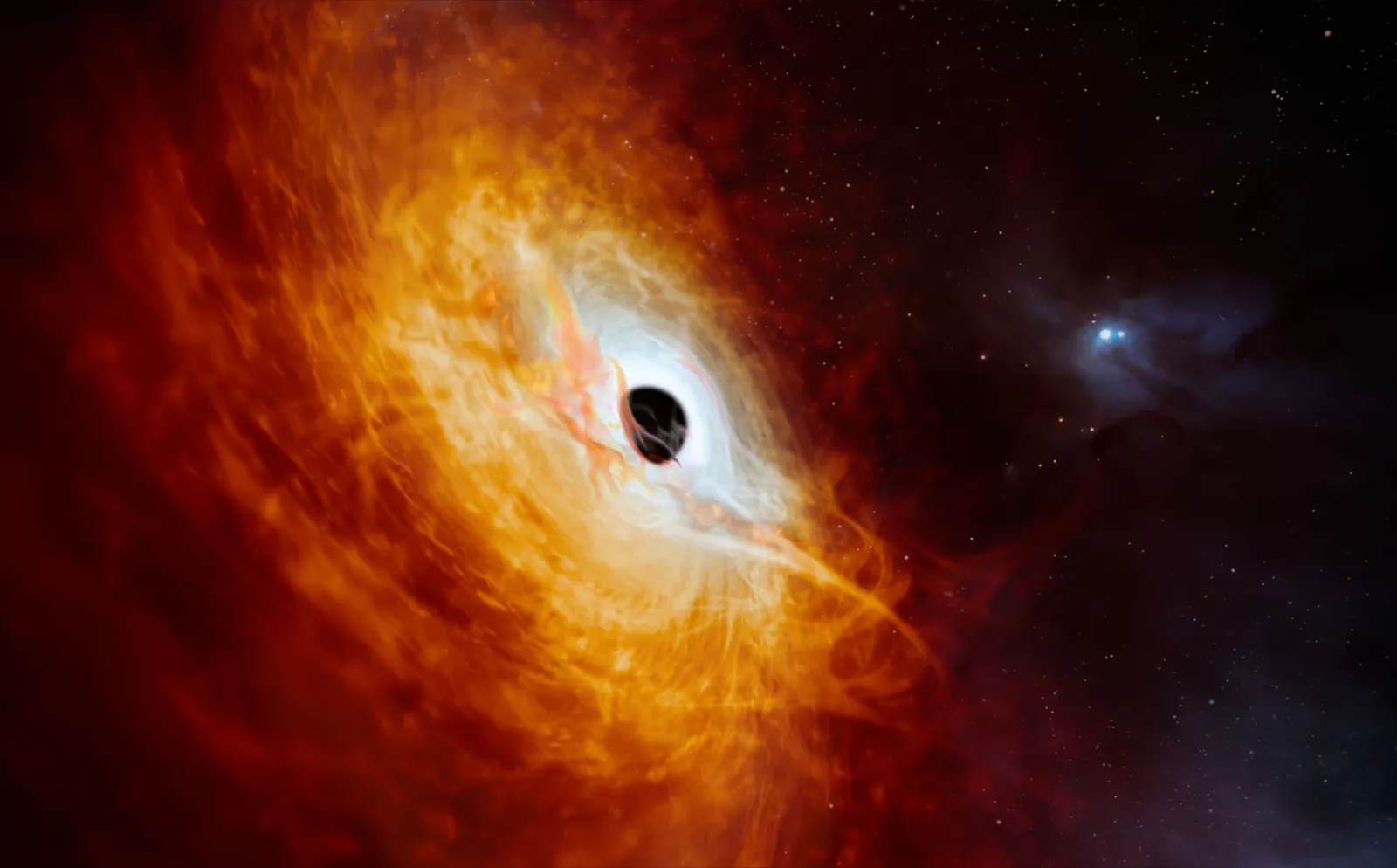
Supermassive black holes weighing billions of solar masses already existed less than a billion years after the Big Bang. How they managed to grow so massive in such a short cosmic timeframe remains one of the biggest open problems in astrophysics. Standard gas accretion appears too slow to account for this rapid growth, pushing researchers to look for alternative explanations.
One hypothesis focused not on the growth rate itself but on the black hole's location within its host galaxy. If a galaxy recently underwent a merger, its central black hole could receive a gravitational recoil kick, displacing it from the galaxy's center. A team led by Aurora Wilde tested this idea directly, studying six quasars at redshift z > 6 using a combination of two of the most powerful instruments in modern astronomy — the James Webb Space Telescope and the Atacama Large Millimeter/submillimeter Array (ALMA).
Two Telescopes, One Coordinate
To test whether a black hole is truly offset from its host galaxy's center, researchers needed two independent, high-precision position measurements: where the quasar sits, and where the galaxy's center of mass sits.
The quasar's position — the point where matter glows as it falls toward the black hole — was traced using JWST NIRCam imaging at a resolution down to 400 parsecs (roughly 1,300 light-years). The host galaxy's position was mapped using ALMA observations of the [C II] 158 μm ionized carbon line and dust continuum emission, reaching a resolution of better than 600 parsecs.
To control for systematic astrometric errors, the team cross-checked their measurements against Gaia data for field stars captured within the same NIRCam frames. This anchored both datasets to a common coordinate system and ruled out instrument-specific calibration errors.
The Black Hole Is Right Where It Should Be
The result was unambiguous: in all six systems studied, the black hole sits within the central ~400 parsecs of its host galaxy — well within the measurement uncertainties, with no statistically significant offset detected.
One particularly telling detail involves optical-wavelength data. In some systems, rest-frame optical JWST images initially appeared to show a noticeable offset between the quasar and its host galaxy. But when the same objects were compared against ALMA data, that apparent offset disappeared entirely.
The explanation lies in dust. Dust within a galaxy absorbs and scatters optical light unevenly, which can make a source's apparent position shift on an optical image without any real physical displacement. ALMA, operating at millimeter wavelengths, is far less affected by dust obscuration, making its positional measurements more reliable indicators of where matter actually sits.
Ordered Disks, Not Merger Debris
Beyond position, the researchers modeled the kinematics of gas in each galaxy using the [C II] data — essentially mapping how the gas moves and rotates. A recent merger typically leaves behind telltale signatures: turbulent, disordered gas motion that doesn't fit a simple rotational model.
None of the six galaxies showed such signatures. Instead, most were well described by the simplest possible model — a rotating disk, structurally similar to disks seen in far less distant, calmer galaxies.
This is a surprisingly orderly picture for objects observed at such an early stage of cosmic history, an era when galaxies were theoretically expected to grow through frequent mergers and turbulent interactions.
Apparent offsets seen in rest-frame optical JWST observations are not detected in our ALMA data, suggesting they likely result from dust obscuration rather than a true physical separation between the SMBH and its host galaxy.Aurora Wilde and co-authors, ApJ, 2026
These findings support theoretical models predicting that black hole positional offsets are either extremely short-lived or intrinsically rare, even at cosmic dawn. That suggests the explanation for how supermassive black holes grew so quickly likely lies elsewhere — not in merger-driven dynamical displacement, but perhaps in unusually efficient accretion processes operating from the very earliest stages of these objects' existence.