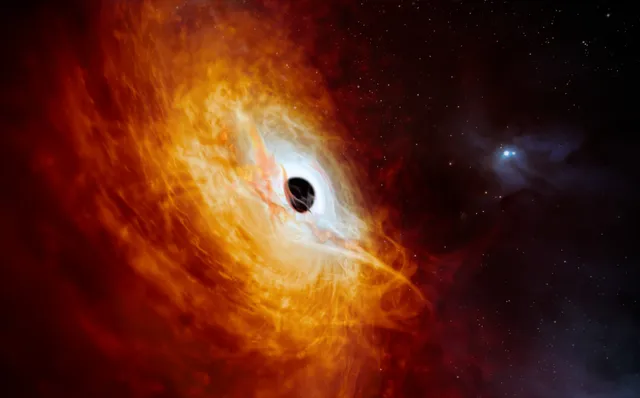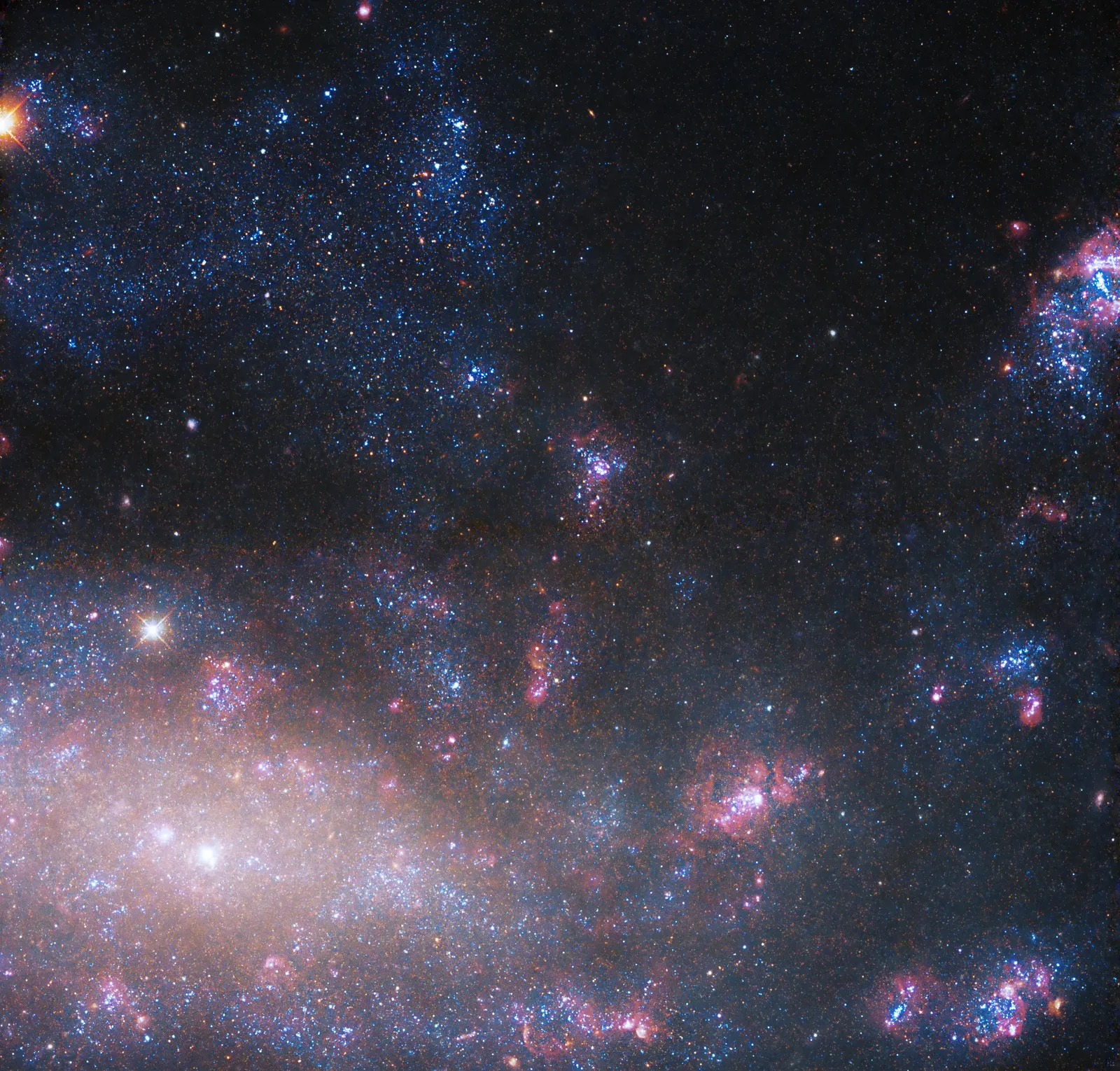
Dwarf galaxies rarely draw the attention of active-nucleus hunters — they are usually too small and too faint. NGC 4395 is an exception: it is one of the nearest galaxies known to host a clearly active nucleus, powered by an intermediate-mass black hole. These objects sit between stellar-mass black holes and the supermassive giants found at the centers of large galaxies, and they remain poorly studied, which makes any detailed look at their surroundings valuable.
A team led by Payel Nandi decided to observe NGC 4395 with three instruments at once and compare the results. The goal was to understand exactly how a relatively small black hole accelerates the gas around it, and where that energy actually goes.
Three observatories, one nucleus
The core of the study relied on JWST observations with the NIRSpec and MIRI spectrographs, covering wavelengths from 1.66 to 28.6 micrometers. This range reaches regions inaccessible from the ground, where Earth's atmosphere absorbs much of the infrared light.
JWST data were combined with observations from the ALMA radio interferometer, which traced the CO(2–1) molecular transition, and from the Gemini telescope using the GMOS spectrograph. Together, the three facilities covered nearly the entire spectrum, from cold molecular gas to the hottest ionized plasma.
The result: 134 emission lines detected in the galaxy's nucleus alone. Among them are hydrogen and helium lines, dozens of fine-structure lines from various ions, rotational and rovibrational transitions of molecular hydrogen (H2), and several bands of polycyclic aromatic hydrocarbons (PAHs) — complex molecules typically associated with cold interstellar material.
A layered structure, from a hot core to a cold shell
Modeling of the H2 lines revealed that the warm and hot molecular gas consists of at least three components, with temperatures of roughly 580, 1,480, and 2,900 kelvin. This alone shows that the gas around the black hole is not uniform but split into layers with distinct physical conditions.
Added to this picture is a cold phase — gas at temperatures below 50 kelvin — traced through the CO(2–1) transition observed by ALMA. On the ionized side, the team found outflows with velocities ranging from 127 to 716 km/s, with blueshifted and redshifted components consistent with a biconical geometry: gas flowing out in two opposite cones from the black hole.
Outflow signatures were detected across multiple gas phases at once: in cold and warm/hot molecular gas, in atomic hydrogen (H I), and in 36 fine-structure lines spanning ionization potentials from 7.6 to 300 electron volts — from weakly ionized atoms to highly stripped ions that form only under extreme conditions close to the active nucleus.
The data also show that outflow velocity and the fraction of gas caught in the outflow both increase with ionization potential. This implies that the most highly ionized gas originates closest to the black hole, where it is also accelerated most efficiently.
The mass paradox: cold gas weighs more but pushes less
The most surprising result concerns how mass and energy are distributed among the gas phases. Although cold molecular gas seems the least dramatic component, it actually carries away the most mass from the nucleus — its outflow rate exceeds that of the warm/hot molecular gas and the ionized gas by one to two orders of magnitude.
But mass is not the same as impact. The kinetic coupling efficiency — the fraction of the black hole's energy actually transferred to the surrounding gas — turned out to be very low: 0.003–0.12% for the coronal-line gas (the most highly ionized component) and 0.4–1.4% for the H I outflow.
Only the low-ionization gas significantly impacts the surrounding ISMfrom the study's conclusions, ApJ, 2026
In other words, despite the complex layered structure and the high velocities of individual components, the ability of this dwarf galaxy's active nucleus to stir and expel gas remains limited. That is an important piece of the puzzle in understanding how intermediate-mass black holes regulate — or fail to regulate — the evolution of the dwarf galaxies that host them.