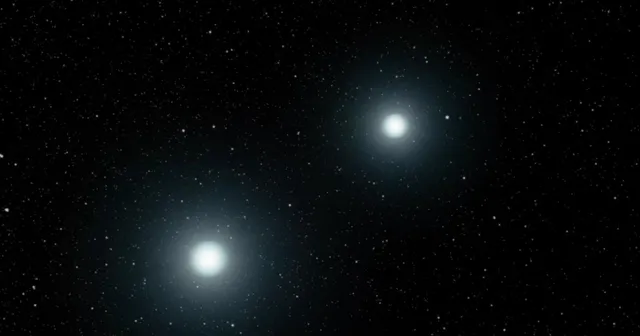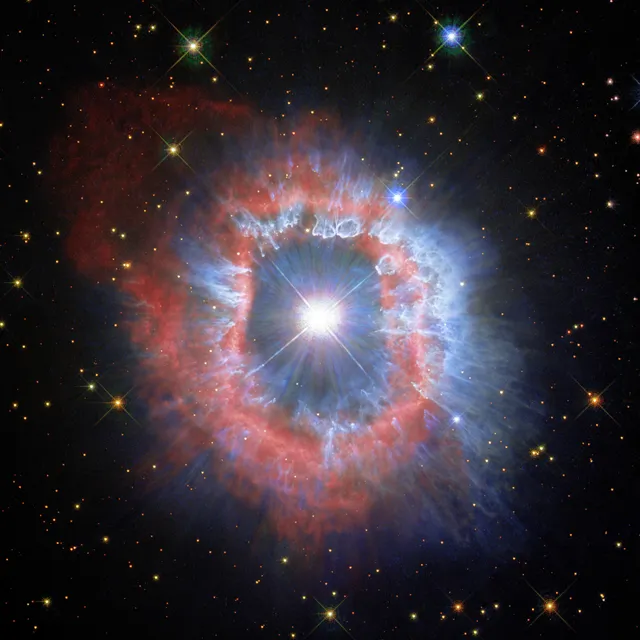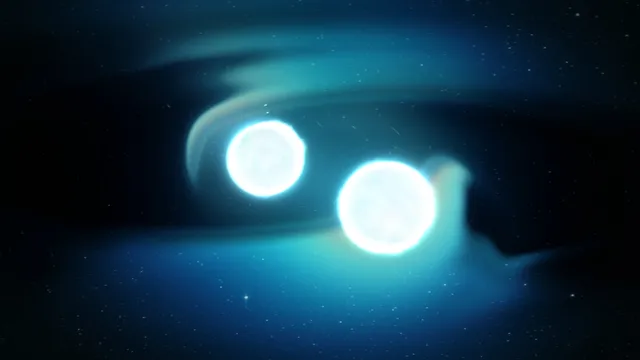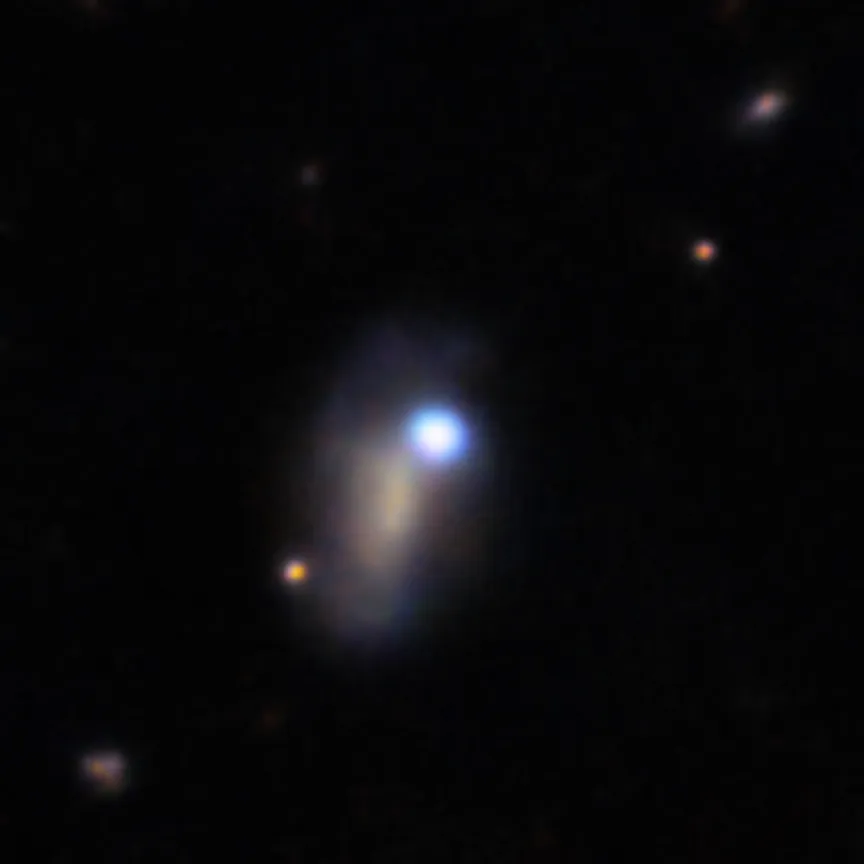
On March 21, 2026, China's Einstein Probe X-ray satellite detected a short but bright flash from a galaxy roughly 500 million light-years away. Several teams of astronomers, including one led by Brendan O'Connor of Carnegie Mellon University, converged on the same interpretation: this was a "shock breakout" — the moment when the shock wave from a star exploding internally punches through its outer surface, producing the first observable burst of light from a supernova. Catching a supernova's birth in its earliest seconds is genuinely rare; most such flashes are found only by chance.
The flash was designated EP260321a. Over the following weeks, astronomers watched the associated supernova, named SN 2026gzf, continue to brighten. Spectral analysis revealed it as a broad-lined Type Ic supernova — a class that arises from massive stars stripped of their outer hydrogen and helium layers before exploding. The width of the spectral lines reveals the speed of the ejected material: in this case, nearly 10% the speed of light. This is the same class of supernova frequently seen accompanying long gamma-ray bursts, among the most powerful explosions in the universe.
Why checking for a jet matters
A gamma-ray burst occurs when a narrow jet of material and radiation, moving at nearly the speed of light, successfully punches through the collapsing star and escapes. But even if the brief gamma-ray flash itself is missed — because it's faint or aimed away from Earth — a successful jet should leave a longer-lived signature: an X-ray afterglow, produced when the ejected material collides with gas surrounding the star. This afterglow can remain visible in X-rays for days, weeks, or even months, depending on the density of the surroundings and the jet's total energy.
So the critical test became whether such an afterglow could be found in SN 2026gzf. That task fell to NASA's Chandra X-ray Observatory.
What Chandra's observations showed
Brendan O'Connor initiated Chandra observations of SN 2026gzf to search for the predicted fading X-ray afterglow expected from a successful jet. Thanks to Chandra's exceptional sensitivity and sharp imaging, the team could search for very faint X-ray emission precisely at the supernova's location.
No source was detected. That doesn't mean the observations were uninformative, though. Because the explosion was relatively close to Earth — 500 million light-years — the observations were sensitive enough that they would have caught nearly any known GRB X-ray afterglow. The absence of a signal is therefore not a failure of the instrument, but a meaningful scientific result.
The Chandra data ruled out the typical bright X-ray afterglow produced by a successful GRB jet. The data also placed strong constraints on jets that might have been weaker or directed away from Earth, essentially ruling out those optionsBrendan O'Connor, McWilliams Fellow, Carnegie Mellon University
A star without a successful jet
The results indicate that SN 2026gzf did not launch a normal, powerful relativistic jet. Instead, the star likely produced a weaker outflow that stalled inside before it could break free.
EP260321a/SN 2026gzf is the first known case of a high-energy X-ray flash linked to a broad-lined Type Ic supernova that shows no evidence of a relativistic outflow. Until now, it was largely assumed that nearly all supernovae of this type, with such high ejecta velocities, are accompanied by a successful jet and a potential gamma-ray burst. This case shows that stripped massive stars can die in more than one way — not only through the classic collapsar-plus-jet-plus-GRB scenario.
This raises a new question for researchers: how many similar explosions have gone unnoticed or been misclassified simply because there was no obvious gamma-ray signal. Combining rapid X-ray flash detection — as done by Einstein Probe — with follow-up from ground-based NOIRLab telescopes, the VLA radio array, and Chandra's X-ray sensitivity allows astronomers to distinguish successful jets from those that stall inside the star, offering a clearer picture of the diverse ways massive stars meet their end.