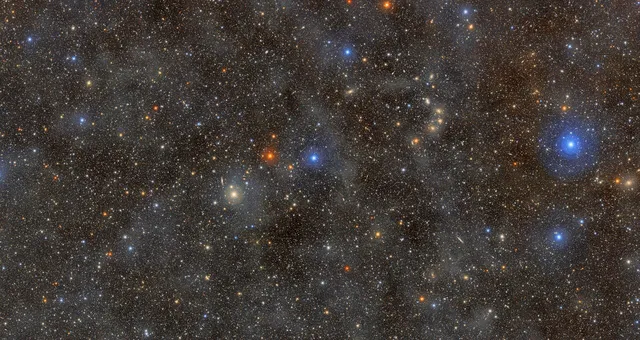
In late February, skywatchers in the Northern Hemisphere have a chance to see something rare: six planets visible to the naked eye at once, given clear and dark skies. This happens because the planets of the solar system orbit the Sun in roughly the same plane, known as the ecliptic. When their orbits place them on the same side of the Sun at the same time, they appear to line up from Earth's vantage point.
To mark this "planetary parade," NASA's Chandra X-ray Observatory released new sonifications on Feb. 25 — translations of astronomical data into sound. Three of the planets on display, Jupiter, Saturn, and Uranus, can now be heard in ways that are impossible from Earth alone.
How an image becomes sound
Sonification works through a scan line that sweeps across an image, left to right or right to left. Each visual element — brightness, position, type of emission — is converted into a corresponding sound, following parameters set by Chandra's sonification team.
The data arrives on Earth as binary code, a sequence of ones and zeros. Sonification preserves the integrity of that data while shifting its form from visual to audible. This expands how audiences can explore what telescopes discover in space, part of NASA's broader effort to share its data as widely as possible.
Jupiter: woodwinds and the Great Red Spot
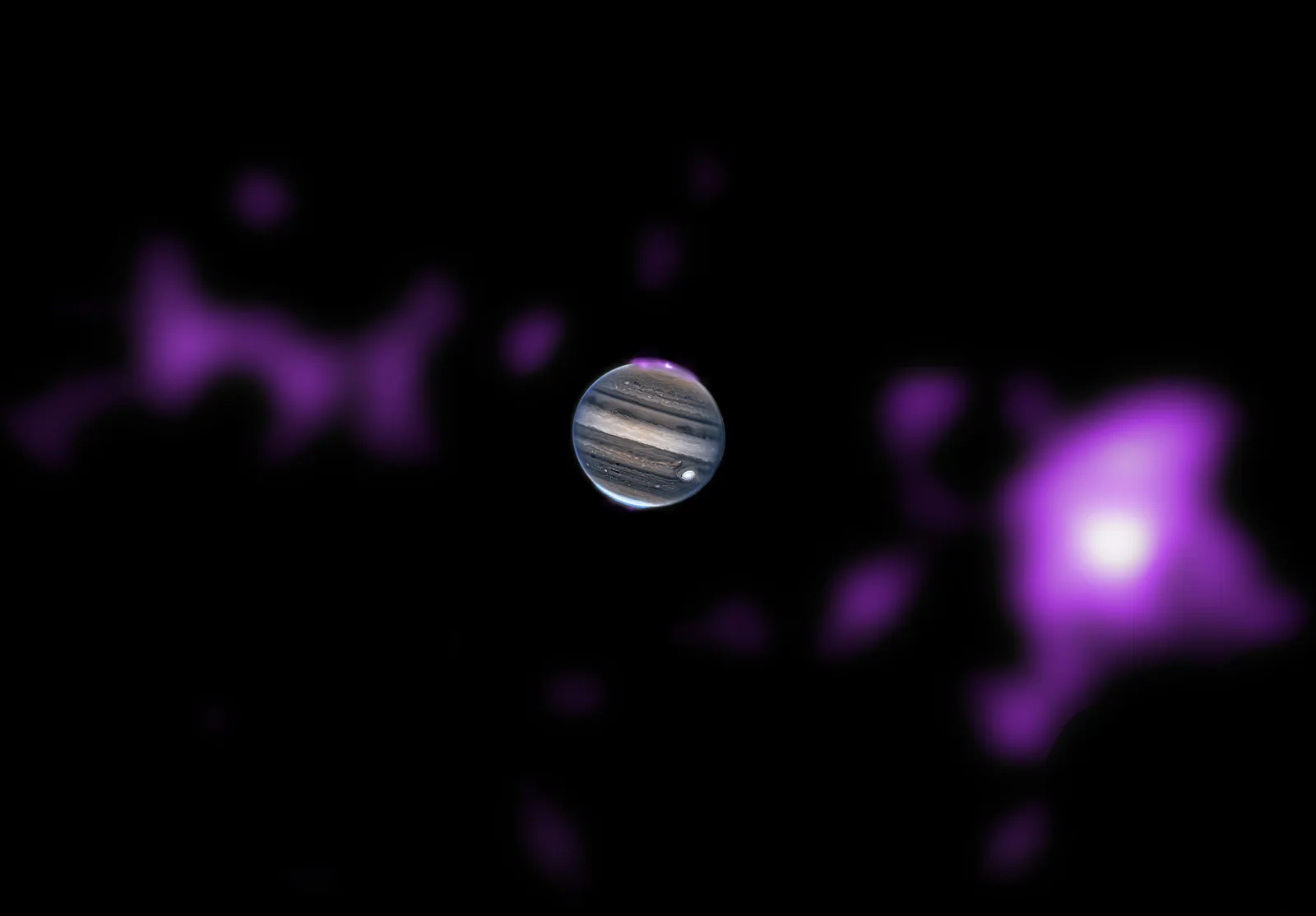
Jupiter's sonification combines Chandra's X-ray data with an infrared image from the Hubble Space Telescope. Bright pink and white clouds flanking the planet represent enhanced diffuse X-rays from a donut-shaped ring of energetic particles surrounding Jupiter.
When the scan line hits these pink clouds, woodwind instruments play. When it crosses the planet itself, shown in infrared, the sound grows fuller as more instruments join in. Because Jupiter is slightly tilted, the pitch dips as the line passes over the bright equatorial band and the Great Red Spot in the southern hemisphere. Further along, the scan meets a larger pink cloud with a bright white core, heard as loud, gusty woodwind sounds.
Saturn: a siren along the rings and X-ray hotspots
Saturn's composite image pairs an optical picture from NASA's Cassini mission with Chandra's X-ray data. The planet is tilted, so its rings appear oval rather than perfectly round.
As the scan line crosses the rings, a siren-like tone follows the arc, its frequency widening through the middle of the oval. Small neon-blue patches on the image mark reflected X-ray light detected by Chandra — each patch triggers a synthesizer tone, its pitch tied to the patch's vertical position. When the line reaches the planet's body, a low, dark synthetic bass tone plays, its volume linked to brightness. This separates the X-ray activity across the rings, poles, and body from the planet itself.
Uranus: a cello line and reflected solar X-rays
Uranus's sonification draws on data from Chandra and the W.M. Keck Observatory. The scan again moves left to right, opening with a sweeping cello note that traces the arc of the ice giant's ring — far less famous than Saturn's, but still visible in the image.
The notes shift to reflect the amount of light detected and its position on the planet, as captured in an optical image from Keck. The X-rays Chandra detected are sunlight reflected off Uranus, heard as higher frequencies as the line passes over the planet's pinkish region. Researchers note that the apparent asymmetry in the X-ray signal may not be a real physical effect, but rather a result of the faint signal and the smoothing applied to the image.
Why Chandra watches planets at all
Chandra is best known for probing black holes and other extreme cosmic objects. But the observatory has long played a role in solar system science as well.
The Sun emits X-rays that travel outward through the solar system and get reflected by planets, moons, and other bodies. That gives astronomers a unique window into physics that cannot be studied through optical or infrared telescopes alone.
NASA's Marshall Space Flight Center in Huntsville, Alabama, manages the Chandra program. The Smithsonian Astrophysical Observatory's Chandra X-ray Center controls science operations from Cambridge, Massachusetts, and flight operations from Burlington, Massachusetts.