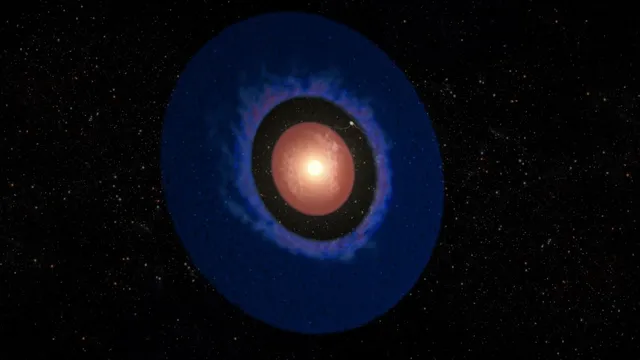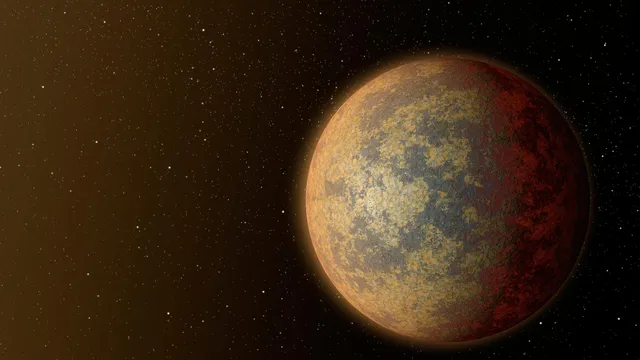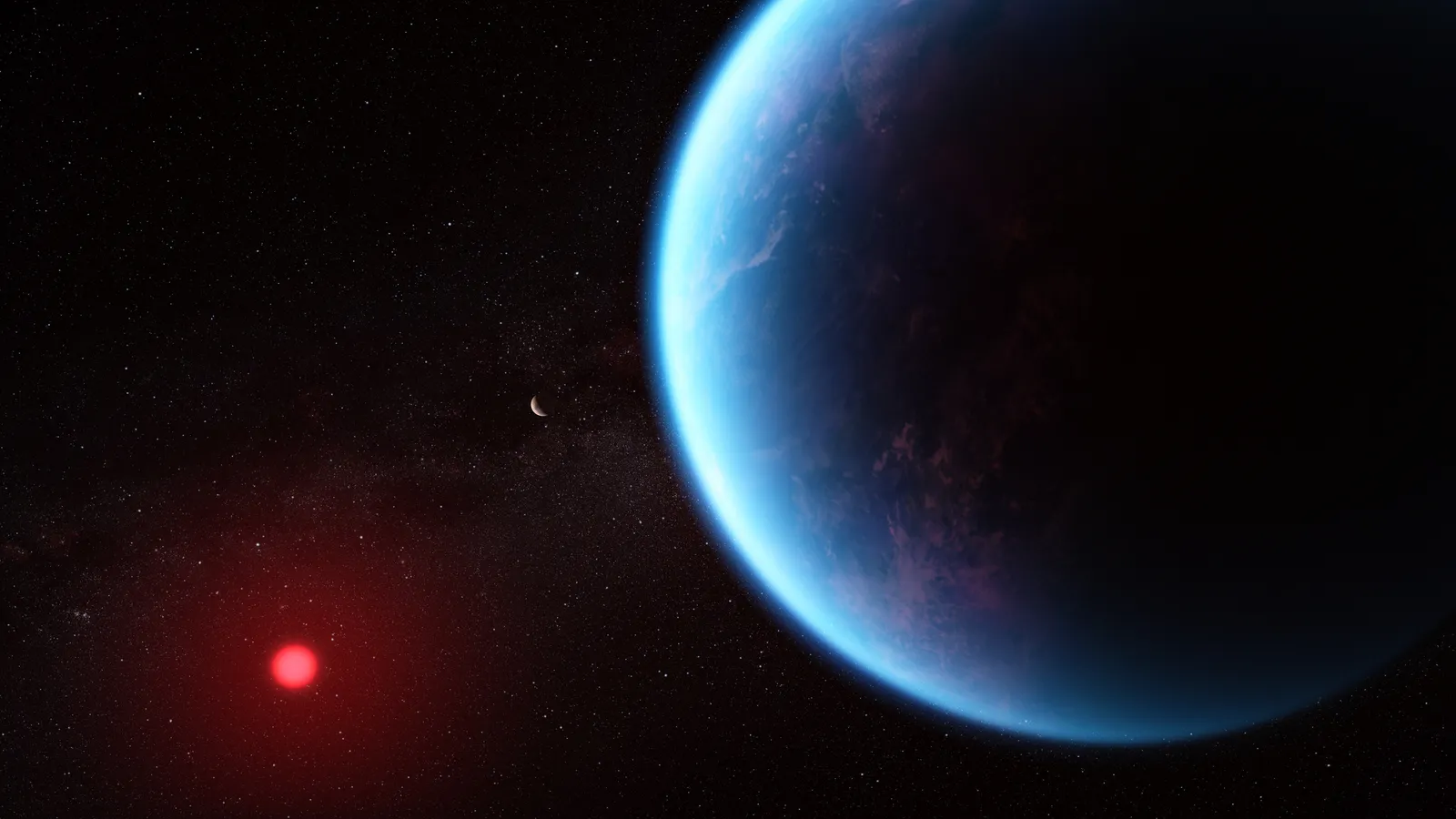
A team led by Juan I. Espinoza-Retamal has announced the discovery of TOI-4507 b, a transiting sub-Saturn planet that belongs to the rare "superpuff" category — worlds so puffed up they are lighter than water. The study appears in the Astrophysical Journal Letters.
The planet's defining feature is its density. With a mass constrained to below 20 Earth masses, TOI-4507 b has a density under 0.2 g/cm³. For comparison, Saturn — already the least dense planet in the Solar System and lighter than water itself — is still denser than TOI-4507 b. Superpuff planets are thought to consist mostly of an extremely extended hydrogen-helium envelope wrapped around a comparatively small solid core.
TESS and the Antarctic ASTEP telescope catch the transit
The planet was found through the transit method, which detects the periodic dimming of a star's light as a planet passes in front of it. The first signals came from TESS, the space telescope dedicated to surveying bright, nearby stars for exoplanets.
Confirmation came from an unusual source: ASTEP, a ground-based telescope located in Antarctica. Polar night there lasts for months, allowing uninterrupted stellar monitoring without the usual day-night gaps. That continuity is especially valuable for planets with long orbital periods, whose transits are infrequent and easy to miss.
To confirm the planetary nature of the signal and measure its mass, the team combined the light curves with radial velocity data from three spectrographs: HARPS, FEROS, and CORALIE. The joint analysis constrained the planet's mass to below 20 Earth masses with 95% confidence.
A 105-day orbit — the longest among superpuffs
TOI-4507 b orbits its star every 105 days, the longest orbital period recorded for any known superpuff planet to date. Most similar worlds have been found on much tighter orbits, close to their host stars.
The host is a young F-type star, only 700 million years old. For context, the Solar System is more than 4.5 billion years old, making TOI-4507 a system still in an early stage of its life.
The combination of a young host star, a wide orbit, and an extremely low planetary density makes this system a valuable test case: at this early stage, the atmosphere has likely had little time to be stripped away by stellar radiation, offering a rare glimpse of a puffy atmosphere in something close to its original state.
The Rossiter-McLaughlin effect reveals a prograde orbit
A separate set of measurements addressed how the planet's orbit is oriented relative to the star's spin axis. To do this, the researchers used the Rossiter-McLaughlin effect — a phenomenon in which a transiting planet sequentially blocks the part of the stellar disk rotating toward the observer, then the part rotating away. This distorts the star's spectral lines in a characteristic pattern, from which the sky-projected obliquity — the tilt of the planet's orbit relative to the star's equator — can be reconstructed.
The measurement yielded λ = −15 (+50/−44)°, with the angle constrained to under 80° at 3σ confidence. This confirms a prograde orbit: the planet moves in the same direction as the star's own rotation.
TOI-4507 is now one of the longest-period systems for which the stellar obliquity has ever been measuredfrom the study by Juan I. Espinoza-Retamal and collaborators, Astrophysical Journal Letters
Such measurements are usually easier for tight, short-period planets, where transits occur frequently and the signal is stronger. For a 105-day orbit, obtaining a reliable result is considerably harder, which makes TOI-4507 b a rare data point in this line of research.
What it means for planet formation models
The combination of a young system, a wide orbital separation, and an anomalously low density makes TOI-4507 b a valuable target for testing models of planetary atmosphere formation and evolution. Researchers are particularly interested in why such extended envelopes don't simply blow away under stellar wind and radiation, and whether — or how quickly — the orbits of such planets align with their star's rotation early in a system's history.