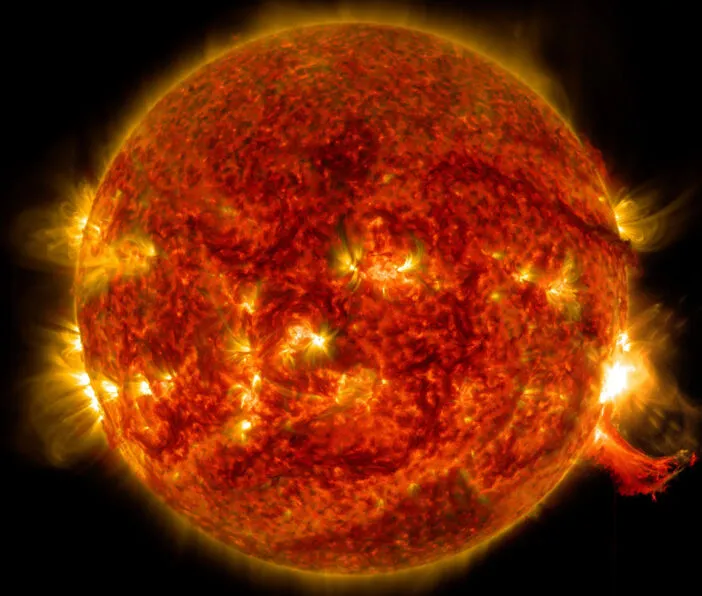
Isaac Newton suspected that the gravitational interplay between the Sun and Jupiter would eventually destabilize the Solar System. Modern computations showed the opposite: over the long term it is, statistically, fairly stable. A new study challenges that confidence, at least for the outer part of the system.
A team led by Konstantin Batygin at the California Institute of Technology (Caltech) analyzed the dynamics of the outer planets under different scenarios of solar mass loss. The paper, "Terminal Instability of the Solar System Triggered by Stochastic Solar Mass Loss," was published in the peer-reviewed The Astrophysical Journal Letters (volume 1009, L22, 2026). It is a result of numerical simulations, not of telescope data.
What was known before
Several earlier studies examined how planetary orbits will change as the Sun sheds mass on its way to becoming a white dwarf. They found that the semimajor axes (the average distances of the planets from the Sun) will grow by about a factor of two. Even so, the orbits remain stable for longer than the age of the universe, on a timescale of about 10¹⁸ years.
Flybys of other stars could speed up the breakup. The expanded architecture is more vulnerable to such jostling. Even with that correction, the giant planets' orbits would come apart only after 30–100 billion years.
All of these models treated mass loss as a smooth function of time. So the dismantling of the system had to be left to external forces.
What changed in the model
In reality, stars on the red giant branch do not lose mass smoothly. The ejections happen at random times and in random directions. They correspond to velocity kicks that can alter planetary dynamics.
First, the researchers tested the classic case of smooth mass loss and confirmed earlier results. The orbits double in size, but the dynamics stay tame. This holds even when mass is ejected asymmetrically: if the process is smooth in time, the asymmetries cancel out.
Next, they simulated stochastic (random) kicks. The behavior of the outer planets was largely tied to the mass of each ejection.
- Up to 10⁻⁷ solar masses: the dynamics mimic the smooth case.
- From 10⁻⁷ to 10⁻⁶ solar masses: in roughly 20% of cases Jupiter and Saturn, and Uranus and Neptune, enter mean-motion resonances. This is a configuration in which orbital periods are in a ratio of small integers.
- From 10⁻⁵ solar masses: the outer Solar System disassembles on a timescale of billions of years.
Resonances do not protect the planets. Resonant simulations disassemble slightly more often than nonresonant ones. The larger the ejection mass, the greater the chance of instability.
What it means for the Sun
Ejection models and observed kick amplitudes suggest a future ejection mass for the Sun of about 10⁻⁴ solar masses. That is well above the threshold at which the system breaks down.
At that value, instability can set in even before the white dwarf forms. About 40% of simulations lead to disruption or violent scattering of orbits while the Sun is still a red giant. Roughly 90% break down within 3 billion years.
The authors conclude that the life expectancy of the Solar System drops from a billion billion years to about one billion years after white dwarf formation. That is a difference of roughly a factor of a billion.
How solid is the result
This is a modeling result, and it should be read with a few caveats. The study concerns the outer planets: Jupiter, Saturn, Uranus and Neptune. The percentages in the paper are shares of simulations of a given type, not exact probabilities of the real scenario.
The key input, the mass of a single ejection, comes from ejection models and observed kicks. The conclusion depends strongly on it: with small ejections the system stays stable. The source gives no uncertainties for the 10⁻⁴ solar mass estimate, so its precision remains an open question.
Still, the conclusion changes the approach. Previously, the fate of the planets around the dying star was left to external influences. Now the random nature of the mass loss itself can destabilize the system.